

It was rare — almost like lottery-winning rare — as three World War II Bell P-63 Kingcobras and one predecessor P-39 Airacobra landed at Wittman Field in late July for EAA AirVenture 2017 in Oshkosh, Wisconsin.
These aluminum ‘Cobras have become more furtive than their reptilian namesakes. To see one at an air show is a treat. To see four is, well, it’s Oshkosh.
The warbird ramp where the four ‘Cobras parked was awash in questions from visitors. So here’s a recap of the Oshkosh ‘Cobra convention, beginning with a brief background history on the P-39 and P-63.
The young Bell Aircraft Co. quickly earned a reputation for original, forward-leaning, and maybe even quirky design rationale. It was that spirit that imbued Bell’s efforts to build the first American jet aircraft, and the world’s first supersonic aircraft.
But before those milestones, Bell began, in 1937, to design what would become the P-39 Airacobra.
When contemporary fighters still rested on tailwheels, the P-39 used a long nosegear strut to put the airframe in a horizontal attitude on the ground. That long nosewheel strut could pivot rearward to nest flush inside the P-39’s nose where one might expect the engine to be.
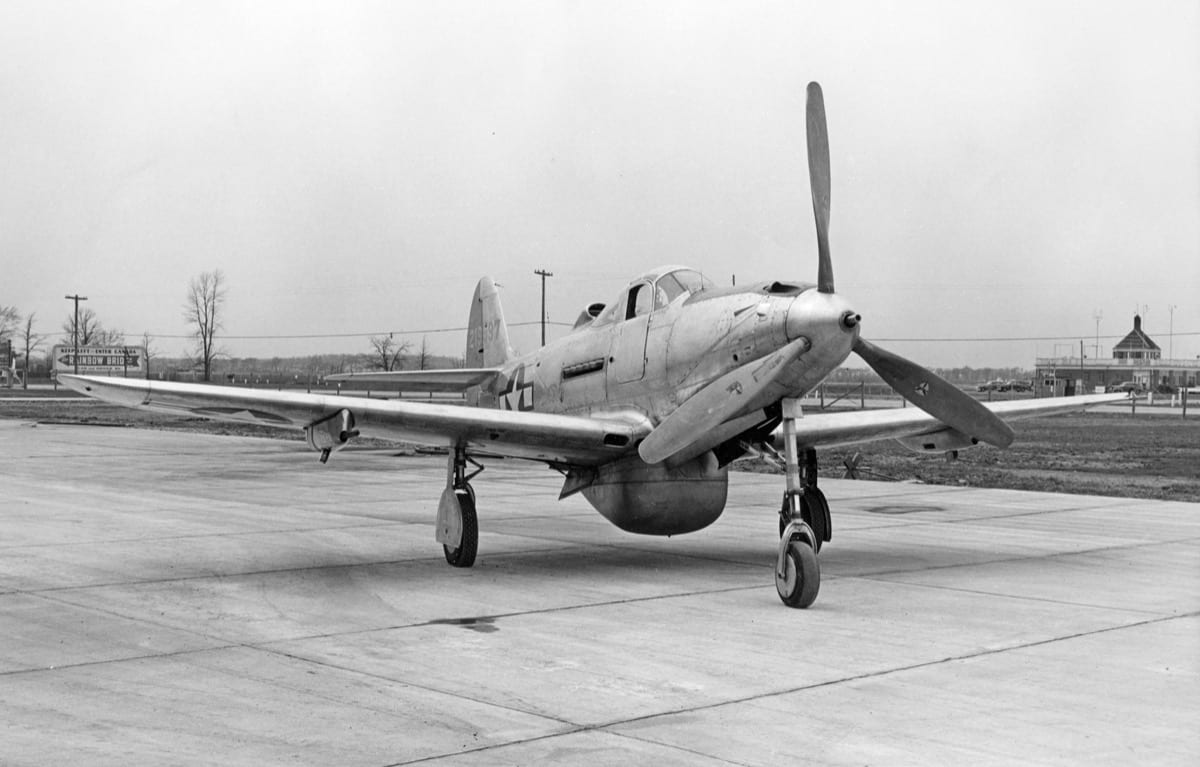
But those radicals at Bell put the engine farther aft, at mid-fuselage, leaving the nose compartment open for stowage of landing gear and mounting of a cannon and machine guns.
The engine, an Allison V-1710, was behind the pilot, transmitting power to a propeller in the nose by way of a segmented drive shaft. The shaft turned at engine RPM; when it reached the nose, a gearbox with planetary gears harnessed the power to the propeller, typically either an Aeroproducts or Curtiss Electric fan.
That planetary gearbox in the nose was open in the center, permitting a cannon as large as 37-millimeter to be mounted. Above the cannon, production P-39s typically sprouted a pair of .50-caliber machine guns as well.
The wings of P-39s carried a total of four .30-caliber machine guns until the advent of the P-39Q, which replaced the four wing-mounted .30s with a pair of .50-caliber guns in underslung pods.

The Bell P-39 was a noble effort at producing a small fighter with minimal frontal area. The use of mechanical supercharging instead of turbosupercharging on production P-39s caused performance to fall short of some other fighters.
Interestingly, as Allison beefed up its supercharging game during the war, later models of the V-1710 would yield more power at altitude. These more athletic Allisons were installed in the successor to the P-39, Bell’s P-63 Kingcobra.
The National Advisory Committee for Aeronautics (NACA) tested an early P-39 in a wind tunnel and suggested ways to minimize drag, including the use of wing root inlets for oil and radiator cooling.
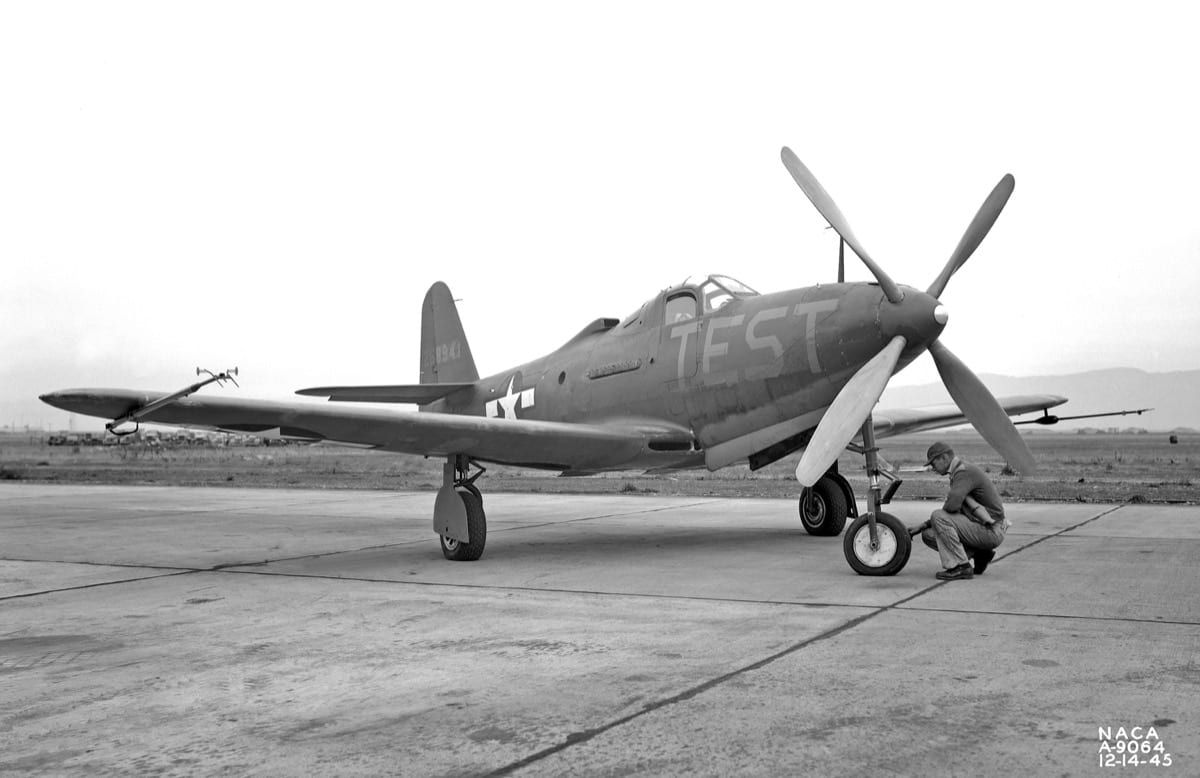
While this improved performance, and was sufficient in flight, Airacobra pilots found the P-39 tended to overheat on the ground because the inlets and radiator area were so small.
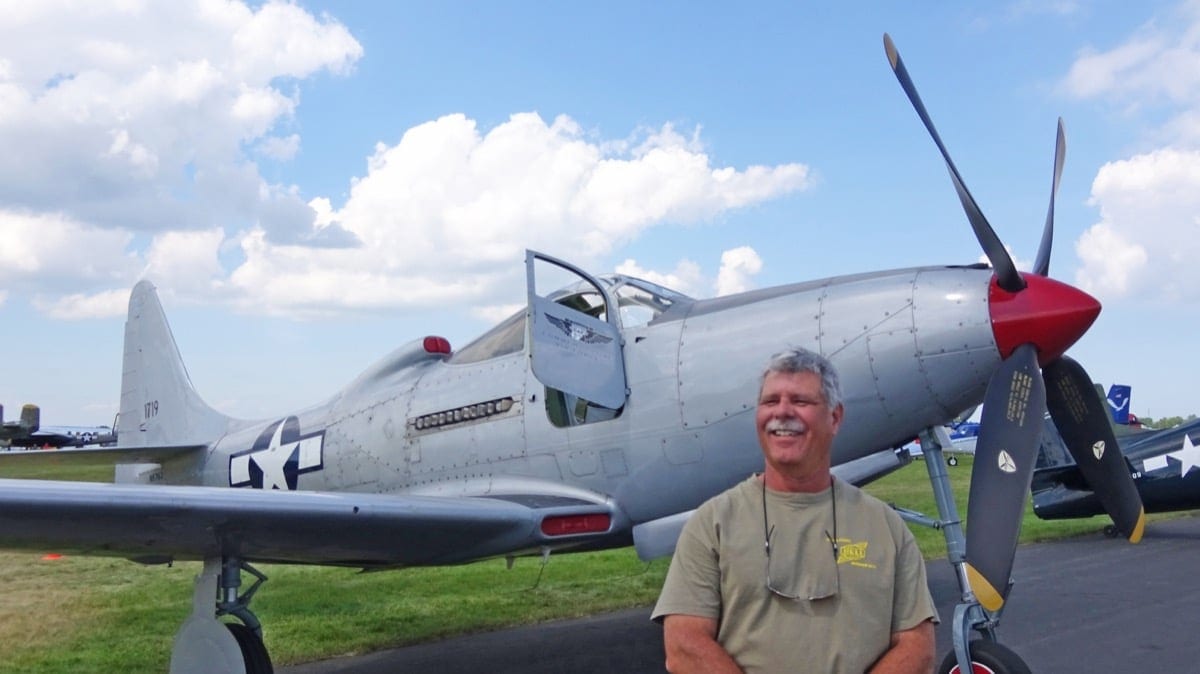
Craig Hutain flies the two P-63s and one P-39 of the Commemorative Air Force (CAF). He explains that the P-39 has more inlet area devoted to oil cooling than to radiator cooling; the P-63 reversed that geometry, improving the critical radiator cooling capability of the Kingcobra on the ground.
If the P-63 Kingcobra looks a lot like the P-39 Airacobra, it is still mostly a new aircraft. Only a few parts, like the hinged cabin doors, are virtually the same.
The P-63’s laminar flow wing, not a part of the P-39’s design, spans four feet wider than that of the P-39. The P-63 is two feet longer than the P-39.
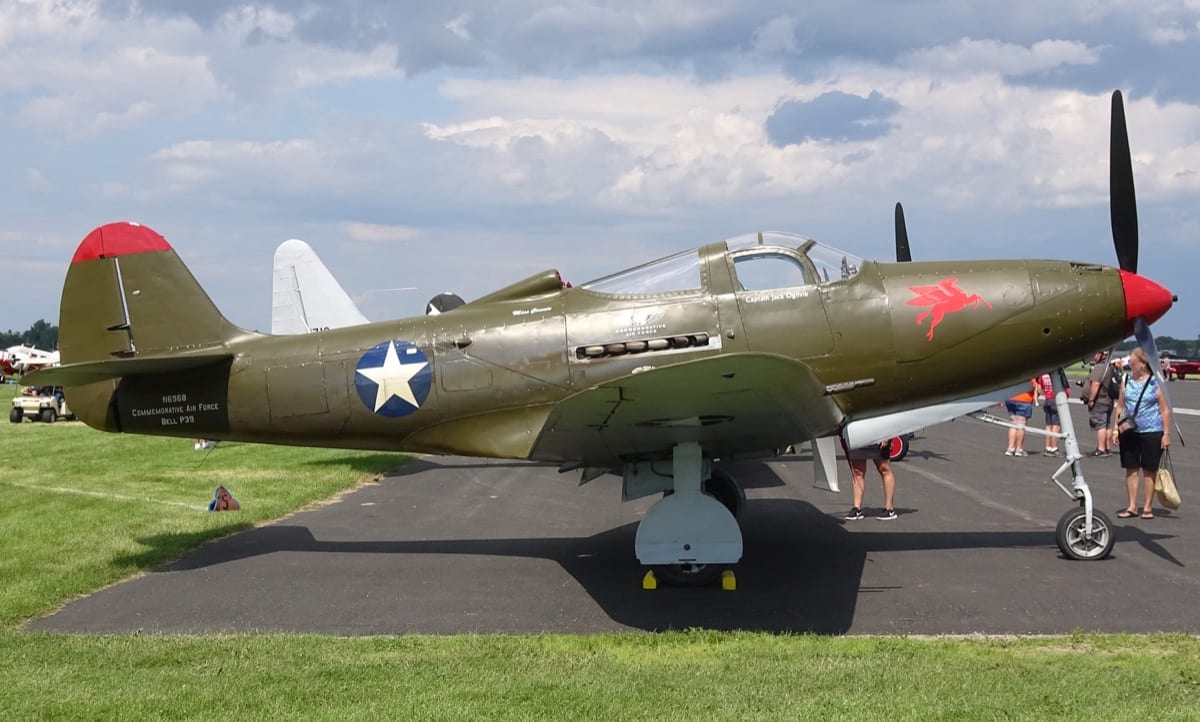
This shows up when looking at the two aircraft side-by-side; the front of the door opening on the P-39 is just about over the leading edge of the wing. On the P-63, the door opening is in front of the wing.
Tail surfaces are different for both types, and the nose gear strut oleo scissors face forward on the P-63 and aft on the P-39. Little differences like these can be clues in identifying close-up cropped photos of various ‘Cobras.
The fastest stock P-39 was the N-model, topping out at an official 399 miles per hour at an altitude of 9,700 feet. P-63 production models hit around 410 mph at 24,000-25,000 feet, thanks in part to newer Allison V-1710 engines with improved supercharging.
The P-39Q Airacobra that was at Oshkosh is a long-time member of the CAF, dating back to the 1970s when the organization was known as the Confederate Air Force. For a number of years the plane, AAF serial number 42-19597, N6968, flew in Soviet World War II-style paint and markings; currently it represents U.S. Airacobras.
This P-39 evidently was damaged in New Mexico when still in Air Force service right after World War II. It remained in that state until it was bought and moved to Texas in the late 1960s. Following rebuild, it first flew again in 1974.
The three P-63 Kingcobras that attended AirVenture included P-63A number 42-68941 (N191H), freshly restored by the Dixie Wing of the CAF in Atlanta.
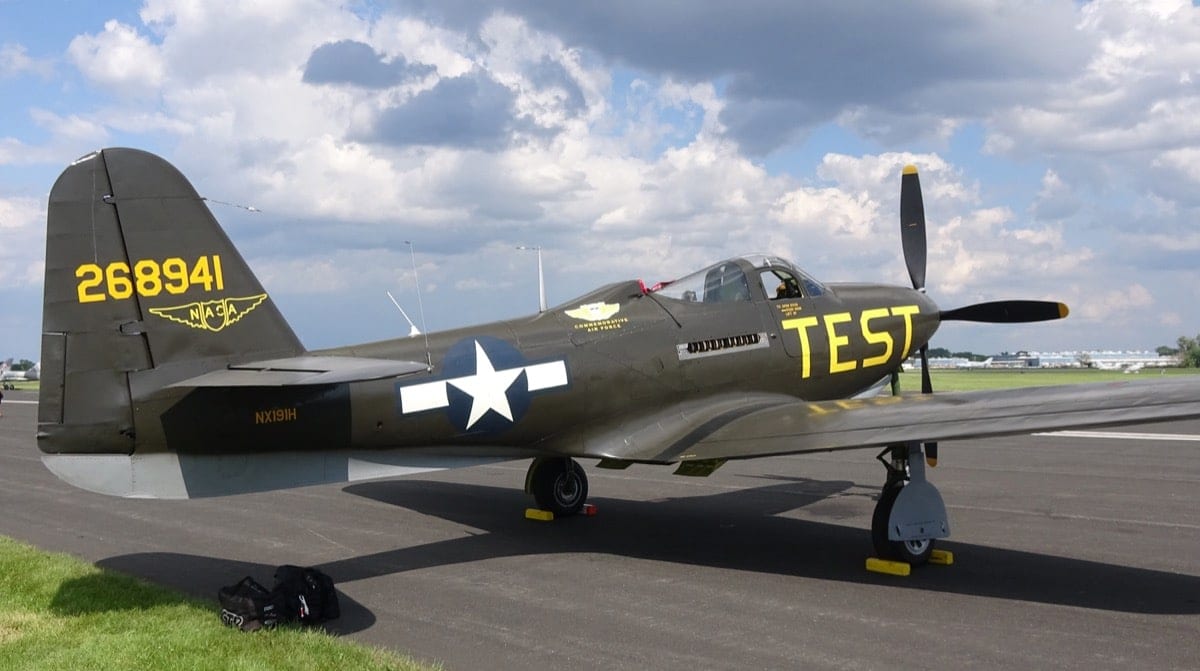
This P-63 was employed by NACA. It flew from the NACA facility at Moffett Field, south of San Francisco, from 1945 through the end of April 1946 when it was made available for purchase. The Kingcobra passed through a couple of owners in Texas until bought by two CAF supporters in 1967.
After a stint in early CAF white paint with red and blue trim, the P-63A took on a set of markings representing French Kingcobras. The French ‘Cobra was a ramp champ at CAF headquarters in Harlingen, Texas, with issues — including corrosion — keeping it from flying.
The Missouri Wing of the CAF adopted this Kingcobra, and work was underway to return it to flying status when a 1995 flood intruded on that Wing’s plans. The following year, the CAF’s Dixie Wing took on the responsibility for the P-63. It first flew earlier this year after extensive restoration.
The aircraft’s historic stint with the NACA prompted the CAF to restore it as it actually was in 1945, complete with large yellow TEST lettering on the nose.
From Rexburg, Idaho, John Bagley’s P-63C was the only non-CAF ‘Cobra in attendance at Oshkosh. It is part of the Legacy Flight Museum at the Rexburg airport.
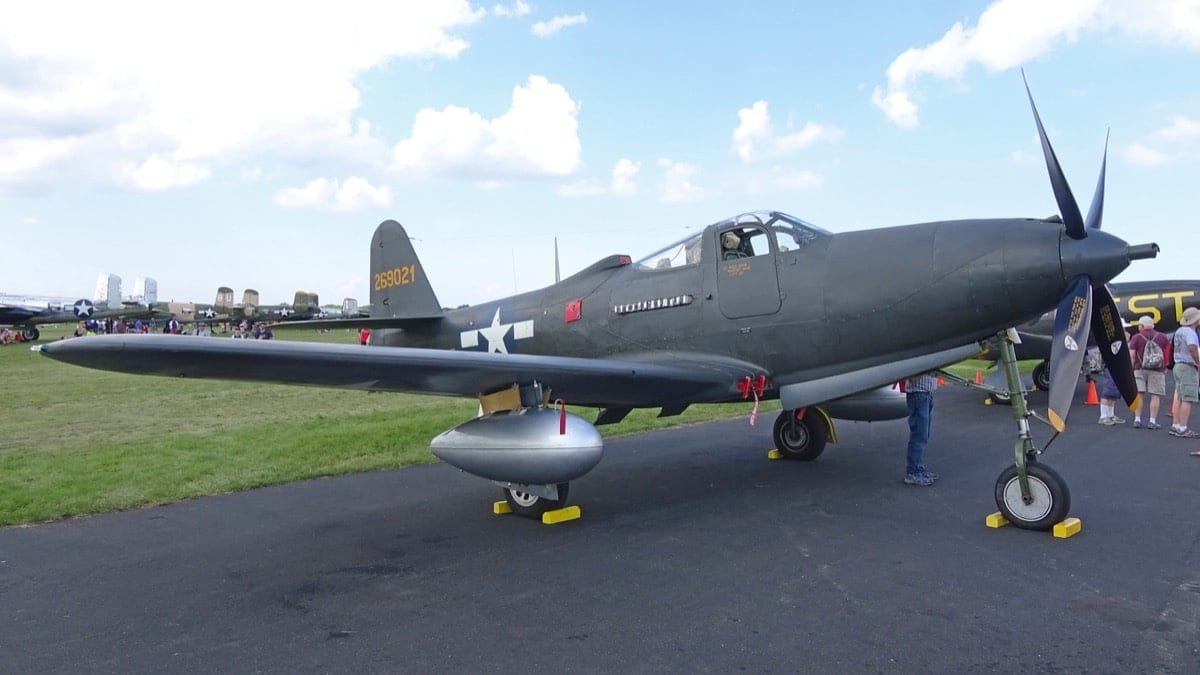
This Kingcobra is a showcase of the restorer’s art, featuring well-finished drop tanks with detailed shackle and sway brace mechanisms, and an unusual prop spinner extension that could allow this P-63 to be started using a starter truck with a shaft to engage the special spinner fitting.
It is sometimes displayed with its nose cowl panels removed to reveal the closely packed 37-mm cannon and ammunition carried by these fighters.
The Idaho Kingcobra, though really a C-model (serial 43-11223) has been marked as a P-63A, number 42-69021.
The third Kingcobra at AirVenture was the CAF’s even rarer P-63F (serial 43-11719, N6763) immediately recognizable with its much taller tail with a sweeping dorsal fin. Only two F-models were built.
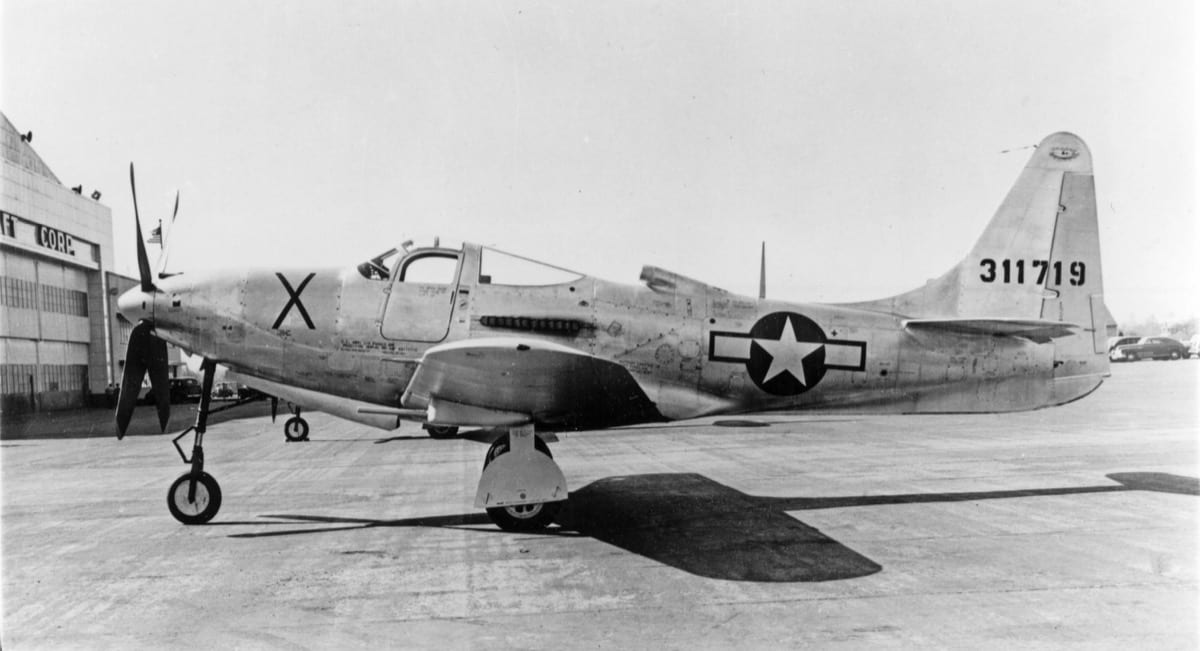
This P-63F may have been purchased for a post-war air racing career. Passing through the hands of several owners, the CAF acquired the F-model around 1981.
The nature of aircraft development and production was much different during World War II than it is today. Back then, all of the combatants endeavored to keep multiple designs available as a protracted war of attrition dragged on for years.
The Bell P-39 Airacobra and P-63 Kingcobra were part of the American mix. Radical — perhaps. The P-39 was plugged into combat for the AAF early in the war in the Pacific and North Africa. And when the bigger P-63 Kingcobra emerged with improved performance, it still did not match the long range escort fighter capabilities of the successful P-51 Mustang.
But, as with thousands of P-39s before it, P-63s found a home with the wartime Soviet air force. Today, these fighters with drive shafts are prized witnesses to that desperate time.

The remote propeller reduction gear train in the Bell Cobra aircraft is composed of spur gears, not palnetary gears. Thanks.
No article about P-39 would be complete without mentioning the fact that P-39 has the highest number of Allied aerial victories by an individual. So in that respect, it is the most successfull Allied fighter aircraft of WW2.
I believe, I could be mistaken, the individual with the highest number of Alied aerial victories is my uncle, Captain Jack Ogilvie. This year he is 94 and will attend the Wings Over Texas air show in Dallas on October 6-7. The Central Texas Wing of CAF has the P39 pictured above with the flying red horse. It is painted with the nose art resembling the art on my uncle’s P39, “Big D”, during his service in North Africa. He told me that the P39s low service ceiling was thought to be a weakness, but he found ways to make it a tool he could exploit to his benefit.