

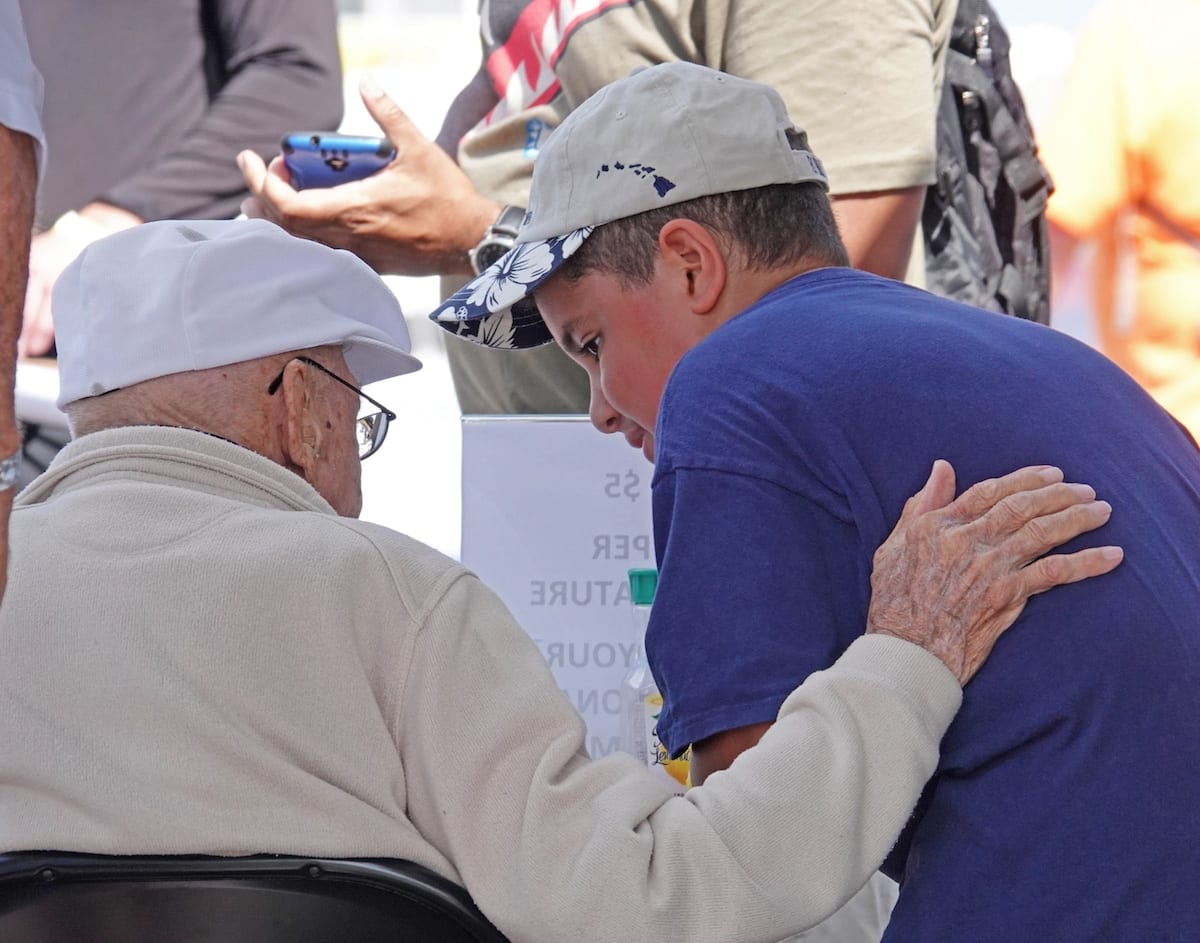
Hundreds of people gathered to be with Dick Cole at SUN ‘n FUN 2018 in Lakeland, Florida, on April 14, 2018.
Cole has earned their acclaim in so many ways. At 102 years of age, his wise and experienced perspective should be sufficient to garner respect from the rest of us. Cole is a World War II veteran — another badge of honor that deserves our thanks. And he is one of the select group of men known as the Doolittle Raiders who shocked the Japanese empire and rallied American spirits with a daring bombing mission over Tokyo in April 1942.
Need more reasons to celebrate Dick Cole? He is the last living member of the Doolittle Raiders. And, by the way, as a young lieutenant, Cole was copilot for the raid’s leader, Lt. Col. Jimmy Doolittle.

Whether you are viewing the iconic Liberty Bell or attending a live artistic performance, actually being in the presence of greatness is profoundly more emotional, more intense than merely reading about it or seeing a picture. That’s how it was for the SUN ‘n FUN attendees who gathered around Dick Cole in front of a wartime B-25 bomber similar to the one he crewed on the Doolittle Raid. Cole was accorded the respect due a true American hero and witness to history.
The event was a special session of Victory’s Arsenal Theater, a new program at SUN ‘n FUN in which a classic warbird is parked next to seating for pilots, owners, and veterans who discuss the planes and their experiences for an audience of interested attendees.
Cole was joined by Larry Kelley, owner of the B-25 “Panchito,” and Tom Casey from the Doolittle Tokyo Raiders Association.
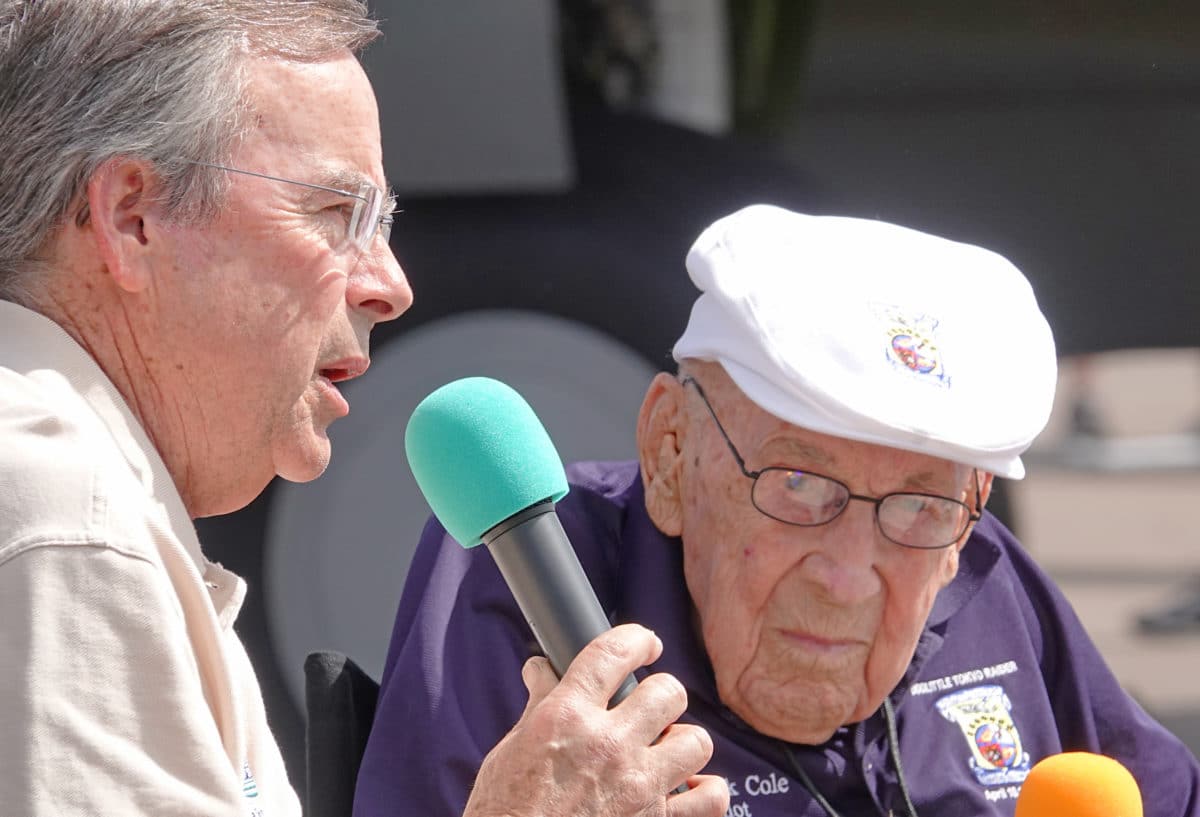
Cole talked about the 17th Bomb Group, his unit before the raid. He said the fliers of the 17th Bomb Group had more experience in B-25s than anyone else. Planners had already discarded other aircraft from consideration for the raid and selected the B-25. It was natural to groom the most experienced B-25 crews for a mission so audacious that it included taking off from a crowded aircraft carrier deck.
The men of the 17th Bomb Group were approached about voluntarily participating in a secret mission. No details were given.

“It’s true that we volunteered,” Cole told the SUN ‘n FUN crowd. “But I’ll let you in on a little secret — we were going to go on that raid whether we wanted to or not.”
Cole said he and the others were sent to Eglin Field in Florida, then to Alameda in California where their B-25s were craned onto the deck of the new aircraft carrier USS Hornet. As they set out to sea and passed under the Golden Gate, the Army fliers and most of their Navy hosts still did not know what the mission was to be.
At sea, an announcement from the USS Hornet’s public address system told the airmen and sailors that the target was Tokyo. Initial clamor over the momentous nature of the mission subsided.
“We were all scared, but there wasn’t much you could do about it,” Cole told his audience. “After a while it got rather quiet and people began to wonder what they had gotten themselves into.”
The Doolittle Raiders faced a new and challenging peril when the USS Hornet’s flotilla encountered a Japanese picket boat about 650 miles off the Japanese coastline. Certain that their surprise was compromised, Doolittle opted to lead his bombers on the raid on April 18, 1942, from a distance of 600 miles offshore instead of the intended 300-mile overwater leg that had been planned.
While this extra distance would alter the recovery sites of the aircraft in China after the mission, the early launch offered some valuable military benefits in light of the fleet’s discovery by Japan.
First, it would allow the USS Hornet to withdraw sooner from seas where the Japanese now knew the American aircraft carrier steamed. And, the longer range of Doolittle’s twin-engine bombers was beyond the reach of traditional Navy carrier-based warplanes, so the Japanese would not be expecting a bombing attack as early as the B-25s could deliver it.
At the SUN ‘n FUN session, Kelley and Casey elaborated on portions of the mission’s history, animated by their enthusiasm for the topic and their respect for Dick Cole. Casey told the crowd that the morning launch from the Hornet put the Raiders over Japan at noon. All 16 B-25s made bomb runs over selected military targets at five Japanese cities, including Tokyo.
Recovery of the B-25s at landing fields in China beyond the immediate control of the Japanese was compromised by the longer distance the mission required once the U.S. fleet was discovered far out at sea. The Raiders made their way westward, sometimes in blinding rain, with each bomber coming to rest somewhere in China, save one that made it to a safe landing in Vladivostok, Russia. Some crews crash-landed their bombers while others elected to bail out.
Jimmy Doolittle flew west until the engines starved and died on his B-25, and then gave the order for his crew to bail out over China.
When an attendee at Cole’s SUN ‘n FUN presentation asked him to describe the best time and the worst time of the raid, he replied: “Best time, when the parachute opened.”
He added that the worst time was just before that, as he pondered his exit from the B-25 into a foggy, rainy abyss.
After he was initially aided by Chinese residents, Cole said he saw a sketch one of them had made of a twin-tail airplane and five parachutes. The artist led Cole to a dimly candlelit room where he could barely make out the form of his pilot, Jimmy Doolittle.
“Boy am I glad to see you,” Cole told Doolittle.
Soon the entire crew was reunited, and carefully spirited away to safety and out of the grasp of the Japanese army.
Most of the crews made similar getaways; two died in the sea with their ditched B-25, one died in China. Eight men were captured by the Japanese, who executed three of them, while a fourth Raider died in captivity.
The story of the Doolittle Raid has been retold by historians as well as the Raiders themselves over the decades. Each telling, especially by the last Raider, Dick Cole, brings that heroic and risky mission to life again in a way that outdistances secondhand accounts.

My neighbor is Pax Cheng. He is one of the Chinese boys in a boarding school who helped the Doolittle Raiders. The Gulf Breeze News of Gulf Breeze, FL recently wrote an article about him. Mr. Cheng missed meeting up with Dick Cole this spring. He went to the Naval Base in Pensacola but Lt. Col. Cole was at Eglin/ Hurlburt Air Force Base in Ft. Walton Beach, only 30 miles away. If you know how to contact Lt. Col. Cole, please contact me. Mr. Cheng is almost 90 and his”bucket list” is a meeting. Thank you.
Great website, thanks for all the photos !