

Every time the pilot of a 16-ton F/A-18 Super Hornet plants the jet on the deck of a U.S. Navy aircraft carrier, an unbreakable thread of history stretches from that landing back over more than a century to the first shipboard landing.
The year was 1911. The Wright brothers’ celebrated accomplishment at Kitty Hawk was barely seven years earlier. Some observers in the U.S. Navy sensed the airplane would have a military application, but for the moment that application was largely unformed.
Airplanes and automobiles defined the new century, and those who were drawn to the mechanical marvels of either machine often crossed over and embraced the other. Eugene Ely first became a road race driver, chauffeur, and automobile salesman. When a Portland, Oregon, automobile dealer began selling Curtiss Pusher biplanes, the transition for Eugene Ely came quickly.
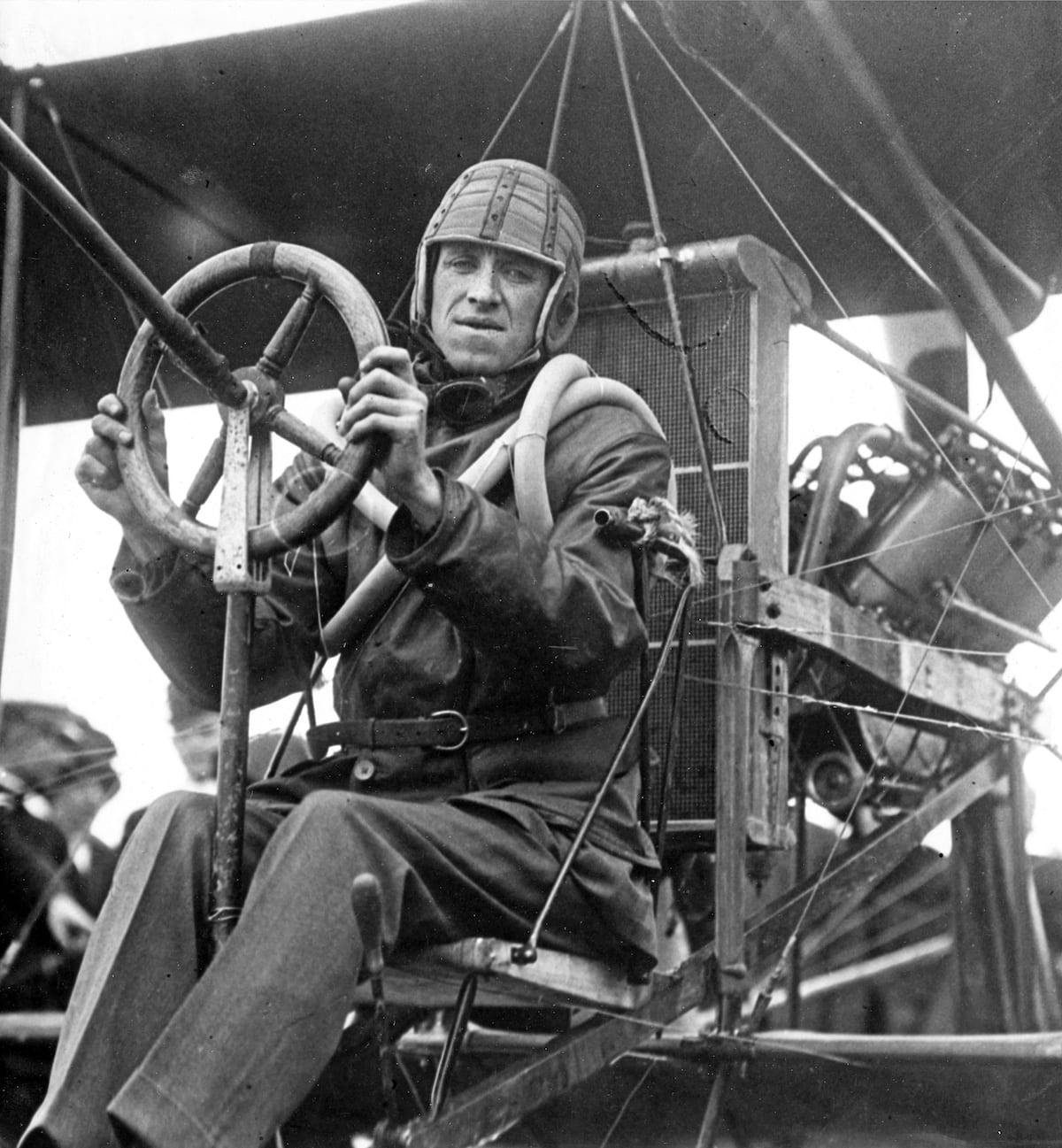
By June of 1910, Ely was making exhibition flights in Canada. He met with pioneer aircraft manufacturer Glenn Curtiss in Minneapolis, and Curtiss figured Ely had the makings of a good demonstration pilot.
By July, Eugene Ely was flying for the Curtiss aerial demonstration team, a group of colorful early-day aviators whose nationwide exploits often were the first time thousands of Americans witnessed an airplane in flight.
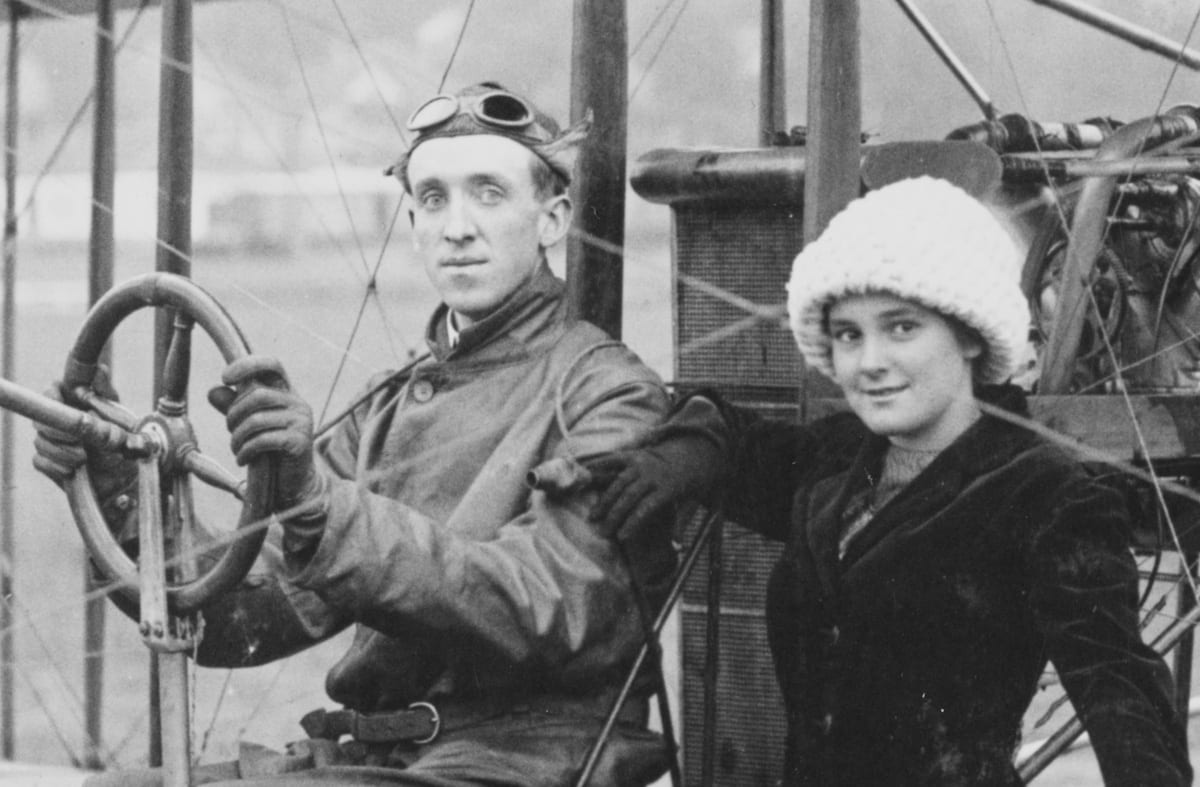
Glenn Curtiss was a world-record-beating motorcycle speed racer who built his own cycles and engines. Those engines provided Curtiss’ entry into the fledgling aviation world. A savvy showman and businessman, Glenn Curtiss was attuned to ventures that might cast airplanes — especially his airplanes — in a good public light.
In 1910, the New York World newspaper came up with a feat worthy of Curtiss’ aircraft and his showmanship, as chronicled by Glenn Curtiss biographer C.R. Roseberry. The plan was to fly an aircraft from an outbound ocean liner at sea, returning to land the airplane on shore. The premise was finding a way to speed transoceanic mail delivery.
The Hamburg America steamship line was engaged in the project. Their liner, the SS Kaiserin Auguste Victoria, was chosen to be the vessel from which a Curtiss Pusher would take off. The intended date was Nov. 5, 1910.
The ship had been the largest ocean liner afloat between 1905-1907, until the Lusitania took that title.
John McCurdy was the Curtiss pilot tagged for the proposed first launch from a ship. It was to take place 50 miles out to sea. A waterproof bag of mail was the intended cargo. Curtiss and McCurdy ramrodded construction of an inclined 85′ ramp on the fore deck of the ocean liner.
On Nov. 4, an eastern seaboard gale made the flight impossible, so the effort was rescheduled for Nov. 12 when the liner SS Pennsylvania would leave port. McCurdy had another flying engagement, so Bud Mars was tapped to become — hopefully — the first pilot to fly an aircraft off a ship.
This time, an engine test for the Pusher aboard the SS Pennsylvania went awry when a piece of hose sucked into the propeller. The ensuing damage could not be repaired in time to meet the liner’s scheduled sailing date, and the fly-off had to be canceled again.
Even while the SS Pennsylvania effort was underway, the U.S. Navy approached Curtiss about conducting such a test from a warship. Eugene Ely was the Curtiss pilot assigned to the Navy quest.
Only two days after the broken Curtiss Pusher caused the ocean liner flight to be canceled, Ely made ready on Nov. 14, 1910, to fly a Curtiss Pusher off a wooden ramp built on the cruiser USS Birmingham at Norfolk, Virginia.
Between 11:30 and 3:30 that afternoon, Ely outlasted wind and rains that swept the wooden platform on the cruiser. Finally a break in the weather gave him a window of opportunity, and Eugene Ely became the first person to fly an aircraft from a ship.
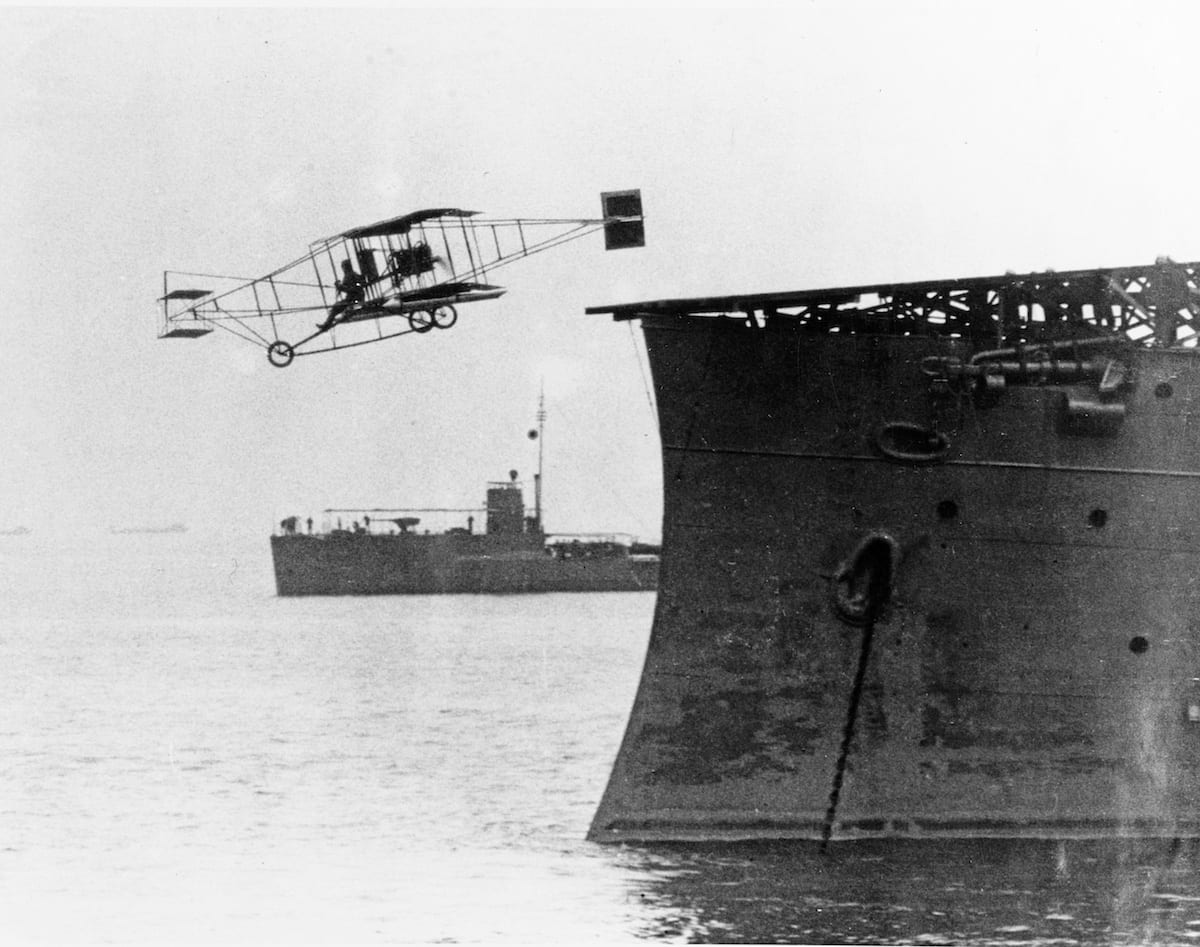
The Pusher plunged off the end of the ramp, and Ely was drenched from sea spray as the open-air biplane’s propeller and wheels skimmed the water. He made landfall safely, and the concept, though a bit shaky in its first execution, was validated.
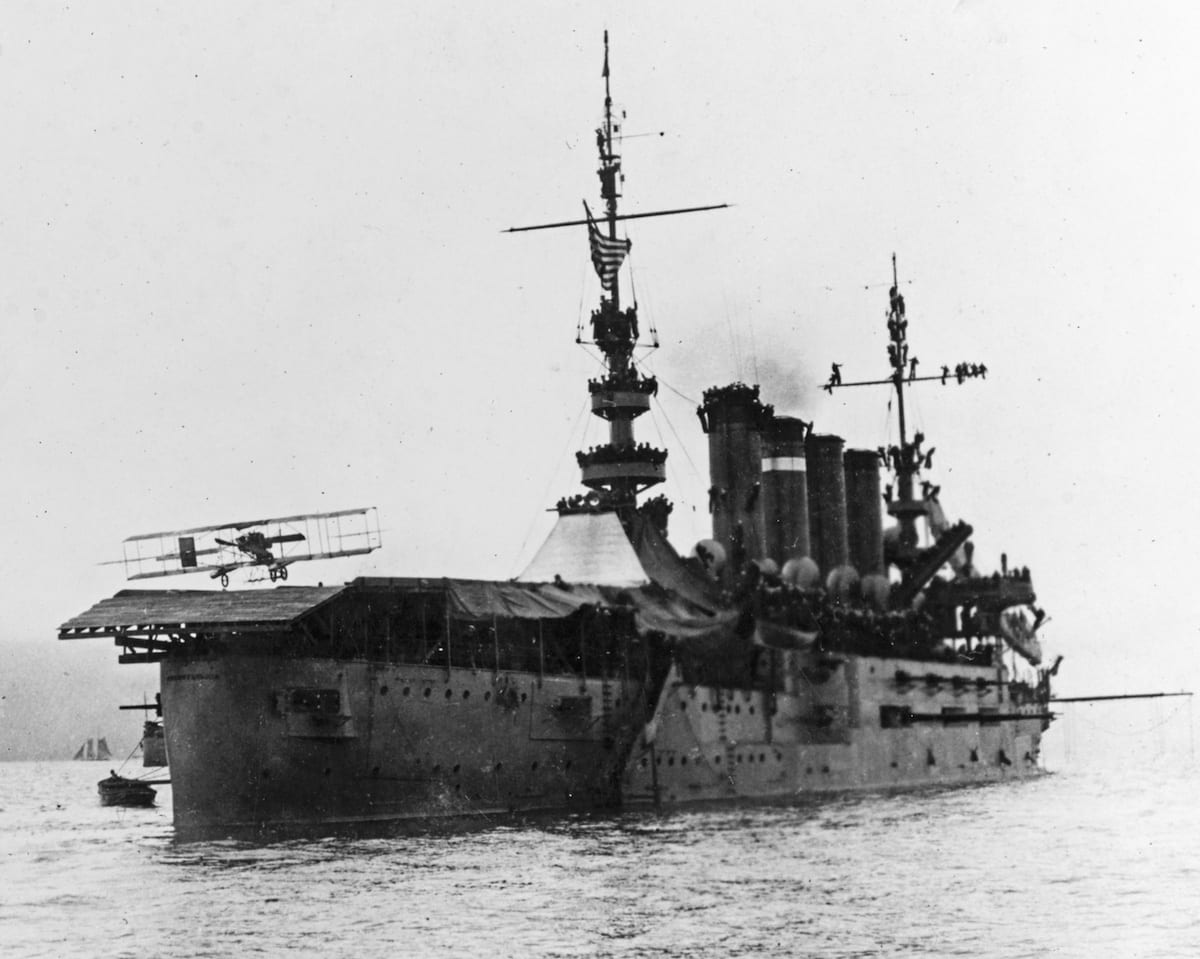
The stage was set for Eugene Ely’s bigger triumph with the Navy. On Jan. 18, 1911, Ely aimed his Curtiss Pusher for a longer plank deck constructed on the cruiser USS Pennsylvania in San Francisco Bay. He made the first shipboard landing, complete with hooks attached to his Pusher to catch sandbagged ropes to abbreviate the landing roll. An hour later, Ely launched from the cruiser and recovered on land.
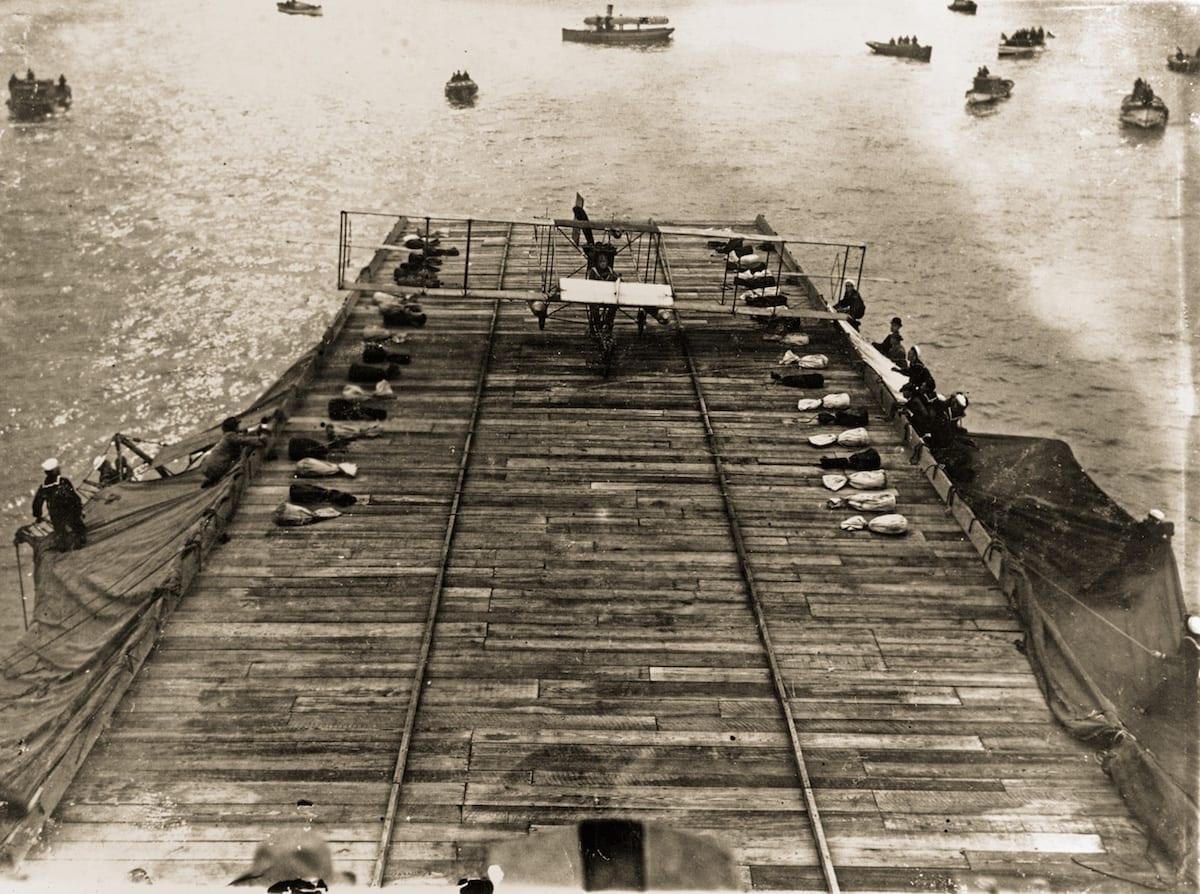
Ely’s profession as a pilot ended abruptly on Oct. 19, 1911, in Macon, Georgia. The crash of his Curtiss Pusher in a demonstration claimed the life of the first flier to land and take off from a ship.
Great Britain and Japan pioneered some attempts at aircraft carrier operations in World War I.
The U.S. Navy, initially investing in seaplanes, returned to the concept of aircraft carrier aviation with the converted USS Langley in 1922.
In the decades since, the U.S. Navy has become the world leader in aircraft carriers.
For his pioneering role, Eugene Ely posthumously received the Distinguished Flying Cross in 1933, awarded by Congress in recognition of his exploits of 1910 and 1911.

Small obvious error in the landing date just below the pic of Ely landing on USS Pennsylvania. Think the year of 2011 should read 1911. Sorry, couldn’t pass it up. I’m planning on having an 8′ wing-span model made for me (I don’t have those talents) to hang ‘in-flight’ in the cove above my front door. With a painting of a 4′ wing-span Spitfire watching over it. What a history. Now I just sit back and remember my A-1 ‘Spad’ days. Anchors aweigh!
Thanks Mike… Fixed.
I am proud and humbled to have been a part of this noble tradition! Lieutenant Commander Thomas E. Holmes, USN. Retired. A naval aviator!
What struck me was the timescales. What was done in days, weeks or months a century ago, now takes years or a nearly a decade. Too much being bogged in minutia and paper. If we continue this risk-averse and compliance culture, our great grandchildren’s lingua Franca will be Mandarin.
Have visited the Curtiss Museum in Hammondsport couple years back. Wow a great museum, airplanes, motorcycles, and many other early inventions. A must see.
It should be noted that the man who devised the arresting gear was another Curtiss Exhibition pilot, Hugh Robinson! He cane up with the idea as he used similar concept when exiting from motorcycle “Wall of Death” thrill show ride he had performed at Circus/Carnivals earlier! Robinson is one of the great forgotten aviation pioneers. Curtiss first met him when he saw airplane Robinson built that was having trouble getting airborne. Curtiss diagnosed the problem as bad prop & loaned him one of his! GHC later hiredhom and he flew w/ Curtiss Exhibition team at the 1st US air mee at LA, Jan 1910. Robinson went on to help with hydroplane development and demonstrated then for Curtiss in Europe in 1912. Left Curtiss briefly & helped Benoist developed Flying boat used in 1st scheduled airline in the world in 1914. St Petersburg-Tampa Airboat Line. Returned to Curtiss after working for Aeromarine on light plane & managed Curtiss “Aerocar” factory in FL.
Interesting. Ellyson seems to always get credit for it, but I love learning how it really came about. According to at least one newspaper of the time, Hugh Robinson also “invented” the track and associated gear used to move hydroplanes and flying boats from the hangar to the water at North Island in January 1911. Really had a significant impact on the Curtiss experiments there and essentially part of his work. I am a huge fan of this period and always thrilled to learn something new.
The Glenn Curtiss Museum in Hammondsport NY is a great experience where you can see reproductions of many of these planes. http://www.glennhcurtissmuseum.org