

Reuben Fleet had an ability for business that ranged from lucrative land deals in the Northwest to the development of aircraft to meet the needs of customers, both civilian and military.
A World War I Army aviator, Fleet was part of the postwar flight test establishment at McCook Field, near Dayton, Ohio, until 1922 when he resigned to pursue manufacturing aircraft. His efforts led to the creation of Consolidated Aircraft, settling in Buffalo, New York, by 1924.
Fleet hired a young Larry Bell and Isaac Laddon. Bell went on to fame with his own aircraft manufacturing company and Laddon’s contributions through Consolidated included leading the design of the B-24 Liberator heavy bomber of World War II.
The young Consolidated Aircraft Company earned a reputation for building multi-engine airliner flying boats capable of several-day flights from Florida to South America. Fleet saw an opportunity to extend the usefulness of the flying boats by creating a short-run series of single-engine monoplanes as feeder airliners.
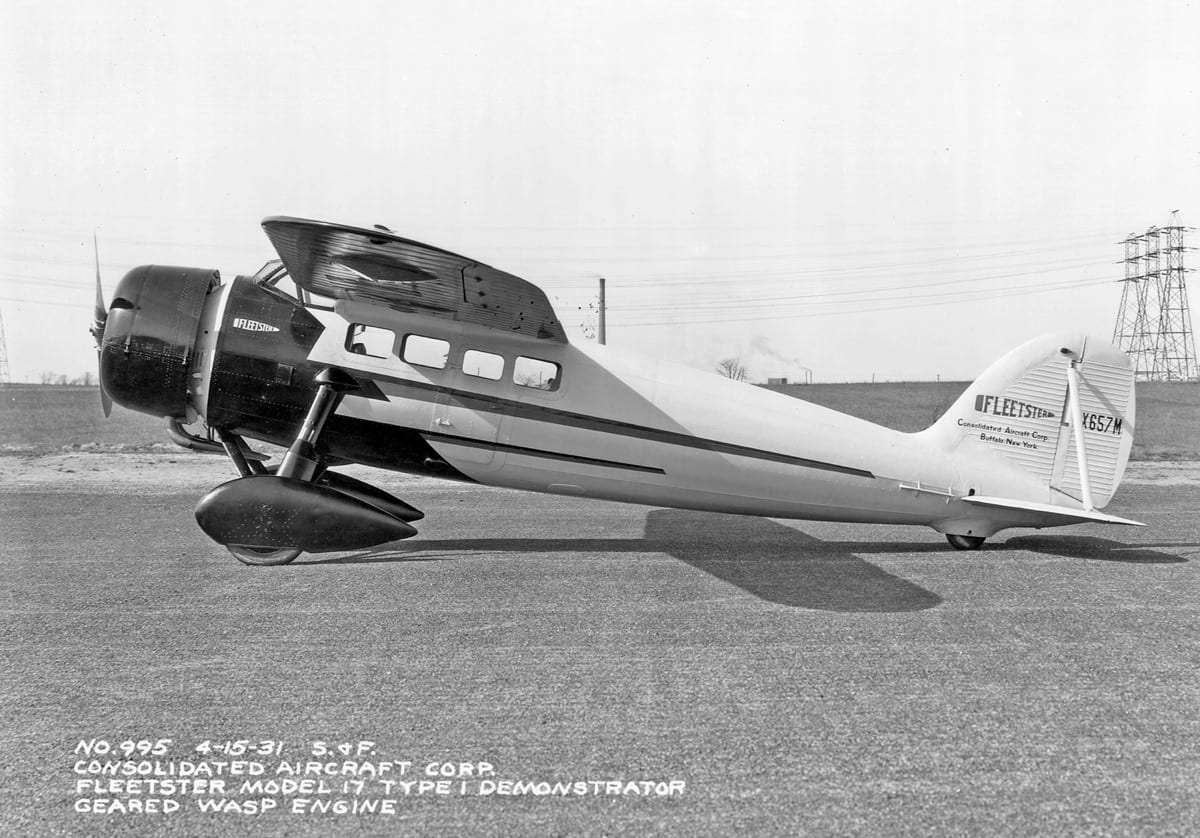
In January 1930, a type certificate was issued for the Consolidated Model 17 Fleetster, a high-wing, single-engine monoplane bearing at least a superficial resemblance to Lockheed’s already successful Vega. Laddon is credited with the design of the Fleetster. The Fleetster extended the coastal intercontinental seaplane routes of the New York, Rio, and Buenos Aires Line (NYRBA) into the interior.
Four Model 17s were built. They seated six passengers in the fuselage, while a seventh passenger could ride up front in the enclosed cockpit with the pilot. That seventh seat sometimes was consumed with radio gear.
The wooden cantilever wing, spanning 45 feet, mated to a monocoque aluminum fuselage 31 feet, 9 inches in length. Taking advantage of a NACA drag-reducing cowling and streamlined wheel pants, the Fleetster could attain 180 miles per hour tops, while cruising speed was an efficient 153. Power was provided by a Pratt and Whitney Hornet radial engine of 575 horsepower.
One of the Model 17s was adopted by F. Trubee Davison, Assistant Secretary of War for Air.
The young Consolidated organization found it feasible to tinker with the Fleetster design to evolve variants. Just as Lockheed and other manufacturers flirted with parasol wing versions of popular designs, Consolidated used its larger Fleetster fuselage beneath a strut-mounted parasol wing to make the Model 20 Fleetster, certificated in May 1930.
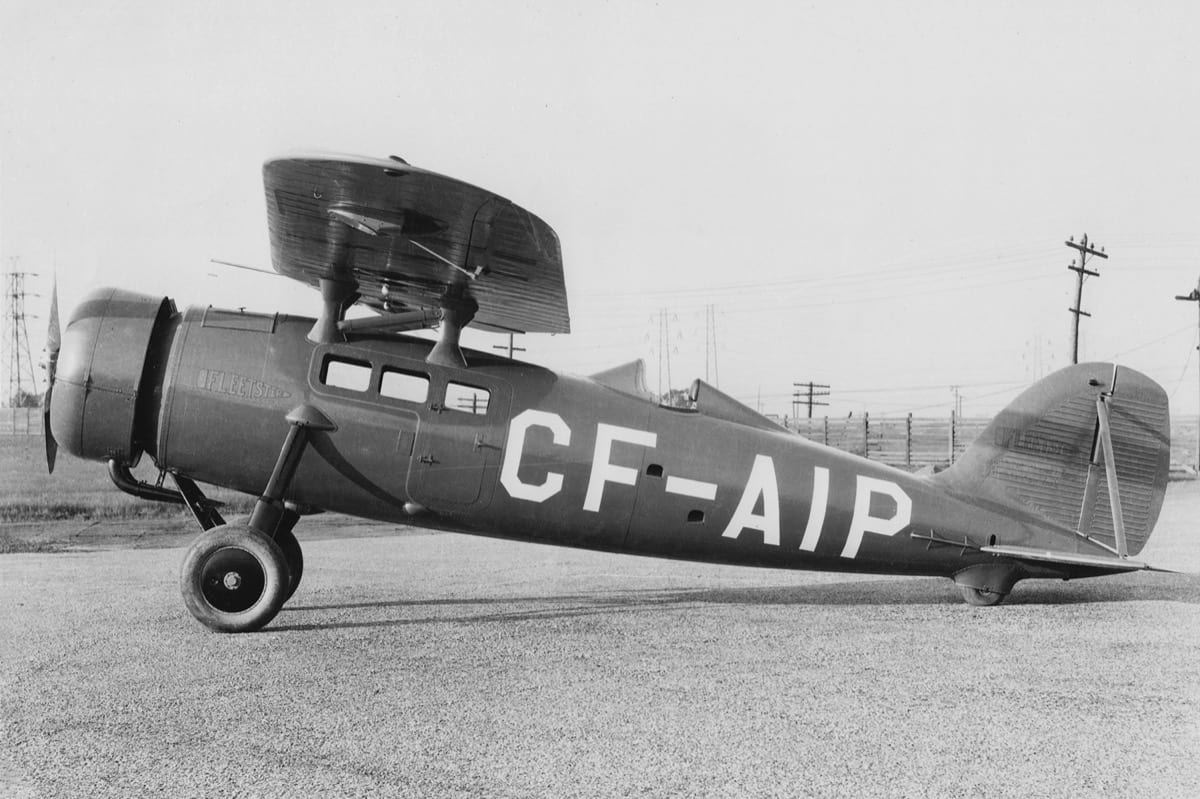
In this parasol, the pilot was relocated farther aft in an open cockpit — something that some fliers still preferred even as enclosed cockpits were making inroads in design. The elevated wing provided better forward and downward visibility for the pilot in his new perch.
The Fleetster Model 20 was a typical tailwheel design, but was constructed with fittings built into the fuselage for float operation if desired by the operator. The Model 20 enjoyed only limited production, with three copies flying in South America and one in Canada.
The strut-mounted parasol wing and open cockpit penalized the Model 20’s performance a little — top speed was now listed as 175 mph. But suspension of the fuselage beneath the wing enhanced stability. With essentially the same wing and fuselage as the Model 17 cabin Fleetster, the parasol Model 20 had the same length and span. But where the Model 17 stood 9 feet, 2 inches tall, the parasol Model 20 measured a foot taller.
The Model 20 sold for more than $30,000, a sizable sum in the Depression year of 1930, and five times the cost of the average home in the United States at that time.
The parasol Fleetster had an enclosed passenger cabin with two bench seats facing each other, an arrangement historian Joseph P. Juptner likened to old west stagecoach seating. Five passengers could be carried in this way or the seats could be removed to create a cargo compartment that could heft more than 1,000 pounds of payload. Another cargo bay in the forward fuselage had 60 cubic feet and a weight capacity of 475 pounds.
The tailwheel was shrouded in a snug-fitting streamlined boot. To facilitate pointing the Model 20 in another direction on the ground, handles were fitted to the fuselage just ahead of the horizontal stabilizer for lifting the tail.
Certificated in September 1930, the next Fleetster was an iteration of the cabin Model 17, the 17-2C, powered by an early Wright Cyclone engine, rated at 575 horsepower. This Fleetster was 4 inches shorter than its Pratt-and-Whitney-powered cousins. Passengers all faced forward. Records indicate this may have been a one-off variant that did not see series production.
Next came the Fleetster 17-AF of mid-1932. As aircraft capacities grew, the 17-AF mounted a wing 50 feet in span instead of the 45-foot construction of previous Fleetsters. Fuselage length grew to 34 feet, 2 inches — a stretch of not quite 3 feet over previous Fleetster fuselages. It could carry up to nine passengers, plus the pilot. The look of the landing gear struts also changed on this model.
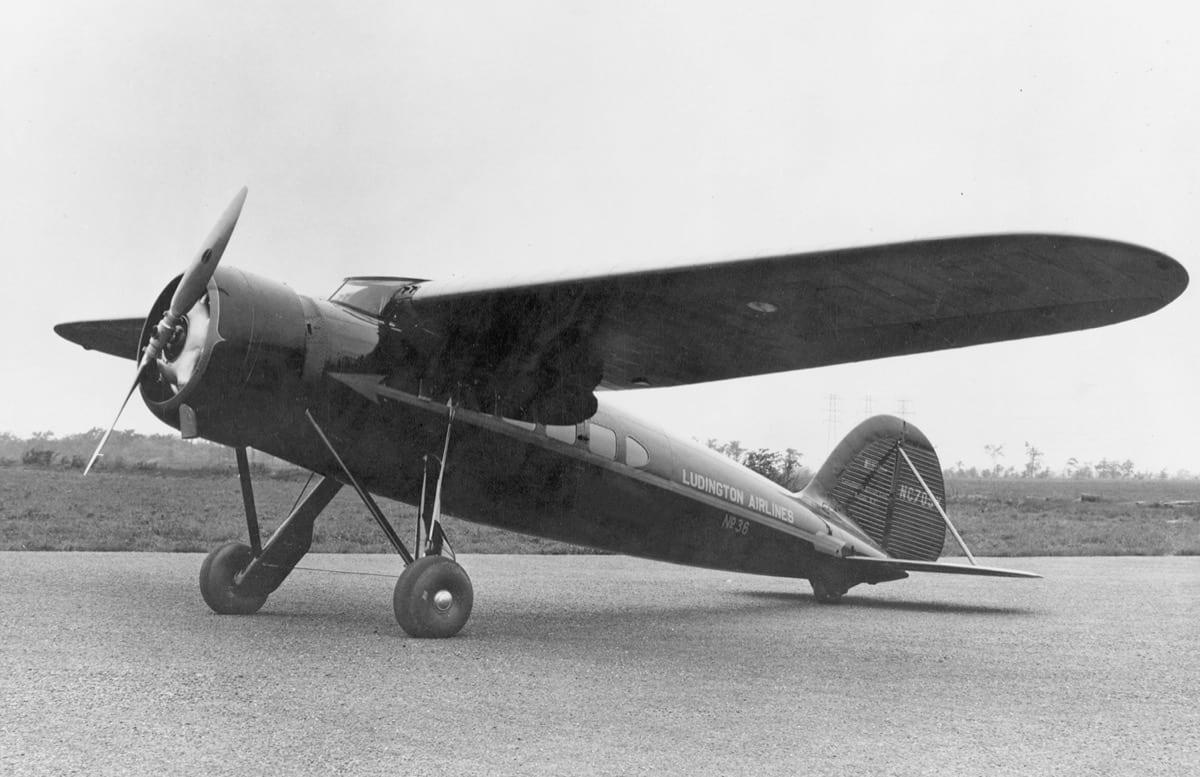
This Fleetster made a name for itself as a fast commuter between New York City and Washington, D.C., serving Ludington Airlines. Three of the Wright-powered 17-AFs were built for Ludington. All were later acquired by Pan American. The price was down from the 1930 parasol Model 20 — a new Fleetster 17-AF could be had for $24,500.
The final type certificate for a member of the Consolidated Fleetster family was issued in September 1932 for the parasol model 20-A. This elegant tribute to the parasol genre was designed for TWA for use in hauling combinations of passengers and cargo to connect with the major transcontinental air route of the era. Passenger capacity was six or seven, plus pilot.
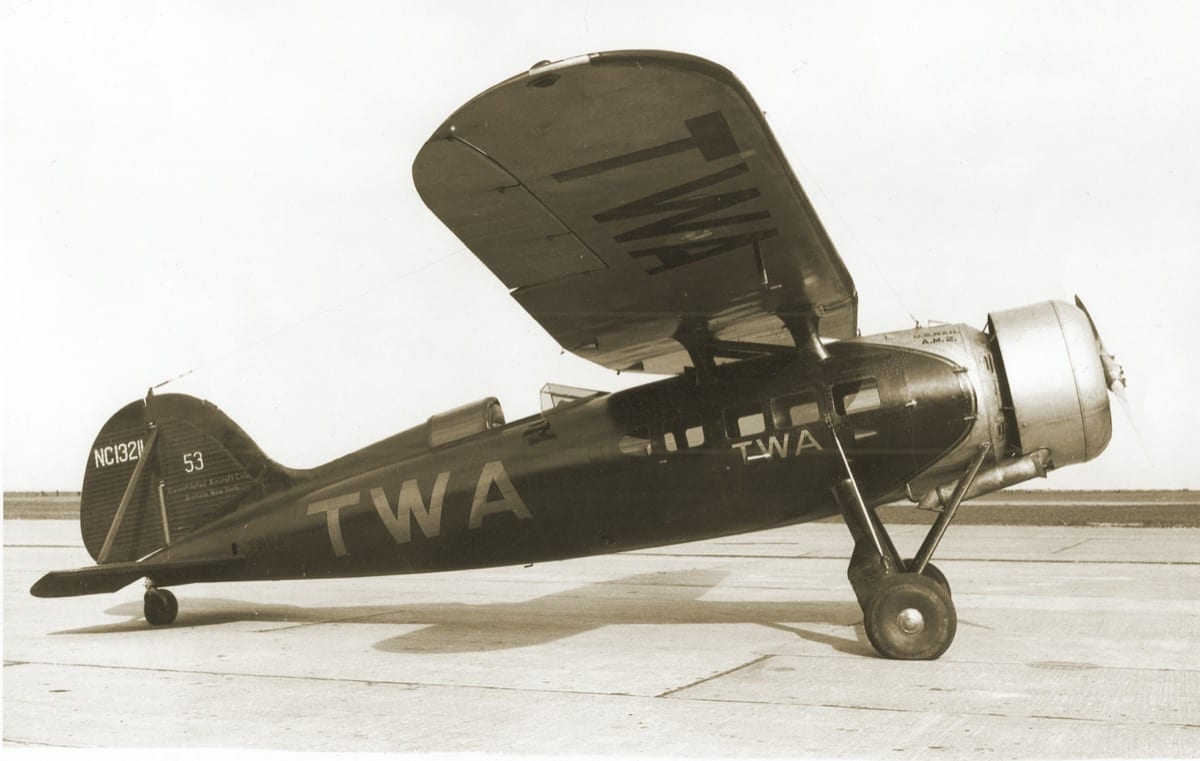
The 20-A employed the bigger 50-foot wing, with a Pratt and Whitney Hornet engine. It measured 33 feet, 9 inches long. Landing gear was revised as it had been for the 17-AF. Top speed was listed as 175, cruising speed at 160 miles per hour. The aft mounted cockpit had a sliding canopy.
This Fleetster answered earlier gripes about ground handling limitations by installing a swiveling tailwheel. Gone were the fuselage handles. Registrations for seven Fleetster 20-A models make this the largest production variant.
Military Fleetsters include one C-11 transport bought by the Army Air Corps and three improved C-22 versions, all conventional forward cockpit models. One customized Model 17-AF was pitched to the U.S. Navy as the XBY-1 attack bomber of 1932, but it did not lead to a production order.
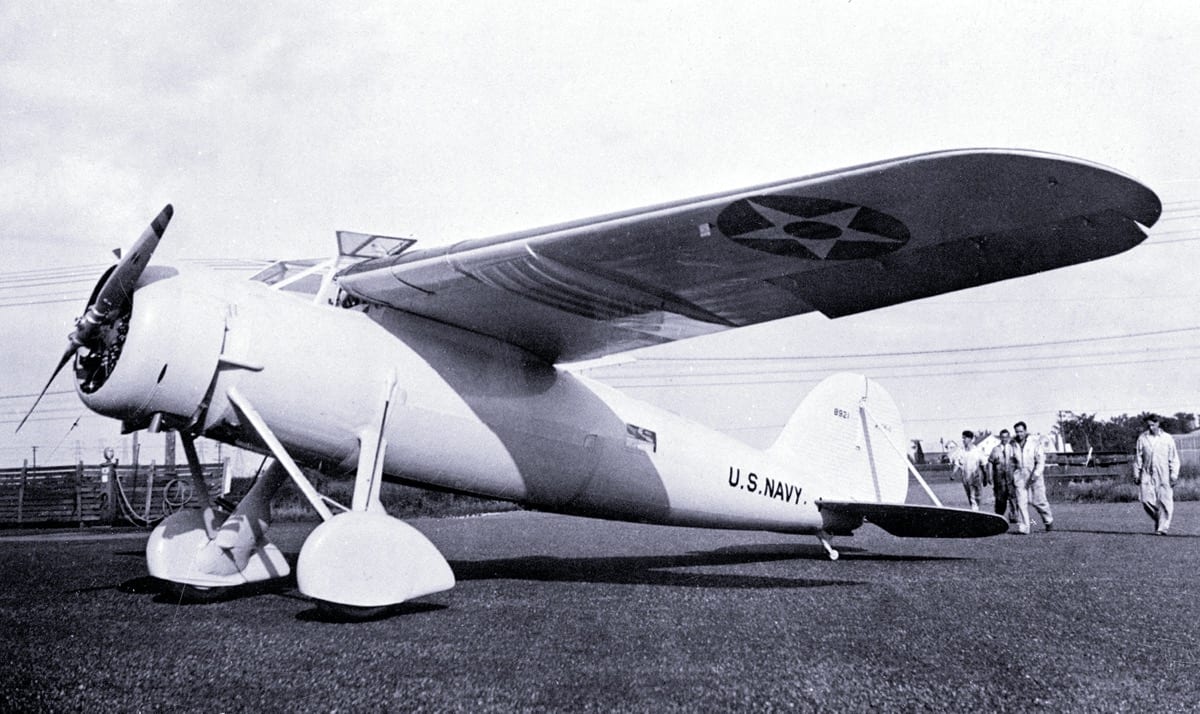
The Consolidated Fleetster series provided an elegant take on the needs of feeder airlines in the early 1930s. But the fortunes of Consolidated Aircraft lay elsewhere. Reuben Fleet grew up in Montesano, Washington, a part of the state that can see 80 inches of rain in a year, making Seattle seem arid by comparison. When he received Army pilot training in 1917, it was in balmy San Diego, and that made an impression on Fleet.
In 1935, with growing flying boat activity demanding a lot of effort from Consolidated Aircraft, and winters in New York being less than cooperative, Fleet remembered his pleasant time in San Diego and relocated the company to that city by the sea.

At San Diego, Consolidated (later Consolidated Vultee or Convair) seaplanes and landplanes were built by the thousands.
(Historian Joseph P. Juptner spent years and much effort meticulously chronicling the development of American civil aircraft. His work, published in a series of books, helps our effort in this column. And Gerald Balzer’s many decades of photo collecting and scanning, which he has graciously shared, made the accompanying images available.)

After world war 1, it is the step worth appreciating that is taken by the fleetster. And thanks to you for taking me back to those days.
Thank you, Sir, for the delicious trip back to aviation’s ‘thrilling days of yesteryear’ as well as for preserving them. They are the next best thing to having been there.