


The number one question I receive about lubricants is “multigrade vs single grade, which is best?”
I have written several columns in the past on this, but I will try to shed some more light on the subject.
Let’s start with the basics: Viscosity is defined as ”the internal friction of a fluid which makes it resist flowing.”
To measure the viscosity of an oil, a lab uses a specially designed test tube. The test oil is put into the tube and the tube is then immersed in a temperature-controlled bath. The bath has a window in the side of it and when the test oil reaches the desired temperature, the oil is allowed to run out. The time required for the oil to flow out past two special marks is then correlated back to the viscosity.
In the past, viscosity was reported in seconds, but now it is correlated back to centistokes, an established unit used to measure kinematic viscosity. I guess that sounds more scientific.
The oil bath is controlled to 100°C (212°F) for the high temperature test, but for the low temperature test it varies for different weight oils.
The high and low temperature viscosity are then plotted and the slope of the line is reported as the viscosity index.
In the mineral oil business there are commonly low, medium, and high viscosity index oils. All aviation piston engine oils are blended with HVI or high viscosity index base oils.
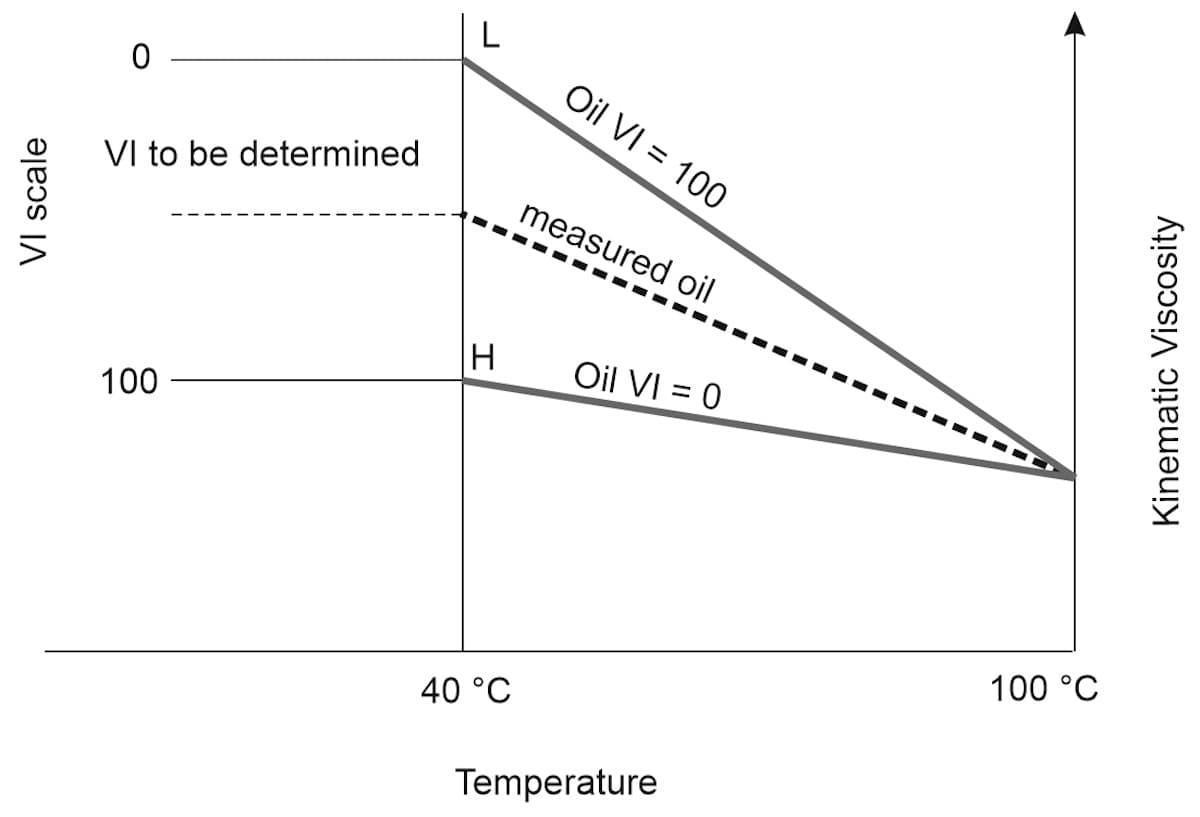
There are basically two routes to blend a multi-grade oil. You can use a synthetic base oil with a super high viscosity index or blend in a polymer additive that works as a viscosity index improver. You can also use a combination of the two methods.
These polymers have long chain molecules that shrivel up when cold and then expand when heated. The polymer does not slow the flow of oil at cold temperatures, but expands to reduce the oil flow rate at high temperatures.
If you blend two oils, one a single grade and the other a multigrade with a polymer additive so that both oils have the same viscosity at 100°C, would they both perform the same in a fully warmed-up aircraft engine?
Not exactly. You must remember that the viscosity measurement was made using just gravitational pull, but your engine operates at much higher oil pressure. This higher pressure can squeeze the polymer’s long chain molecules and even shear them down permanently, both of which can result in increased flow.
This is kind of a good news/bad news thing.
The big advantage for multigrade oil is in cold starting. During one test in the lab, we filled the crankcase of a test engine with Aeroshell 15W-50. After a short run-up, we let the engine sit in a cold room set at 20°F overnight. In the morning we cranked the engine and measured the time from when we started cranking until we had oil flow to all parts of the engine. We then did the same test with the single-grade Aeroshell Oil W 100.
The multigrade oil had oil flow within four seconds, while it took more than 10 seconds for the 100 grade. So that’s a definite advantage for the multigrade oil.

On the down side, multigrade oils tend to leak more than single grade oils. So, if you have significant leaks in your engine, you can expect more leaking with a multigrade oil.
This brings up the debate about whether switching from a single grade to a multigrade will harm your engine.
I have never seen that.
If your engine has oil leaks or you have loose intake valve guides, then going from a single grade to a multigrade oil will probably increase your oil consumption.
But if you do not have any significant leaks and the main source of your oil consumption is past the piston rings, then you will probably see a 30% to 50% reduction in oil consumption when going from a single grade to a multigrade oil.
This comes from improved oil flow in the ring belt area, which comes from improved efficiency of the oil rings.
The improved flow characteristics of a multigrade oil also help reduce the fuel consumption of your engine.
In a year long test at a large flight school, part of the fleet used Aeroshell 15W-50, while another part of the fleet used the single-grade Aeroshell W 100. The test found that the fuel consumption on the airplanes with multigrade oil was around 4% less than the part of the fleet using Aeroshell W 100.
These savings can help offset some of the higher price for multigrade oil.
But What Affect Will It Have on My Airplane’s Engine?
Earlier I noted that the high pressure in your aircraft’s engine can squeeze the polymer’s long chain molecules and even shear them down permanently, both of which can result in increased flow.
That leads some people to worry that this may result in increased wear over the long haul.
What I have found is that the increased flow with multigrade oil will offset the shear in most bearings that are lubricated hydrodynamically, like crankshafts and cams/lifters.
The only exceptions that I have noted is a slight increase in wear on some big radial engine master rod bearings and sometimes on exhaust valve tips, especially if the aircraft is operated in very high temperature conditions.

So What Oil Should I Use in My Airplane?
So, what is my best advice on which oil to use?
It depends on where you live and the climate that you fly in.
If you live in the middle part of the U.S., then mix it up with single grade in the summer and multigrade in the winter.
If you live in a warm climate, you can use a single grade oil year around. However, if you plan a trip north in the winter, add a multigrade oil change for that trip.
Actually, using a multigrade oil in the summer works well for most situations, but using a single grade oil in the coldest part of the winter can cause starting problems and even oil cooler congealing.

The use of synthetic oil way surpasses mineral oil. The molecular shear strength is 300 times greater than that of mineral oil, and synthetic doesn’t carbonize easily under great heat. This means that if you lose engine oil in flight the residual synthetic oil won’t fail as quickly as mineral oil.
The remark about lead is correct. Lead is not suspended as well in synthetic as it is in mineral oil (again, different molecular structure) but since the EPA is getting behind eliminating leaded fuels this will soon become irrelevant).
Synthetic oils are at about operating viscosity when you add them to your engine so the synthetic circulates rapidly where mineral oil has to heat up to operating temperature before it circulates, which can take as long as a couple of minutes.
Once the engine is running and normal temperatures have been achieved, all oils are pretty much the same. Modern mineral oils have additives, like synthetics, which protect the engine.
Phillips 66 recently came out with their “VICTORY”, in both straight and multi-weight oil,
that contains the Lycoming additive,
When I swung wrenches for a Cessna dealership, we used Aeroshell 80W in everything, all year long and never had an oil related problem. But one thing I found out from a well-known engine manufacturer is that using any synthetic engine oil where leaded fuel is used is not a good thing. The synthetic oil would not hold the lead and its by-products in suspension, and engine deposits would result.
What about multi vs straight weight for the average airplane flying around 50 hours a year? Any differences with corrosion inhibitors or synthetic vs mineral?
Thanks
If your aircraft flies for 1 hour a week, that should be sufficient to maintain the oil film on the cam and lifters.
I use Camguard to enhance the oil film retention on critical parts. It also scavenges carbon from the ring lands and other cylinder areas.