

Anyone who’s ever sat down to draft a family budget with a pad and pencil (or a spreadsheet), a calculator, and a strong drink, knows that there’s only so much money to go around.
For non-independently wealthy aviators, this means making choices: The panel upgrade or the family vacation? For the wealthier: A vacation home or step up to a twin…or a jet? Of course, for student pilots it comes down to eat or fly.
OK, I exaggerated.
But not by much. Getting a certificate can entail if not outright sacrifice, at least a major alignment of resources, especially for young would-be pilots.
So naturally, many readers were keen to know more about how the Albuquerque-based Southwest Aeronautics, Mathematics and Science (SAMS) Academy charter school we profiled recently manages to offer private pilot certificates to its students at absolutely no cost to the student.
K-12 Schools in the Land of Enchantment
In the state of New Mexico, there are both public and private schools serving K-12 students. And, like 43 other states, it also has public charter schools — publicly funded, but privately run schools — that offer a wide range of different academic approaches or academic focuses.
There are charter schools that teach in a dual language format. And there are schools that teach to non-native English speakers. There are schools offering individualized learning, or blended learning, or project-based learning, or mono-gender classes, or Montessori. There are charter schools that specialize in dropout re-engagement, as well as schools that offer dual college credit and others that focus on college prep. There are also schools that offer non-traditional hours.
Meanwhile, the academic focus of the state’s charter schools ranges from visual arts, to health and wellness, to technology, to community service, to environmental studies, to cultural identity, to performing arts, and of course STEM (Science, Technology, Engineering and Mathematics).
New Mexico has a 20-year history of charter schools, and there are now 99 across the state, serving an estimated 25,700 young people — roughly 8% of all public school students.
Funding K-12 in New Mexico
In many states, public schools are funded by local taxes. But in New Mexico, there’s a problem with that. You see, the state is home to both one of the richest counties in the nation and home to one of the poorest counties in the nation — with a mind-boggling $92,000 gap in median household income separating the two.
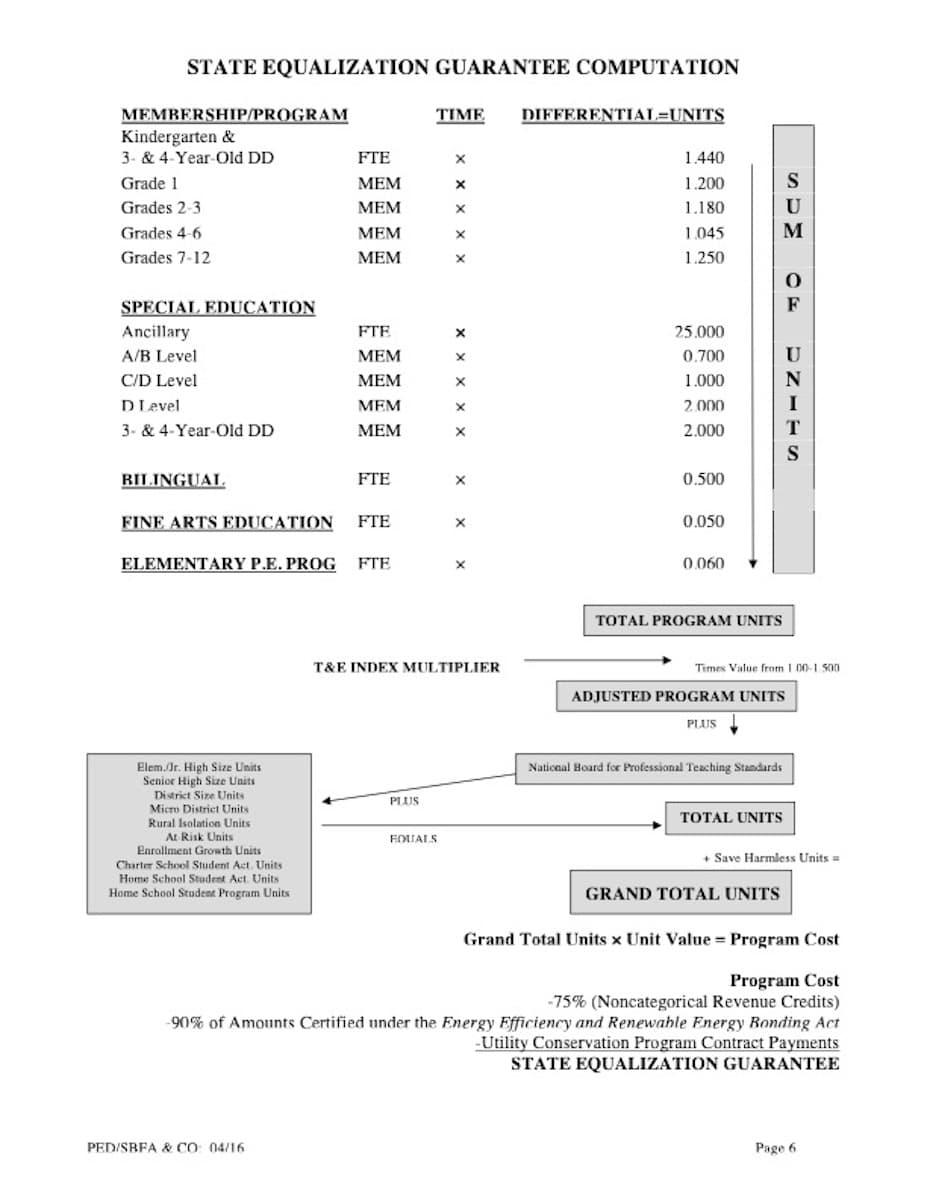
So instead of funding locally, since 1974, school funding has come from the state level and is distributed under a measure called the State Equalization Guarantee (SEG), which ensures every school in the state gets a fair share of the funding the state legislature allocates for education each year.
Under the SEG, public schools are funded using an arcane formula based largely on the school’s number of enrolled students. The state basically “pays” schools a set dollar amount per head to educate each student. Precisely how those funds are spent, however, is up to the school, the district, or the school board, depending on the local school’s structure.
How arcane? Well… you asked… enrollment at each level from K-12 is multiplied by a different base factor, which can range from 0.72 to 1.44, to adjust for the required student-teacher ratio. Next there is a staffing cost multiplier ranging from 1.00 to 1.50 to adjust for subjects requiring more experienced teachers. This is followed by nine different program unit adjustments ranging from 0.05 to…
Ah. I can see your interest dimming, so I’ll spare you the 17 separate components of the formula, but the bottom line is that over the last few years, the state has paid schools about $9,000, on average, per student, per year.
Some of the money each district and charter school gets is earmarked for specific programs or purposes, but approximately 75% of the funds received are discretionary.
Quoting a Legislative Education Study Committee fact sheet, “This allows local school officials to spend funding formula dollars to best meet the specific needs of their communities and encourages schools to minimize costs to allow funding to be used for other priorities.”
I added the italics, and you’ll see why in a moment.
SAMS Academy Priorities
From the beginning, SAMS was STEM and more, the “more” being aviation. After all, SAMS stands for Southwest Aeronautics, Mathematics and Science. The goal of providing no-cost pilot training to students (many of whom are from economically disadvantaged backgrounds) was the bedrock that the school was built on, and the funding from the state absolutely allows for it. So long as a school does its main job — educate the kids — the school can spend the lion’s share of its funding in any way it deems fit to accomplish its mission. Its charter.
But like our family budget, if we want to spend a ton on one thing, there is that much less to spend on other things. As pilot certificates aren’t cheap, where could the school “minimize costs to allow funding” for the priority?
That was the challenge facing the SAMS founders: Figuring out how to save money in other parts of the school’s operation so they could provide no-cost pilot certificates to every student who wanted one.
Saving Money to Spend Money
What are the big expenses for a school? Operationally, it’s the administration and faculty, so SAMS created a lean administration and kept teaching staff light by leveraging online learning, with the bulk of the academy’s curriculum taught online, supplemented and guided by a small group of onsite teachers. And mind you, this was long before COVID.
So, I can see some educators cringing. I understand that. But to be able to fund the goal it makes sense. At least it makes sense as long as the students are getting a good education.
Are they? Well, US News and World Report’s high school rankings show that the academy’s standardized test scores place it on par with the surrounding school district, and well ahead of the rest of the state. Considering that quite a number of SAMS grads have secured scholarships to Embry Riddle Aeronautical University, I think they’ve demonstrated success on that front. The academy also boasts a superior graduation rate compared to the rest of the state.
Bridget Barrett, who serves as the academy’s combined Head Administrator and Principal (lean administration, remember?), says that online learning also creates other opportunities for SAMS students.
She points out that it is self-paced, accommodating various learning styles, giving students the freedom to set their own schedules, allowing, for instance, students to maintain part-time jobs. In fact, she’s delighted that two of her students who received drone certificates through the school are now actually earning money, “at 16 years old” with those certificates while still in high school.
She notes that the online curriculum also reduces wasted time commuting, as most SAMS students, especially the ones in the higher grades, only come to campus two to three days a week to interface with live staff and strengthen the online learning.

Another place the school saved money for the mission — ironically — is in owning its own airplane. Actually, at one time it owned two, but operationally and financially it made sense to sell one and use the proceeds to upgrade the other.
But this one-plane fleet means that SAMS isn’t paying airplane rental for flight training, and the school operates the airplane at cost, with no profit built into each flight hour to drive up the hourly rate.
“Basically,” says Barrett, “it’s just gas.”

Additionally, the school’s flight instructor, Lauren Hollingsworth Chavez, is a salaried staff teacher, who also teaches the ground school classes.
The school also leverages every no-cost resource it can find to pinch every possible flight-training penny, such as Young Eagles flights, and using the free student resources from Sporty’s Pilot Shop (including the company’s Young Eagles vouchers that pay for a flight lesson after student pilots complete Part 1 of the Sporty’s Complete Pilot Training Course, which itself is available at no-cost from the company for young people who’ve taken an EAA Young Eagles flight).
And lastly, doubling up on training stretches each gallon of that gas by maximizing what Chavez calls “butts in seats.” Every training flight has three students onboard: One flying, two observing.

While the school doesn’t have hard and fast numbers (as every student pilot varies) officials estimate creating each private pilot costs the school about $6,000, a considerable savings over the national average.
According to Bob Rockmaker, president and and CEO of the Flight School Association of North America, his organization estimates that the national average cost of a private pilot certificate has risen to “around $16,000.”
But there’s one area in all of this where SAMS doesn’t cut corners to maximize dollars, and that’s on flight time. Most SAMS pilots have about 60 hours in their logbooks when they go for their check rides.
And while Barrett admits that it would be “cheaper for the school to NOT give students this opportunity,” and she says that most aviation-themed high schools don’t, she feels that ensuring every student who wants a private pilot certificate gets one, “is the highest priority of the institution.”
And she adds, “it was online learning that made that possible.”
Not for Everyone
Wait a second…Who wouldn’t want a free pilot’s certificate?
Well… some of the students are planning non-pilot aviation careers. Others have no interest in aviation, per se, but liked the other STEM aspects and self-paced learning of the academy.
And, of course, these are high school students we’re talking about. They have many competing interests, and the certificate requires substantial dedication in terms of study and training that is above and beyond the rigorous academics at the school.
Plus to keep training “frugal and efficient,” as Chavez labels it, flight students are required to fly at least two times a week, with no regard to vacations or holidays.
All told, since its inception in 2010, SAMS Academy has trained 24 junior and senior high school students to the private pilot level, with the numbers per year ramping up over recent years. While that might not sound like a lot, it’s 100% of the students who were interested in — and willing to work for — the opportunity.
Future Focus
When SAMS started out, most people had never even heard of STEM. These days, it’s been widely adopted, both by other charter schools and traditional public schools.
“Now everyone is doing STEM,” says Barrett, so SAMS is adapting to stay on the cutting edge. It has a new focus, a new building, and soon… a new name (still Top Secret) that will better reflect its future path.
And while the new name is still under wraps, the large airplane motifs framing the front entrance of the new facility makes it pretty clear the course the school is charting to the future.
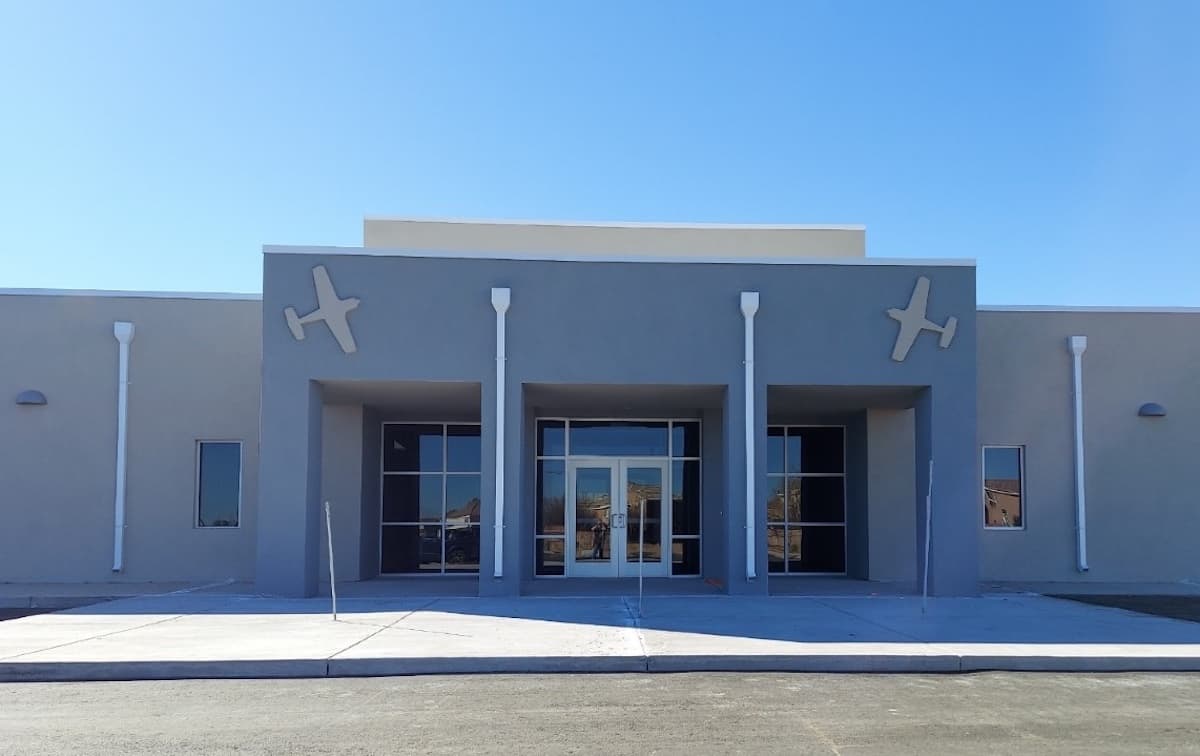
A grand opening for the new building was held Feb. 17, 2023.
STEM will always be in the school’s DNA, according to Barrett, but the academy is beginning the shift into becoming a true full-fledged aviation school, where the world of aviation will be embedded in every subject and at every level. Language arts will be reading and writing about aviation subjects. Psychology will look at human factors in aviation. Math and science will be studied through the lens of aviation.
And the new focus won’t be just about pilots. Barrett also has her sites set on adding an ATC track and an A&P track as well — both of which the school is actively seeking grant money to launch. And being based in the home of the Albuquerque International Balloon Fiesta, Barrett would also ultimately like to have a lighter-than-air track.
Barrett, who started off at the academy as an instructor and worked her way up to the top spot at the school, says she has loved her connection to the aviation community, which she describes as an incredibly “beautiful community” that has provided a lot of support to the school in donations of time, gear, and — occasionally — money.
But it is the state SEG funding system, and the priorities of the school’s charter, that made it possible for SAMS Academy to add 24 young private pilots to the nation’s roster — at no cost to the students.

SAMS (and SSLC) used to have a fully operational ATC curriculum (complete with 8 month internship with Albuquerque ARTCC/Albuquerque TRACON/Albuquerque Tower and Double Eagle II Tower – 2 months at each facility), A&P curriculum, and Aerospace Engineering curriculum in conjunction with offering both Private Pilot (junior year) and Instrument ratings (senior year). Further, they were all Dual Credit classes (meaning the students received both high school and college credit simultaneously). What happened? Why the downgrade in the program?
No downgrade – e-mail me: [email protected]. 😊
What a great story, inspiration and model for others to follow! I love this story, the ingenuity and foresight to change the precious lives of our future aviators! So proud of this school! A&P, ATC and airport management would be wonderful additions! God bless!
Thanks, Karyn 🙂
The school does not mention maintenance, especially with only one aircraft. Is there an A&P mechanic/IA on staff? 100hrs.? With one plane, that means they don’t fly when the aircraft is down. Just wondering how all that is workedout.
No A&P on staff, Susan – when the airplane is down for maintenance, the students are all “grounded”. BUT, we have a WONDERFUL A&P/IA (David Robertson, of Robertson Aircraft) who takes very good care of us – to keep our kids safe and in the air :). We couldn’t do it without a great team of people who appreciate what we are able to do for these kids!
I think this is great. Yes, I too wish such an opportunity had existed when I was in school, but I’m happy to see the aviation community benefiting from this. I would love to see this type of program more widely available and branch out to other aviation job fields – especially maintenance.
We couldn’t agree more, Jon. We are actively working on AMT options 🙂
Demoralizing for the rest of us who had to work for it.
Sigh, born wrong place wrong time