


Frederick Municipal Airport (KFDK) in Frederick, Maryland, has two paved runways — plenty of space for a wide variety of aircraft to arrive and depart the area.
Runway 12/30 is a hair shy of 3,600 feet in length. Runway 5/23 is both longer and wider, clocking in at more than 5,800 feet long and 100 feet wide. Heck, even I can put an airplane down on that.
On the east side of the field, well away from public roads and traffic, sits the control tower. Or rather, the new control tower.
Opened for business in May 2012, this utilitarian building stands 106 feet tall against a backdrop of forest that lies beyond the airport fence. Topped with a traditional looking cab suited for two to three controllers, this is a structure that’s easy to see from anywhere on the field.
An absolutely powerful tool in the battle to maintain the safety of free-flowing air traffic, the tower stands as a testament to practicality and austerity. There’s nothing glamorous about it. Yet, it works. It does what it was designed to do. That’s enough.
Due west of the new tower, the old control tower and terminal building still stands. Thank goodness. Short, boxy, small, and totally impractical as a functional control tower, this squared-off World War II-era design has found new life as a restaurant, a snug airport administration office, and a tip of the hat to a time gone by that should be remembered.
The City of Frederick purchased the property KFDK sits on in 1945. Within a year construction had begun on what was considered at the time to be a thoroughly modern airport. Three grass runways graced the master plan. Two were 2,600 feet in length. The third nudged up to nearly 5,000 feet. A truly impressive and highly desirable public project for the post-World War II era.
The first landing on those runways happened in 1949 when a Stinson piloted by a fellow named A. B. Sutherland touched down on an April evening, right around 5 p.m. The terminal building was described at the time as “ultra-modern.”
A local newspaper described the interior as having a “combined lounge and lobby, two private offices, two rooms which can be used as offices or a dining room and kitchen, restroom facilities, and properly located corridors, baggage passage, ticket counter, janitor’s closet and public telephone locations.” All this was located on the first floor.
Stepping through the doors today, it’s hard to imagine how small those rooms must have been. Yet, for a public just getting used to the idea of flying machines being housed in their neighborhood, this must have been a tremendously exciting place.
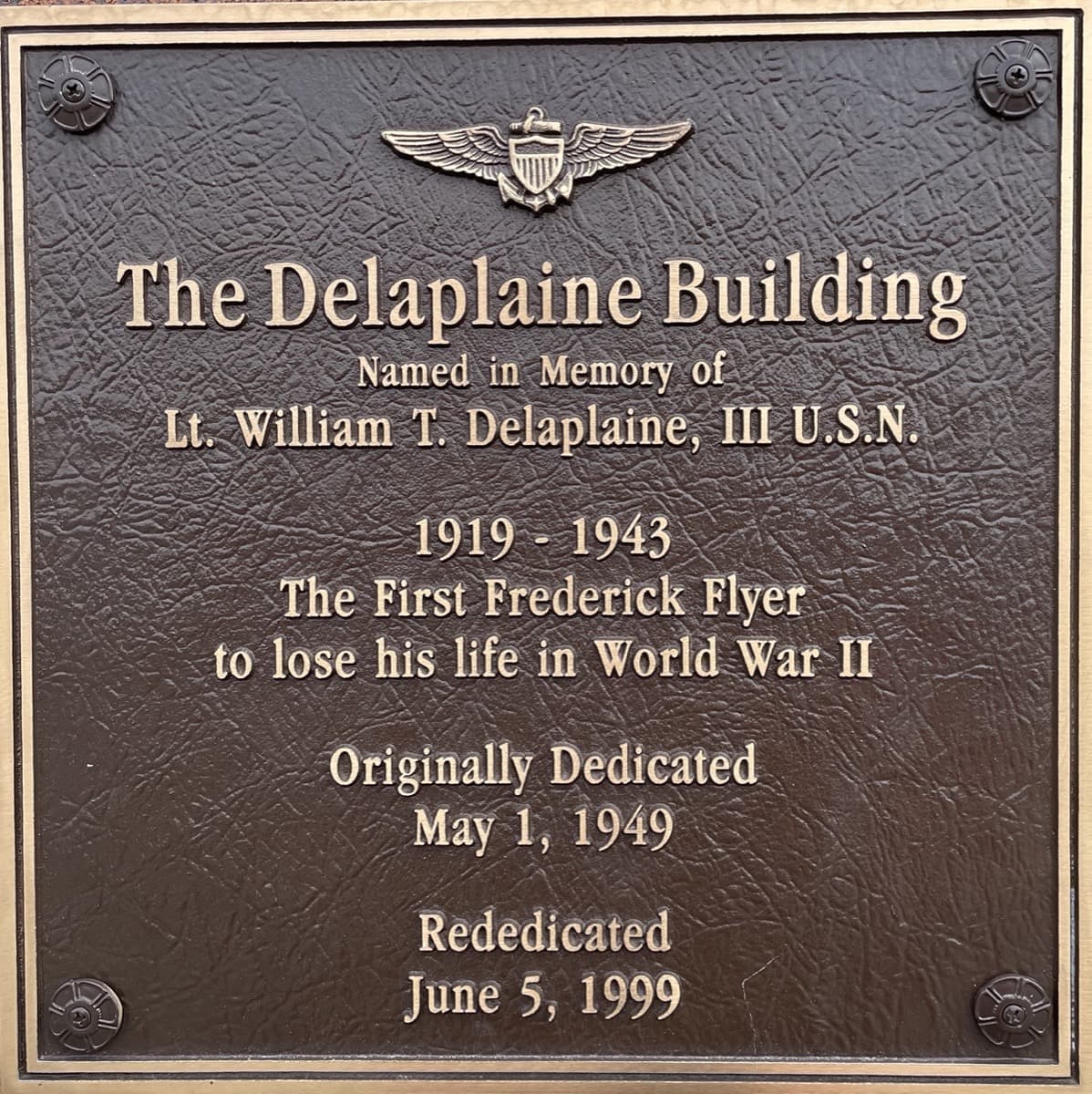
The building is now known, at least officially, as The Delaplaine Building in honor of Lt. William Delaplaine III. A native of Frederick, Maryland, Delaplaine achieved his status as a Naval aviator in 1940, well before the U.S. joined the war effort. He was just 23 years old when he and seven fellow naval personnel were killed when their transport aircraft crashed near NAS Oakland, California, in 1943.
Today he is remembered in the form of a brass plaque at the entrance to the building, which primarily functions as a restaurant called The Airways Inn.
When in Frederick I often stop in for lunch at this classic building. The food is good, the service is better than average, the prices are reasonable, and the view is excellent. From my seat at the window I can clearly see the new tower looming on the opposite side of the field.
I prefer the old tower, however. And not just because I have a propensity for a high calorie lunch now and then. As with all things aviation it’s about the people.
That’s what hooked me all those years ago. The people are still what enthrall me.
It was Dec. 7, 2023, when I most recently took up space in The Delaplaine Building. Pearl Harbor Day. I hadn’t realized how that would matter when I set off to grab lunch. But it did.
The Airways Inn is sectioned into three relatively small rooms. I was seated at a table for two on the south end of the building. Not the main room. One of the two smaller spaces. Facing the windows that look out over the ramp and runways. I sat alone.
This is the kind of place where it would be entirely appropriate to substitute the term “intimate” for “small.” The tables are close together, but the layout works. Beside me was a larger, round table. A small gathering of old men took up residence there. Regulars. They greeted the server by name. She reciprocated by using theirs.
As we ate, the old men told stories of their recollections of the Dec. 7 of their youth. Too young to be in service at the time, they had older siblings and neighbors who were of age to serve. They watched the world through a different lens than we do today. Radio and newspapers brought them news — mostly bad — in a time when it seemed the whole world was headed for disaster.
They spoke of pride, of fear, concern, and hope. They related stories of their own service years later in Korea. And I suspect they reflected back on a time when this busy GA airport on the edge of town was served by the very building where we sat. When piston-powered airplanes ruled the skies. When grass runways were considered modern and efficient. When the future was as uncertain as it ever was, but far more immediately intimidating than it is today.
It was Pearl Harbor Day. That really meant something to me. Framed by the conversations of old men who had been just boys when Hawaii saw its darkest day. While I enjoyed a delightful lunch in a building named for a Navy man who perished before the first bombs dropped.
Thank goodness someone had the presence of mind to preserve and rededicate The Delaplaine Building. Long may it reign over the ramp at KFDK.
May you preserve the history of your towns and cities, too. That history tells a story that has real worth.

Great history! Thanks for sharing! Just a note, the current building on the West side was never a Control Tower…. There was a weather station upstairs, a terminal, administration offices, but never controllers.
My hangar mate is 84 years old, and first soloed at KFDK in 1959. He has great stories!
This blog post really struck a chord with me! It beautifully captures the rich history and character of the Frederick Municipal Airport, weaving together tales of aviation milestones, architectural preservation, and personal reflections.
Does anyone know what type of aircraft
Lt Delaplaine flew as a Navy pilot ?
The battle of Guadacanal wrapped up early Feb 1943. Wonder if he was returning to the states from that battle ?
Yes Jamie, I read and think about every word you write. Delaplaine lost his life in 1943, while the “first bombs were dropped” in 1941. He WAS though, the first Fredrick aviator to perish in the war. Thank you for another one of your enjoyable articles, and Merry CHRISTmas👍😀
Scott, you caught me in one of my periodic brain fades. When I wrote the piece I was thinking of the date Delaplaine was given his wings (1940), when I should have been thinking about the date he was killed (1943). I got that wrong, as you suggest. The bombs dropped on Hawaii in December 1941. Which makes Lt. Delaplaine even more deserving in my estimation. He signed up well before the war brought throngs to the recruiting stations in a wave of patriotic fervor.
I apologize for the error. Small as it is, I should have caught it before the piece left my hands. Thanks for caring.
There is an old tale I’ve heard more than once around Frederick. It is usually told in hushed tones in a group of aviators enjoying a post flight beverage in or around a hangar at the end of a day of flying. It involves two aviators, both of whom are alive today who, upon finishing up a rather long day of flying, sat down at a picnic table on the grass outside the terminal building and watched the deepening shadows as the fireflies came out and a summer evening settled across the airport. This was many years before the control tower opened up in 2012. These two aviators, both of whom were old enough to know better, opened up a short case of fermented, malt beverage and proceeded to knock of the entire dozen, one at a time. As their consumption increased, like any other gathering of aviators, so did the questionable veracity of the tales they spun. For reasons unclear to this day, one of them suggested that they climb atop the roof and take a ride on the rotating beacon. One chose the green side, the other chose the white side. And around and around they went. I’ve verified this story from several people who know both parties involved very well and I have no reason to doubt it.
Thanks for sharing that story, JJ. It’s absolutely believable. Pilots! What are ya’ gonna do with ’em?
Wonderful article, Thank You! I well remember as a member of the Civil Air Patrol at 14 in 1960 being there for a drill. That was in an era when you could still walk out on the tarmac at Friendship to see your father off in the big Connie’s of the day. There were no fences around the airports, and we young kids would wash and wax a plane for a spin around the pattern. That all seems gone here in the East and I’m not so sure it’s a good thing. Thanks again for taking us back for a look and General Aviation.
Great story and i am glad the town fathers let this place open…..I like the fact that there are regulars as my airport restaurant, a great meeting place and a busy place too