


You’ve heard of SUN ‘n FUN, of course. Perhaps you’re also familiar with Buckeye Air Fair, or the Pacific Airshow, or Wings Over Houston, or possibly Thunder Over Michigan.
EAA AirVenture Oshkosh, which is going on now until July 27, may be the granddaddy of them all, but even that amazing gathering owes a tip of the hat to those that came before.
Long before — when pilots were true risk takers. Airplane designers were largely guessing what would work and what might not. And wrecks were often more common than successes.

The airplane was proven in December 1903 on a windy North Carolina beach. It was yet another great American invention that would change the world. But the air show, the celebratory gathering of the curious and the fully committed, was born in Reims, France, 116 years ago.
Welcome to the state of the industry in August 1909.
The Grande Semaine d’Aviation de la Champagne lasted eight days. It’s estimated more than 200,000 attendees swarmed the grounds to marvel at this new technological achievement mankind had brought forth.
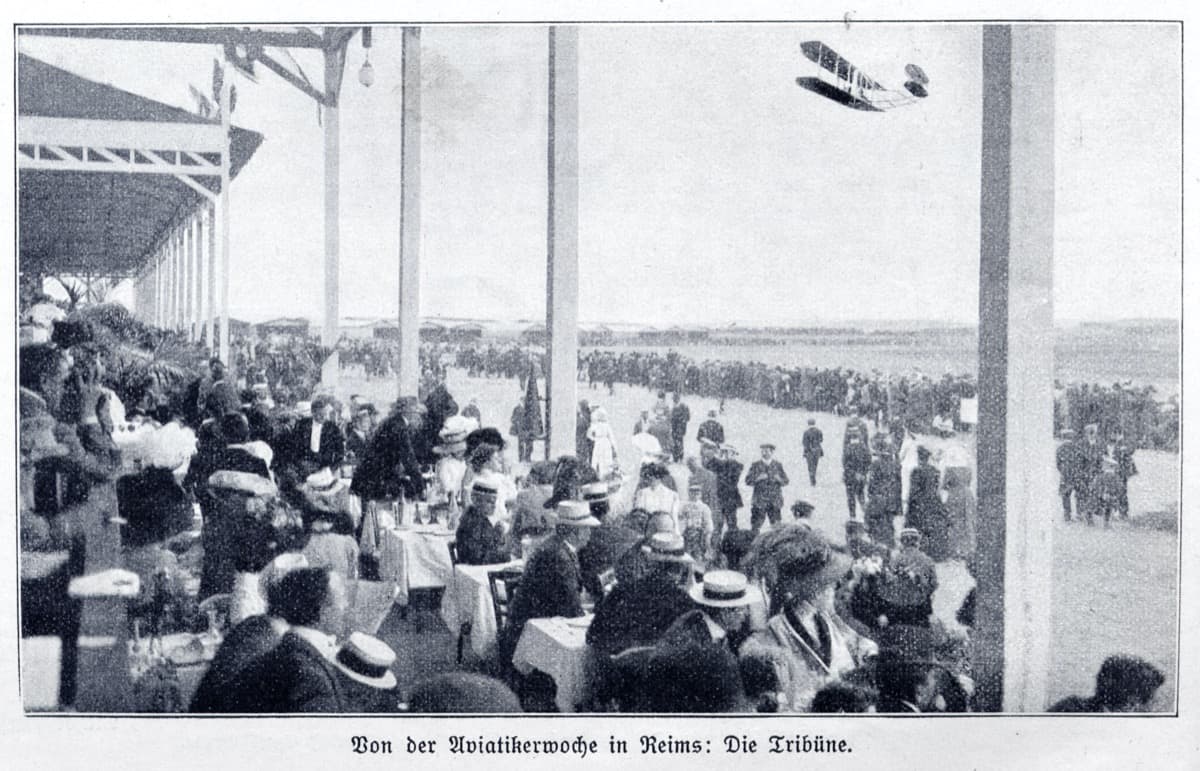
The true luminaries of the industry were on hand for this historic event.
A Frenchman named Hubert Latham was there. Largely lost to history now, Hubert was the first intrepid flier to attempt to cross the English Channel at the controls of an airplane. An Antoinette monoplane to be specific.
Latham failed due to engine issues. In fact, he only made it about seven miles into the Channel before being brought down. Although he fell short, it was a noble attempt that was much celebrated. Being bold enough to make such an attempt placed him in the upper echelon of aviation pioneers and technological leaders of the day.
Louis Blériot succeeded in making a flight across the English Channel just weeks after Latham’s failure and weeks before the Reims show. It is true he essentially crashed at the end of the flight, but he crashed in England. Not in France. Not in the Channel. His was a brilliant achievement.
Louis flew the Blériot XI, an airplane he’d designed and built himself. Interestingly enough, his aircraft was powered by a three-cylinder Anzani engine. These early powerplants produced what was considered to be impressive horsepower for their weight, but lacked what modern pilots would consider to be reliability. The Anzani developed a tendency to blow a cylinder head off during flight. A true inconvenience, as you can imagine.

Fortunately, there was a fix for this vexing issue. Mechanics took to wrapping a steel cable around the radial engine’s cylinders to cinch them down tight. Following that modification the number of cylinders departing in flight diminished significantly. It’s worth noting that particular practice was not FAA approved then — or now.
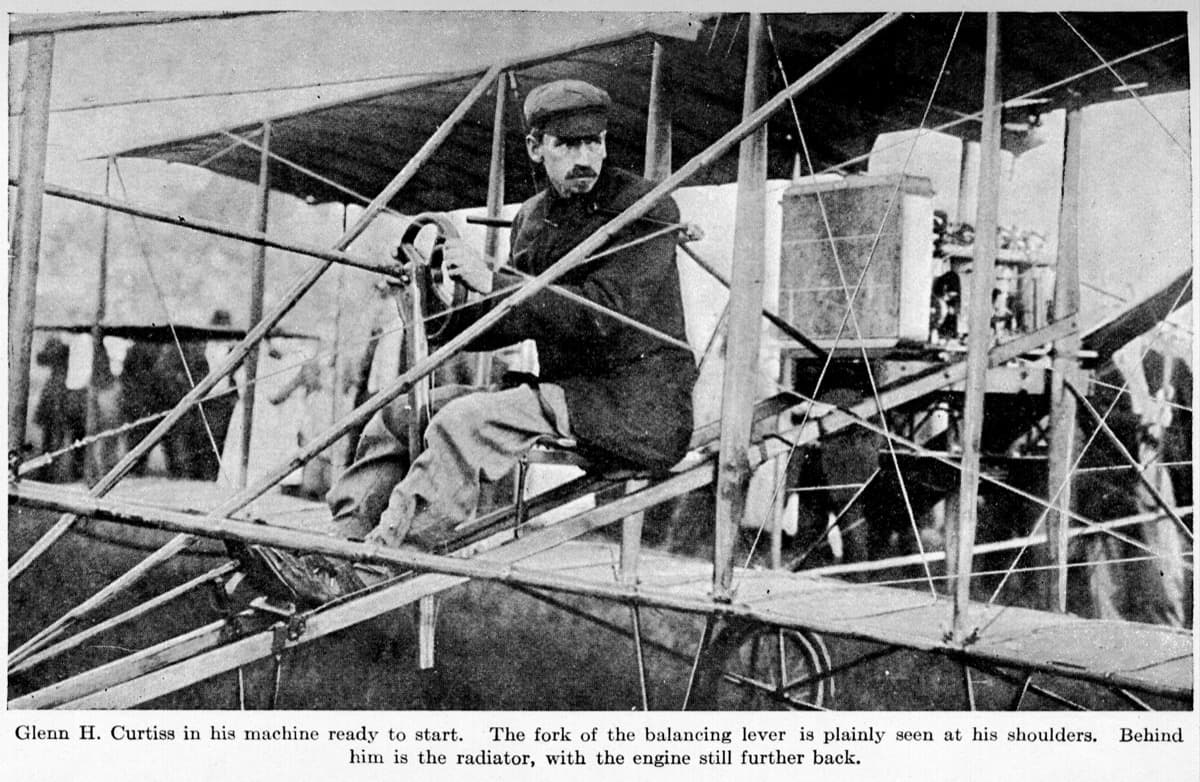
American designer, pilot, entrepreneur Glenn Curtiss was in attendance as well.
Flying the Curtiss Reims Racer (Curtiss Number 2), he acquitted himself respectfully. Curtiss and his airplane continued their tour after the Reims event, eventually setting a new, blistering airspeed record of 55 miles per hour in October of that year.
Speaking of records, many were set at Riems. Henry Farnham flew an almost unbelievable 110 miles — a distance that was virtually inconceivable at the time. He also wowed the crowd by completing a lap around the racecourse while carrying two passengers.
Yes, traveling slightly over 6 miles in flight with three people on board was a nearly unimaginable feat.
Hubert Latham may not have made it across the English Channel, but he did achieve the dizzying height of 509 feet. An altitude that was not just respectable in 1909, it was flat out incredible.
Louis Blériot set the single lap speed record in a three-lap race. He clocked in at a withering 47.8 mph but did not win the event as he suffered a spectacular crash before the final lap. Glenn Curtiss and his Reims Racer took the prize in the end with a final time of slightly more than 25 minutes for three laps around a 10 km course.
Imagine traveling roughly 10 miles in under half an hour. Astounding!
This is where it all started. Even now more than a century later we flock to a wide-open field to see what technology has brought us this year. We witness pilots doing the seemingly impossible, while knowing that training, study, and practice would allow pretty much any of us to do something substantially similar — provided we can handle the physical punishment of the task.
Can you imagine the conversation if Louis, Glenn, and Hubert could wander the rows of aircraft on display at EAA AirVenture Oshkosh 2025? Enclosed cockpits, radios, GPS, ADS-B, flaps, stall strips, winglets, ballistic parachute systems, multi-engine aircraft, carbon fiber, aluminum monocoque construction would all be a revelation to them. Advancements we perceive as being relatively pedestrian would blow their minds.
Oxygen systems for high altitude flight! Cruising speeds measured in the hundreds of miles per hour! For goodness sake, our traffic pattern is nearly double the altitude record Hubert set in Reims way back when.
And let’s not even consider the cardiac emergency that might occur if they were to witness an eight-point roll, a loop, an Immelmann, or heaven forbid…a Lomcvák.

Air show season is amazing. It was then. It is now. We get to see, hear, touch, and emotionally resonate with some of the most remarkable machinery on the planet, managed by a collection of tremendously talented folks. And in some cases, we even get to ride along or take the controls ourselves.
Consider the most pedestrian general aviation airplane on the field. One we might consider to be underpowered, with a cramped cockpit and antiquated instrumentation. To the pioneers that airplane would be a marvel. Their reaction to what is not just possible but common would be analogous to us being thrown into the cockpit of a Falcon 9 capsule during a launch sequence. Something that happens frequently — but not for most of us.
We are luckier than we know. We’re more advanced than our grandparents believed possible. And we’re here.
Make the most of it. Every minute. Every relationship. Every day. The air shows are worth the trip from anywhere.
