

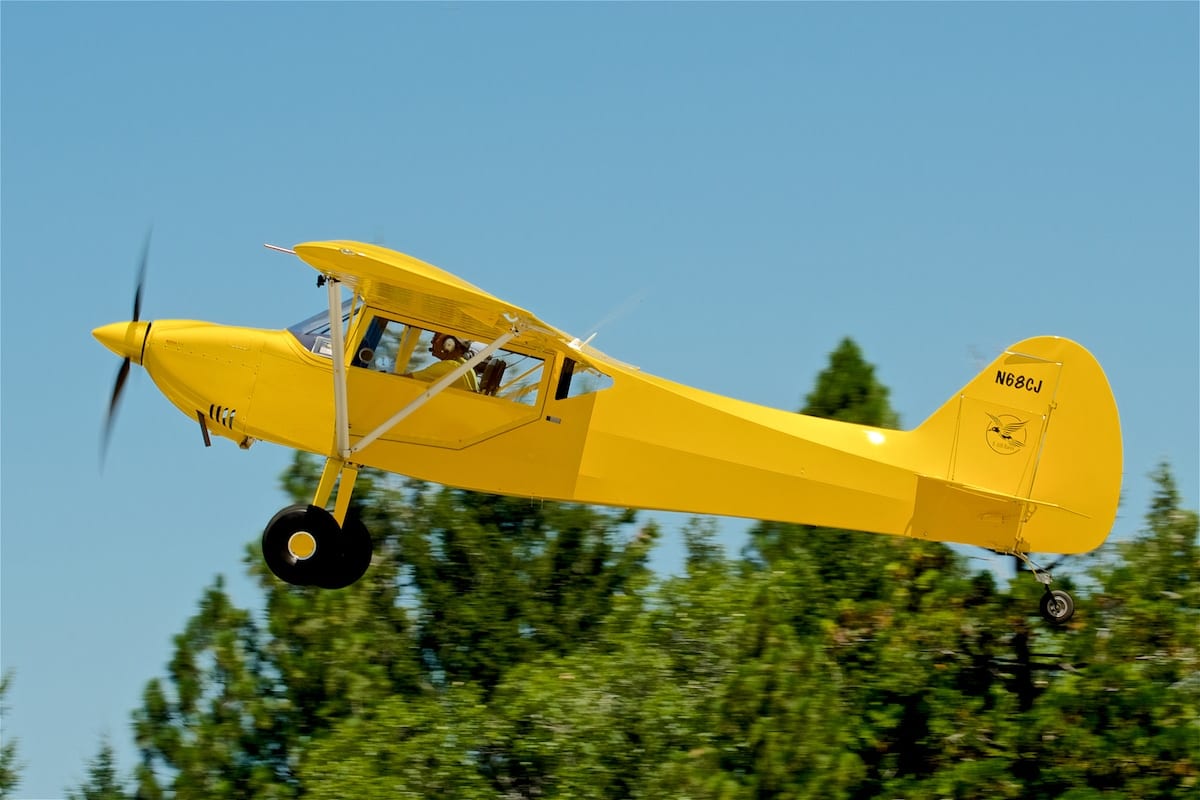
There is a moment experienced during every flight that I find particularly gratifying.
If I were to boil down the reason I’ve been so attracted to airplanes and flight over the years, it might come down to this one consequential event. There is an emotion to the moment I cannot fully articulate, but I suspect everyone who flies has a soft spot in their heart for it, just as I do.
As the airplane gains speed, I track the centerline of the runway. Within the first hundred feet of my takeoff run I monitor the tach to verify I have sufficient power to proceed. I give a quick glance to the windsock to be sure the wind hasn’t shifted or unexpectedly increased in strength or direction. All the while my feet are dancing on the rudder pedals to keep the nose of my little flier pointed into the wind.
As we accelerate along the length of the runway the airspeed indicator comes alive. Within a matter of seconds, just a few hundred feet from where I started, it happens. My landing gear gets light, it lifts from the surface of the earth, and we are airborne. The airplane and I have taken flight.
We were on the ground. Now we are not. The transition from one state to the other speaks to me.
The moment is subtle. It’s almost imperceptible at first. Within just a few seconds of flight our increasing altitude over the world below becomes undeniable.
The airplane and I have left the ground-pounding nature of mankind behind in order to take on a new environment. One that is foreign to our kind, but manageable for those who are bold enough, smart enough, skilled enough, and humble enough to operate the machinery that allows human beings to go where our species was never intended to be.
That last concept is one of far greater importance than some of us realize — to our great peril.
Man was not intended to fly. We do not have the physical attributes of a bird, or a bat, or even a flying squirrel. Flight is not included in the operating manual for the human form.
Yet, through determination, grit, and gumption, the men and women who came before us developed technologies that would allow virtually any of us to fly. The caveat being that we only enjoy this luxury provided we maintain the ability to operate the machinery responsibly, with care, and in a manner that is not a danger to others.
Each and every one of us must accept our limitations as a human being. For all the affection we have for flight, for all the pride we feel for earning our mastery of the air, none of us is immune from the processes that will one day render us unable to fly safely. This ride will indeed end, for all of us. As sad as that may be, it is the truth of our situation.
The events of July 21, 2025, should make that point crystal clear to one and all. This was the day that saw the pilot of a small general aviation airplane depart on a relatively short pleasure flight to a destination thousands of their fellow pilots sought out on that same day. The unavoidable difference between this particular pilot and the thousands of others sharing the airspace with him was this — he was unforgivably unprepared for the flight he himself initiated.
His decision to fly unprepared put others at risk.
There should be no dissent on this point. No excuses. But there will be. For we are loathe to accept our own fallibility — even at the risk of our own lives or the lives of our neighbors. A minority of us find it too painful, too much of a personal affront to walk away from our aeronautical pastime. This is true even when the writing on the wall is spelled out in big, bold, blinking neon letters that read; “It’s time to hang it up, Bubba.”
For VFR pilots the path to EAA AirVenture Oshkosh is not a mystery. It’s published and widely disseminated. Known as the FISK Arrival, the procedure is designed to allow the otherwise sleepy town of Oshkosh, Wisconsin, to become the busiest airport in the world for a few days each summer.

It is specifically because pilots accept and commit to the FISK Arrival procedure that AirVenture can occur year after year with such a high degree of safety. It is a fact of life that the only reason literally thousands of aircraft can descend on KOSH in such an organized fashion is the existence and acceptance of the FISK Arrival procedure.
Until one lone pilot decides to fly to KOSH on the busiest day of the year without familiarizing himself with the procedure. This pilot decides that he’ll go as if on a whim. When his confused antics become disruptive enough that ATC recommends he divert to another destination, he declines and persists with his own plan.
In effect his attitude becomes one of, “I wanna go where I wanna go even if that means I need the busiest control tower in the world to hold my hand every step of the way to keep me safe from my own shenanigans.”
That attitude is unacceptable.
I gave up flying from the left seat earlier this year. Not for a lack of desire, but rather because of an issue that affects my eyesight. I’m fine most of the time. But sometimes I’m not. I occasionally can’t see well enough to fly safely. So, I stopped.
I’ve been flying since the mid-1980s. I’ve loved the experience. On a handful of occasions, I’ve scared the bejeezus out of myself. Flying is like that. Like all pilots, I accept that. Yet I have no problem looking myself in the mirror, assessing my condition, and calling the game on account of my personal clock running out.
The challenge is not with this one errant pilot. It’s not about my flying career coming to an end. It’s about all of us accepting reality as reality.
Personally, I would very much prefer to pull the plug on myself rather than having the FAA do it for me. Or worse, those gathered at my funeral whispering quietly, “He should have stopped flying.” Worse yet they might say, “It’s a shame he took those other folks with him.”
The truth may be ugly, but it’s still the truth. We would all do well to face it head on in a responsible manner.

Don’t walk away cold…..fly with an instructor, go to the seminars or give a seminar. Yes crawling around and under an aircraft is hard sometimes, but i offer owner assisted annuals where the owner has the plane open and I can easily inspect it and keep going that way.
Fly with a friend a sic……and do go to airport coffee shops and hang around the airport and hangar and help with ever you can……
Keep going the best you can ……
regards to all
I had to stop flying for medical reasons. But, I transitioned to a different kind of flying… on the ground.. RC Aircraft. I joined a club. Frankly, it was harder to learn than GA flying including IFR! I also fly drones. Sure, I miss flying in the left seat, flying between the full moon and a cloud layer right below… that moment when the ILS becomes alive and I glide down that invisible corridor of radio waves.
I have my memories. But what I am doing now with RC is safe and challenging. At some point I know one day I may not be able to tolerate the heat here in the mid Atlantic or something may limit my ability to continue RC…. But, not yet.
It’s all just a matter of acceptance, understanding our own limitations. Back in the day before the Internet I used to read accident reviews hoping to learn from others mistakes. But this is different, it about accepting our own limitations.
I am 81 years old and I have flown for 51 years. I have owned my Cessna 180 for 48 years and I’m having a hard time giving it up, but I have finally come to the conclusion that I need to sell my airplane and quit flying. I am just not as sharp as I should be. Owning a plane for that many years giving it up is almost like giving up a family member. I have such great memories over the years, flying my family in the plane and traveling from north of the Arctic Circle to as far south as Texas but I just have to bite the bullet and sell it
Much like the milk in the refrigerator, piloting has a “best if used by…” date. The insurance company helped me identify this date. I knew the last flight I would ever pilot. I landed in a major rainstorm, only the water works was on the inside of my glasses.
I saw my mistress for sale yesterday. She is still as lovely as the day I picked her up, and the day I passed her to her next companion. Should I??? Perhaps not. Alas, she has aged more gracefully than I.
I have hung up 55 years of piloting and aircraft ownership for all the good reasons previously mentioned. I will always belong to AOPA as it is a good source to tap for up to date info regarding aviation. The love of flying for me will never go away and leaving the cockpit has been a psychological struggle which thankfully has diminished as time goes on.
For those who have considered an at home simulator, there are only 2 providers that I would suggest you consider: X Plane 12 and Microsoft Flight Simulator. My choice is X Plane 12 as it is more of a pilot’s simulator rather than an emphasis on scenery and “gaming” in my opinion.
In addition, Microsoft charges a monthly fee after the initial expense of the purchase to participate, while X plane does not. At the end of the day, the choice is yours after visiting both provider’s sites to make a personal decision. Not sure if Microsoft offers a free trial, but I can confirm that X Plane does. Both providers will indicate the computer requirements and the hardware brands (yoke, stick, rudder pedals) that will make it all work. Both also have support group websites to answer questions.
At the end of the day, nothing will replace the joy of actual flight, but the simulator is better than nothing, reasonably priced and extremely safe. It has helped me move on.
I read the various comments about retiring as a result of age and agree fully. I am 86 years of age,,. owned and operated my own flight school, no longer instructing and sold my personal plane. What to do now? I invested in a flight simulator with all the bell and whistles allowing me to fly anywhere in the world in an aircraft of my choice shooting various approaches etc. Not the same as being in an actual aircraft but does stimulate my mind and keeping me in the world of aviation contacts and its related upgrades. I am renewing my instructor ratings even though I no longer instruct in the air but allowing ground instruction. This has helped me make the transition from active to retirement so to speak.
I am getting there but ….not yet……I stopped multi training and night flying as well as actual IFR……No desire any longer to do those types of flying….
Still doing maintnenance and annual inspections on aircraft and FR’s and IPCs
The time is coming and when it does I will stop…….
Probably still hang out at airports and go to meetings…..and give seminars…..and discuss safety
Thanks for the article…..
Jamie, are you saying that you have stopped flying? I didn’t think you were that old. I have stopped flying about 8 years ago because of my age and also because I don’t have anything to fly. I retired from TWA with more than 25K hours from when I soloed in 1964 but I am now 86 years old and I feel it’s time to give it up. But I really do miss it!
Yes – it hits us all – age. If we are fortunate.
At 85 I thought about it and how I’d swapped a flight to somewhere and trailered instead. Different wonderful trips. It was time after 14600+ in the air.
So all the ratings and IA and what not turned in.
A relief from those responsibilities in a way.
God provides.
Phases of life are passed through.
I really appreciated this article. It brought a tear to my eye, because I too just had to stop flying because of an age related thing that I had thought wouldn’t happen to me — memory issues.
For now, I’m still OK driving a car. But I’m suspecting that one day I will have to give that up too.
Great article, surely made me think and stop crying about my age and flying skills. Yes I made the decision, the wife did help, she called it downsizing. I called it “It’s time to quit. Sold my airplane, gave up my A&P and IA and a bunch of ratings. It Was Time.
Way to go, Like a man. Responsibility to oneself and others up in the blue skies and on Terra Firma. We’ll done.
It should never be…”I’ll hang it up when I can’t pass my medical” There are many factors that need to be prioritized into that decision. Just as before each flight you need to decide if that flight can be completed safely. Not just by the rules but by our abilities and state of mind……
A well said article that stands along against all the internet “experts” who lack compassion, care and concern for the individual. 09R is unfortunately burned into the brain cells of thousands. Yes, he put others at extreme risk. Yes, he really fell below the standards we all hold true. This sort of mistake brings out the self-righteous among us. But he’s still a human being. Still one of us. We can point to the failures, but let us not forget that but by the grace of God, we are all going to be at some point, aged out in flying. And the aviation culture we hold dear says that confession is good for the soul, humility is the way we learn, taking care of each other in the traffic pattern is the way we fly.
Jamie … Well done.
May l suggest you invest in a good computer driven Flight Simulator?
That’s a way to stay connected with aviation, and even fly some of the “heavy iron” that you never imagined you’d be able to fly.
You can view the world you’ve been too, as a tourist or venture out to places you have never seen!
I’ll admit however to “one thing!”
Computers can be VERY FRUSTRATING for us “old timers!”
“Good luck”and “best wishes.”
I’ve always appreciated you articles.
85 year old Dave … (a longtime AOPA member and Flight Simulator Guy.)
The article is interesting reading about when to “hang it up”, but I fail to see what it had to do with the pilot flying into and out of AirVenture.
Has the pilot been interviewed? Age? Experience? Was it intentional, or just stupid?
Maybe entitlement?
There is this old saying, “One day you walk out to your aircraft knowing it’s your last flight” then there is “that day you walk out to your aircraft not knowing it’s your last flight”, which has nothing to do with age.
I’m a much more safety conscious pilot now than I was in my younger years. I now only fly when the weather, winds and aircraft conditions are perfect, otherwise I stay on the ground. I know my day will come but i will continue to fly as long as I feel confident and comfortable with my skills.
Well said by all. A Wise Man once said: “A man/woman must know his/her limitations.” Knowing such contributes to longevity. Ignore at your own peril.
Regards/J
What was the connection between the pilot’s decision to go to OSH unprepared and his time to hang it up? I didn’t catch it.
A good strategy for us older pilots is to fly regularly with a good instructor. Tell him/her to closely monitor your skills and abilities and let you know if they remain sufficient to continue to fly safely. If you fly with that instructor year after year, they can monitor your deterioration better than you can yourself. The problem is many pilots are just not honest with themselves and as you point out Jamie, can’t face the truth. Another problem is the number of older pilots who don’t have medicals and don’t fly with instructors anymore. I’ve known more than a few. AOPA has a great safety video on this topic. All older pilots should watch it.
Well written, Jamie. When I was contemplating retiring from aviation, it occurred to me that there were several ways to end. Crash and die. Die in bed. Medical revoked. Insurance is too expensive. Engine overhaul not practical. Family or friends’ decision. Nope, I did it my way on my own terms. Sold my plane and quit while I was ahead, no regrets, never looked back. Also did this at my day job at a major midwestern university………made the decision to walk out the door before the boss decided it was time for me to retire.
Steve Sanderson
Boca Raton, Florida
Great advice, sad but true. Why don’t you team up with another pilot as co-pilot, relinquish the responsibility as PIC, and still enjoy the gift of flight?
Poignant and thought provoking, as well as informative. That day comes for us all….and we hope to face it with the courage and insight that you did, sir.
You’re pretty good at this. Maybe you ought to write for a living. 😉
Well said. Alas, that day is probably not far off for me, either. The tough question: Am I a sufficiently self-aware, honest, decent and honorable enough to recognize the truth, and act accordingly. That will be one of the great acid tests of my life — just as the day my 95-year-old father (a passionate adventurer, with a near-perfect driving record, having made a life of travel to all the 50 states, starting with a Model T), finally knew it was time to hand me the keys to the car, and surrender his most precious possession: his driver’s license. My time is likely to come much sooner. Will I be half the man, in my 80s, or 70s, that he was at 95? Time will tell.