

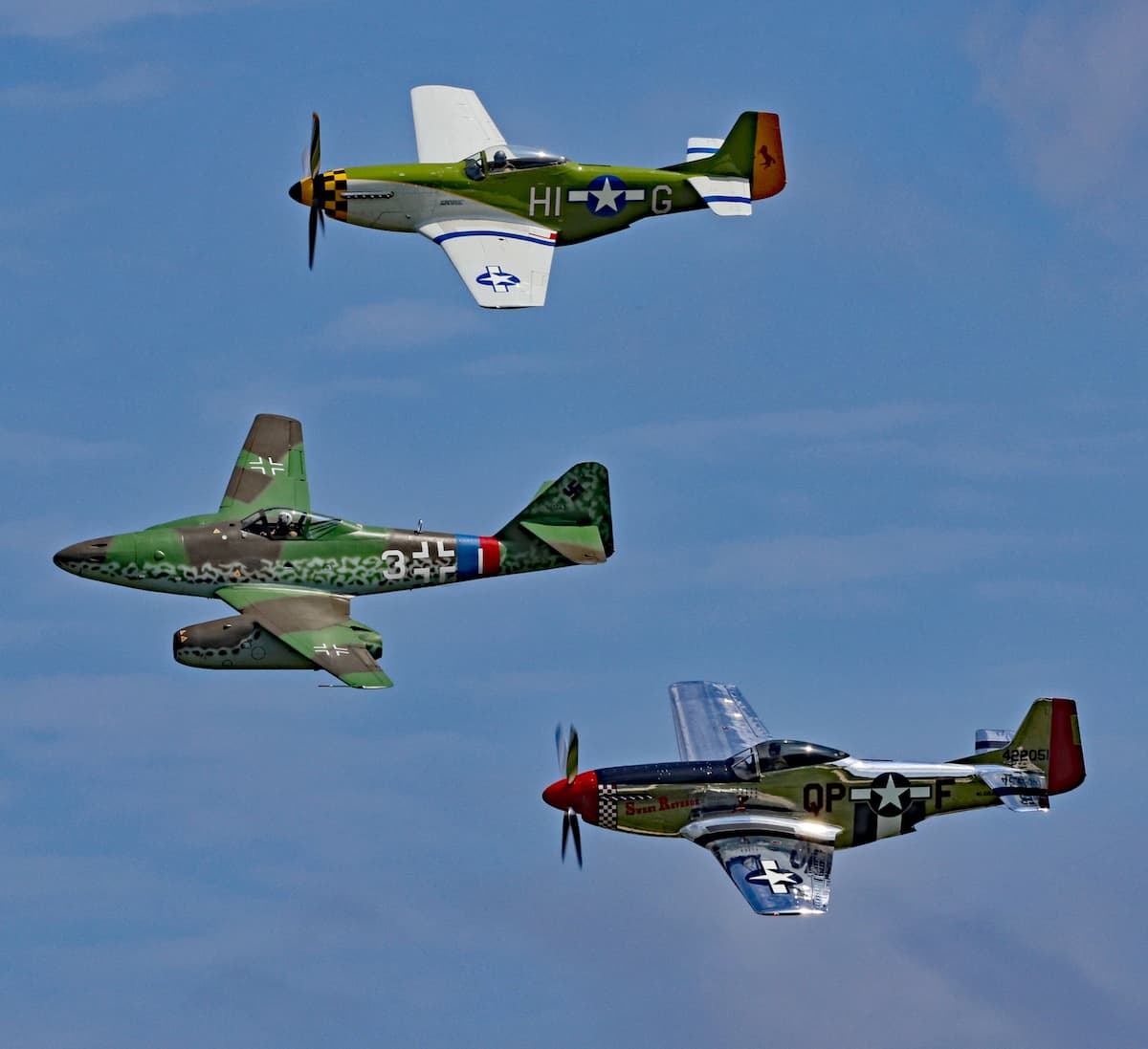
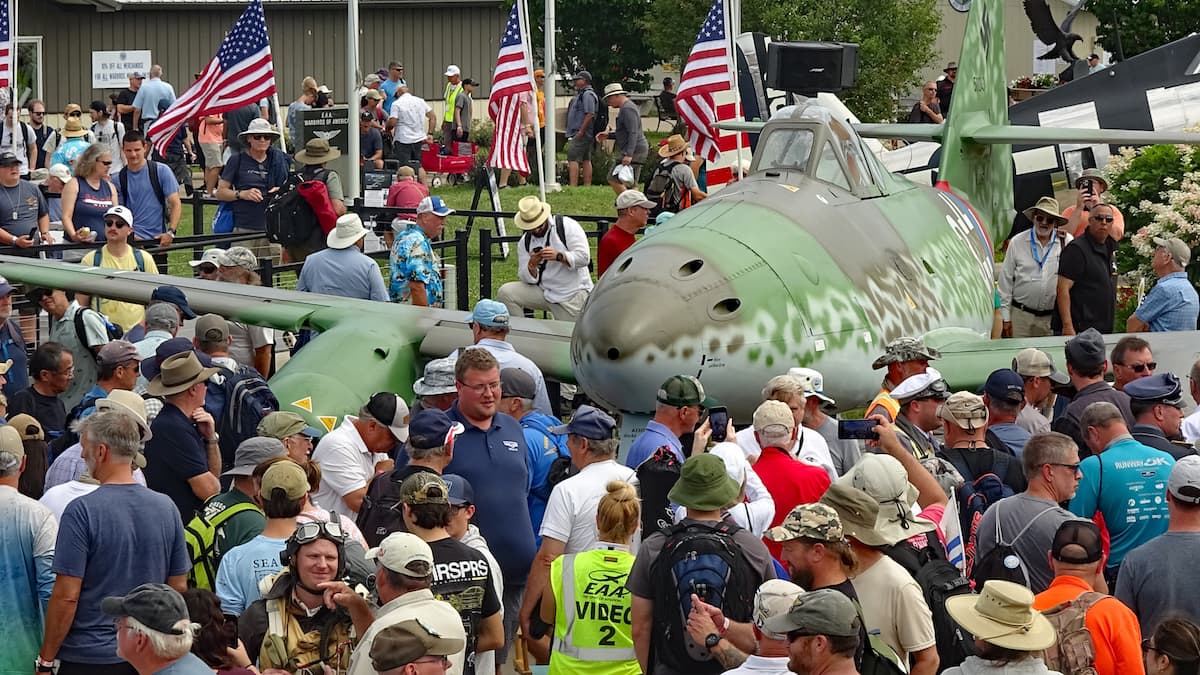
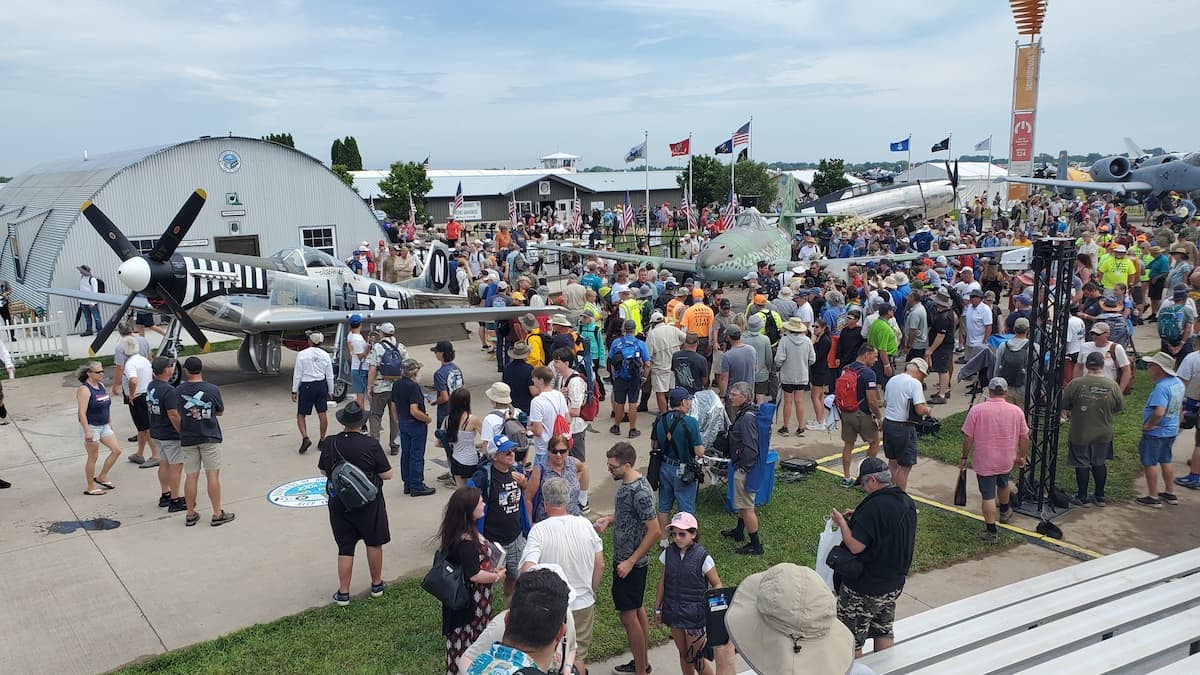
A standing room only crowd at a Warbirds in Review session during EAA AirVenture Oshkosh 2025 was transfixed as Joe Peterburs shared a thrilling encounter between his P-51 and a German Messerschmitt Me 262 jet fighter during World War II.
Joe flew high cover 5,000 feet above B-17s in his P-51 Mustang, nicknamed Josephine after his girlfriend back home. It was April 10, 1945. Nobody knew it, but the war in Europe was less than a month from its conclusion.
Joe caught sight of a jet-powered Messerschmitt Me 262 fighter blowing two of the bombers from the sky. Diving with his Mustang’s Merlin engine firewalled, Joe was able to close on the faster jet fighter and sink some .50-caliber machine gun rounds into the turbojet engine mounted snug under its left wing.
Thus unfolded a chase to lower altitudes, the Messerschmitt jet smoking even as it accelerated away from Joe’s piston-powered P-51. At about 3,000 feet, the German jet nosed into cloud cover.
“I wasn’t going to follow him into the clouds,” Joe told his AirVenture audience.
Instead, the looming presence of a German airfield dotted with aircraft gave Joe a target-rich environment for strafing.
The last of several airplanes he destroyed or damaged was a four-engine Focke Wulf Fw 200 Condor bomber. During his strafing of the bomber, Joe detected one, then another, thud against the airframe of his P-51, accompanied by the flow of oil over his windscreen.
The prognosis for a safe journey home looked grim.
Losing altitude as he flew west over the Continent toward the lines at Magdeburg, Germany, Joe unbuckled his restraining harness, preparing to bail out of the stricken fighter at about 1,000 feet.
But fate was not done with Joe Peterburs yet.
His P-51 was pounced on by a German Fw 190. Joe nosed his Mustang into a head-on confrontation with his attacker, who sent a volley of air-to-air rockets at the Mustang, but missed. With smoke already issuing from his stricken P-51, Joe figured the German pilot thought the American was done for.
The encounter with the Fw 190 cost more altitude, and now Joe faced a new peril only 500 feet above the ground.
His harness unbuckled and splayed about the cockpit, he would not have time to reharness in anticipation of a crash landing. But the low altitude did not afford safety for a bailout.
Joe figures he got out of his Mustang somewhere between 400 and 300 feet of dwindling altitude, smacking his right knee on the horizontal stabilizer as he pulled the rip cord. Almost instantly, he hit the ground hard, bruised but alive.
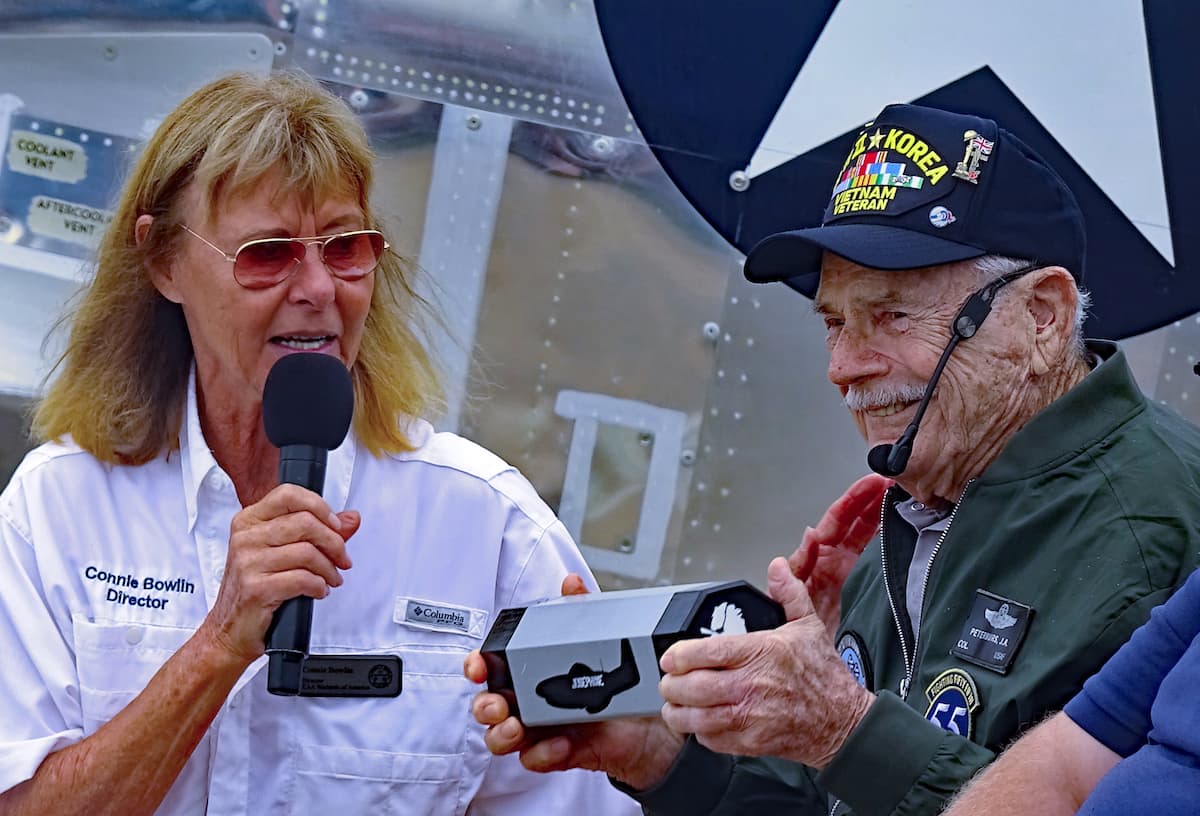
Joe’s drama was not over yet, as he was immediately captured by the Germans and marched, with other prisoners, to POW camp Stalag III. An escape days later found Joe heading toward Allied lines, where a Soviet tank unit took him in, gave him a rifle, and he continued fighting the war against Germany.
Joe didn’t put in a claim for an aerial victory over the damaged Me 262 because he did not see it destroyed. His last view of the jet was as it slipped into clouds. Only decades later, when researchers in Germany pored over records of combat action for that date, was it possible to reconstruct what became of that Messerschmitt and its pilot.
Joe told his AirVenture audience the German pilot was Walter Schuck, an experienced multiple ace with 206 aerial victories. It was Schuck’s fate to bail out of his Me 262 that April day.
In the unemotional mathematics of combat, the trade of Peterburs’ Mustang for Schuck’s Me 262 was a win for the Allies, who could better sustain a war of attrition than could the Germans by that time.
The packed AirVenture audience for Joe Peterburs’ Warbirds in Review session on July 23 was under inclement skies. People intently followed Joe’s first-hand account of combat 80 years ago, on the frontier of the jet age.
It’s the magic of Warbirds in Review that brings veterans like Joe Peterburs together with aircraft, including a flying replica Me 262 and a P-51 Mustang like he flew when he downed one of the vaunted jets. Joe will be 101 years old this year.
Joe wasn’t alone on the Warbirds in Review ramp. He was joined by Mike Spalding, chief pilot of the Military Aviation Museum, who flew the replica Messerschmitt jet to Oshkosh from Virginia, and who demonstrated it during AirVenture. Keegan Chetwynd, the museum’s director, provided historical context.
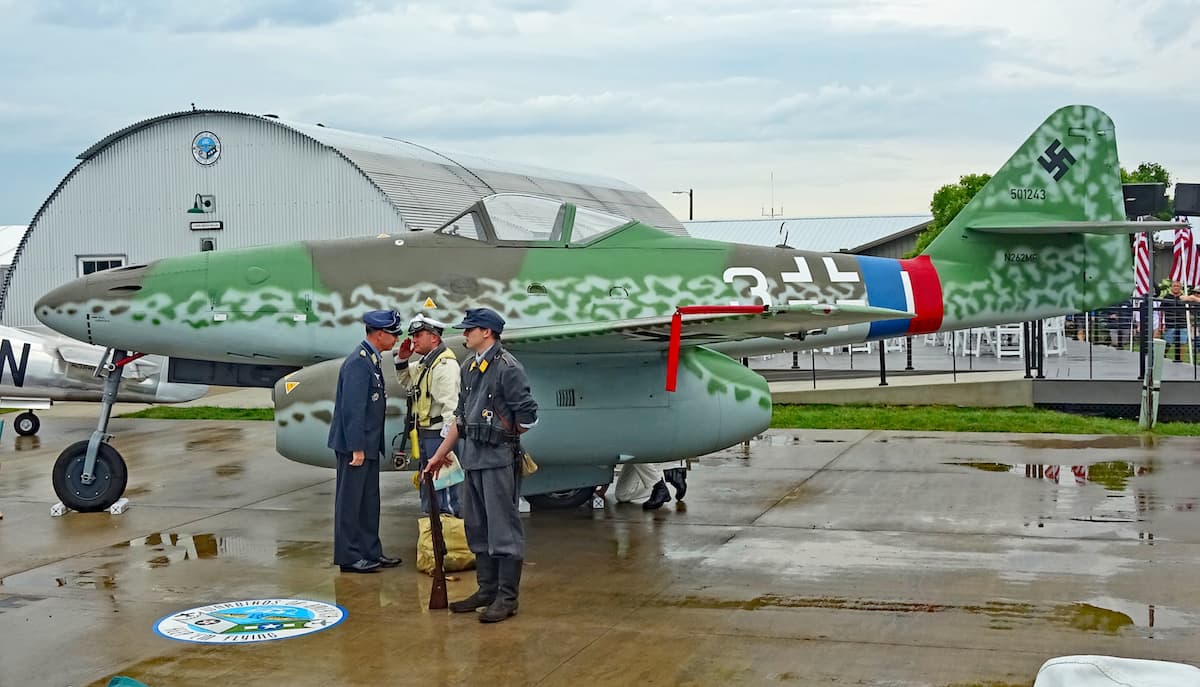
Mike told the crowd the replica Me 262 houses a pair of General Electric CJ610 turbojet engines, that are typical for some models of the Learjet, in its accurate nacelles. The CJ610 bears some commonality to the military J-85 jet engine.
Original Jumo engines in wartime Me 262s had short life expectancies and other quirks of operation in the infancy of jet propulsion. Surging throttle advancements could overheat the metals in the Jumos, shortening their lifespan. Luftwaffe pilots learned to be gentle with throttle changes.
The modern engines?
“They’re much more reliable now and engines are basically not an issue at all,” Mike said.
Well, except for a balky oil sensor that acted up as Mike was preparing to fly the Me 262 to Oshkosh. Diligent work by the museum team got the fantastic fabricated fighter to AirVenture.

True to the original Me 262, the replica’s nosegear strut is not intended for towing the jet on the ground. The nose landing gear was an accommodation after tailwheeled prototypes experienced handling difficulties during takeoff.
The replica Me 262 carries 3,000 pounds of fuel, Mike explained, but burns 4,000 pounds an hour at takeoff power settings. He generally plans on a flight leg not longer than an hour.
Keegan indicated original Me 262s suffered some failures of the tail, and the replicas are not flown as violently as wartime fighters would be.
The replicas are a remarkable story of reverse engineering, as a company in Texas began building five replicas while measuring an original Me 262 it was restoring for static display for the Navy. The replica program was completed in Everett, Washington, with replica aircraft going to museums and collections in the U.S. and Europe.
There’s one more thing Joe Peterburs’ story revealed at AirVenture.
That bold young fighter pilot who took on the Luftwaffe’s best, then bailed out, then escaped captivity, and finally fought beside a Russian tank column was still under 21 years old. Upon his return to the States, he required his mother’s legal permission to marry his beloved Josephine!

Wonderful story! Thank you!
Thanks for your comments. This is fun! Listening to Colonel Peterburs was enthralling.