

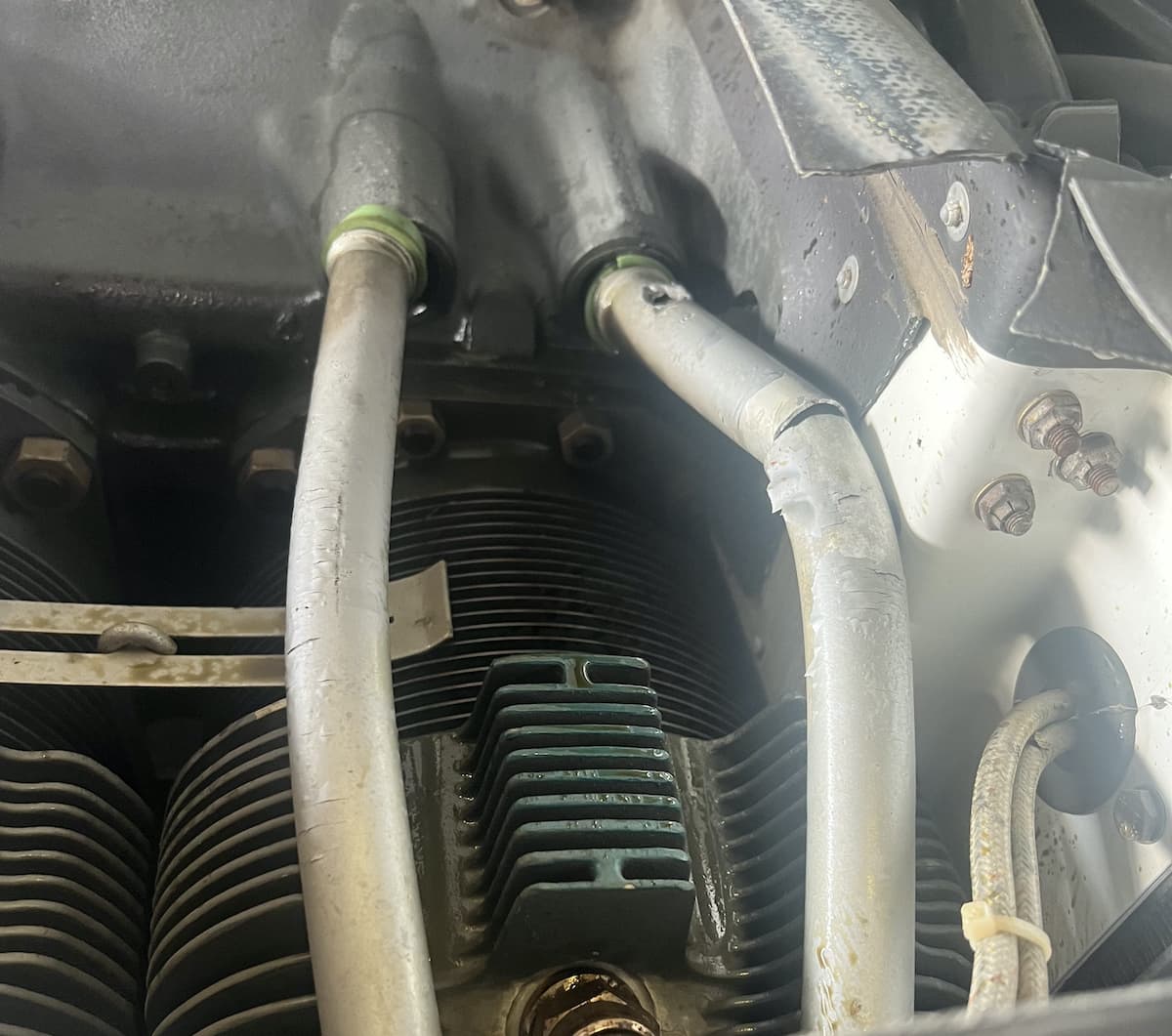
I recently received this photo with this question: What could cause something like this to happen?
If you look closely at the photo, you’ll notice that the exhaust valve pushrod shroud tube on the right is bent severely and has fractured the pushrod shroud tube. The intake pushrod shroud tube is also bent, but you’ll also notice that this has caused much more serious damage because it has cracked the tappet boss on the crankcase, which means the crankcase will either need serious repair work completed at an FAA-approved facility or a complete crankcase replacement.
This type of failure is quite rare that both exhaust and intake valves would cause damage this severe.
So how could this happen?
To begin with, there could be several causes for a situation like this, but the end result is the fact that you’re going to spend a lot of money to fix it.
There are several things that come to mind when looking for answers as to how to avoid this.
One of the first things is frequent oil and filter changes, which is one of the easiest preventive steps you can take.
Regardless of how you feel, Lycoming’s recommendation is spelled out in the latest revision of Lycoming Service Bulletin 480, “Oil Servicing, Metallic Solids Identification After Oil Servicing, and Associated Corrective Action.” This is something I consider important. As I’ve mentioned in the past, the two least expensive things you can put in your engine are gas and oil.
Looking at the photo — and from my past experience — I’ve come to the conclusion that the exhaust valve stuck initially and possibly broke the valve head into pieces.
While the engine was still continuing to rotate, I think one of the broken pieces of the exhaust valve got stuck between the intake valve and the intake valve seat, which caused the pushrod to have enough force to push the tappet body out of its bore, causing the crankcase to crack. It’s a shame to think that possibly better maintenance could have prevented something this serious to happen.
Let’s look at some other things that may contribute to a scenario like this.
There is no doubt that this may have been a result of high temperatures caused by inadequate engine cooling caused by poor engine baffling.
I’ve learned that the condition of engine baffling is something that is commonly overlooked.
There is no way to have proper engine cooling if the baffling is worn or not properly fitting under the cowling.
It’s so important that the baffles fold in towards the cylinders on each side and the rear baffles fold forward at the rear of the engine and stand up in order to make contact with the top cowling. There also should be no gaps between each piece.
Using a flashlight, check the position of the baffling by looking through the front bug eyes or air inlets of the cowling. That should give you some idea whether the baffles are in the proper position and doing the job they are designed to do.
If you notice that the baffles are lying down on either side of the engine or folded back in the rear, it’s time to consider replacing all of the baffle material and I strongly recommend that you don’t go with cheap material.
Remember, if the baffling is not doing its job, then the cooling inlet air will not be directed down between the cylinders, which results in inadequate cooling of the cylinders.
The heat generated in each cylinder is dissipated through the exhaust valve guide to the cylinder fins, which are then cooled by the cooling air being forced by the cylinder heads by properly performing baffling. If you don’t cool the cylinders properly, the chances of cracking a cylinder head or a sticking exhaust increase.
If you own any of the Piper aircraft models that you can remove the top cowl, I suggest you consider the following way to confirm if your baffling is working properly. Remove the top cowl and clean it thoroughly and allow it to dry. Take a spray can of white paint and paint the underside of the cowl. Even if the paint hasn’t had a chance to dry, reinstall the cowl and be certain all of the baffles are in their proper position.
Next, go fly the aircraft for 30 minutes or so. Once you return to the ramp, remove the cowl and you should notice along both sides and across the rear of the cowl where the baffles have made contact leaving rub marks. These rub marks should be quite distinct if the baffling is in good condition and doing its job.
I might also point out that Lycoming Service Bulletin 388C, “Procedure to Determine Exhaust Valve and Guide Condition,” is very important and compliance should be considered in the event that valve sticking is suspected.

If a broken piece of the exhaust valve jammed between the seat and the intake valve, this would make it easier for the intake pushrod to open the valve since it is already partially open. If however the exhaust valve head came off (this happens when the exhaust valve is sticking a little, it does not seal well enough to transfer it’s heat into the seat). Then the valve head gets tossed around and may jam the intake valve stuck withe the help of the piston while the pushrod tries to open it. Did the valve head come off?
The other scenario: not enough cooling and too rich operation is much more likely to have caused sticking of the valves from carbon build up in the guides but both??
It is very important to understand and follow SB388C, for both Lycoming and Continental engines.
‘Morning sickness’ , where the engine cold starts running rough and then smooths out after a few minutes, is an indication of a sticking exhaust valve.
If the valve sticks open, as mine did, it does no damage. but if the valve sticks closed, as it appears with this engine, it gets very expensive.
I started adding Alcor TCP to the fuel, and after about 4 hours, the ‘morning sickness’ stopped. Alcor doesn’t indicate that it removes the lead-bromide deposits, but it appears that it did on my GO-300, scavenging the lead-bromide into lead-phosphate, which is very soft and gets removed out the exhaust.