

In the wee hours of the morning, an aging and not particularly lovely Cessna 172 departed the east coast of Florida on a leisurely jaunt to the west coast. The route flown appears to have been fairly random, meandering this way and that.
Turning north the pilot guided the airplane to Page Field in Fort Myers, where it circled erratically while descending down to just 600 feet before climbing to 1,500 feet.
The path of flight illustrated by FlightAware is not one most of us would be proud to call our own.
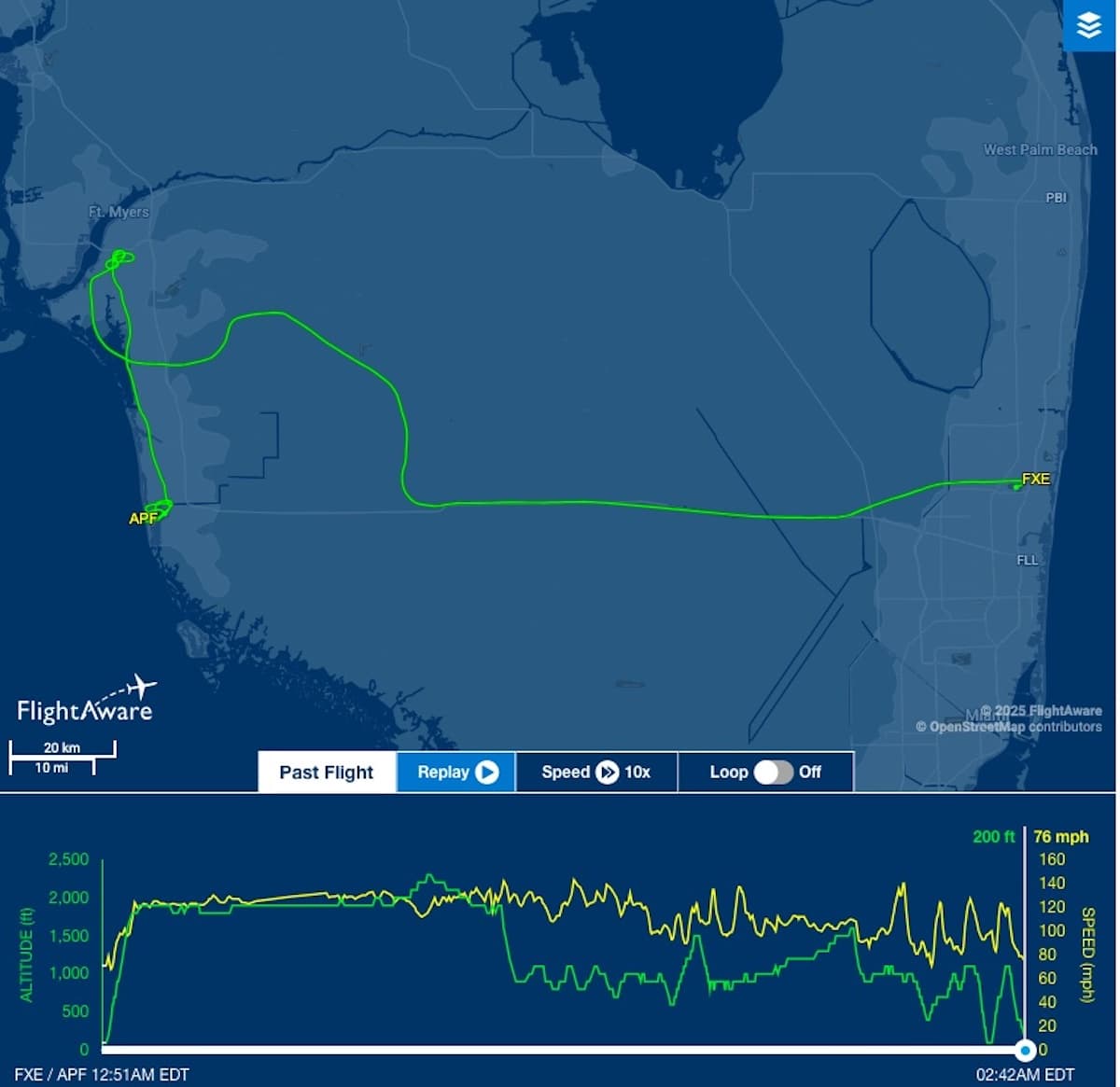
Departing Fort Myers the Cessna flew south to Naples where it performed a truly unique traffic pattern entry for Runway 5. It’s unclear if the airplane actually did a touch and go or simply made multiple low approaches, but either way the traffic pattern flown was large, loopy, and erratic. In the end the aircraft touched down on Runway 5.
That’s when things got really interesting. The Cessna left the runway and crossed into the grass where the nose gear collapsed, the prop impacted the ground, and the airplane finally came to rest.
We know this to be a reasonably accurate description of what happened because the Internet allows us to view the flight path in great detail and the damaged airplane actually exists. The Naples Airport crew discovered the abandoned aircraft in the grass when they arrived for work at approximately 5 a.m.
The pilot and a second person it might be assumed was a passenger simply walked away. Perhaps due to the late hour combined with the understandable shock or embarrassment of the incident, they chose to go elsewhere rather than alert the authorities to their plight.
To rent an airplane, wreck it, then abandon it is not a good look. That’s not part of our training. None of us ever wants to find ourselves in a similar position.
Yet, it’s possible this scenario could befall any of us. Was there a medical issue? Was there an instrumentation error, a hostage situation, or a distraction that caused the pilot to perform in a less than desirable manner? Was there a control system failure that made the airplane difficult to fly?
All that is for the NTSB and the FAA to determine, along with local law enforcement. Our responsibility is simply to let them know of the incident in a timely manner. They’ll figure it out from there.
Should the worst happen and we find ourselves standing beside an incapacitated airplane in the dark of the early morning hours, at an unfamiliar airport, after sliding off the runway, what should we do?
First, get yourself and your passengers out of the aircraft and ensure their safety. If anyone is hurt, a call to 911 is appropriate to get aid headed your way.
Beyond that, NTSB Part 830 is our guide. At least initially. The regulations tell us that aircraft operators (and that term applies to pilots of rented aircraft, not just the entity that rented the aircraft or the owner) are expected to notify the NTSB immediately following an aircraft accident or certain incidents.
Let that word “immediately” percolate in your head for a minute. Memorize it. Take it seriously. This is the standard we’re going to be held to.
And while some of us might debate whether a given scenario constitutes an accident or an incident, we can err on the side of caution by making that immediate notification with the confidence the NTSB will figure that part out all on its own.
Fortunately, immediate notification is easier than ever thanks to modern technology and 24-hour staffing. All we have to do is call the NTSB’s Response Operations Center at 844-373-9922 and tell our story. The feds can take the investigation from there.
We can even ask something like, “What do you need from me next?” to get insight into what to do as the sun rises and the authorities come out to evaluate and investigate.
This matters. Not just in the legal sense, but also in the decent human being sense.
Abandoning a damaged airplane on or near a runway without even calling a local cop shop to let them know of the accident puts every other arriving or departing aircraft at risk.
With no indication of a possible obstacle on or near the runway, others may be unpleasantly surprised to experience a wing strike on takeoff or during their after landing roll-out. They may encounter debris on the runway that could damage their aircraft.
Rather than departing the scene thinking, “Uh-oh, I might be in trouble,” any one of us should be thinking, “Who can I contact right now to mitigate the risk to others?”
I get it. Wrecking an airplane isn’t a happy moment. And it’s entirely possible there are circumstances casual observers aren’t aware of that could explain why the accident happened.
But walking away and keeping quiet about the situation is not a sanctioned Pilot in Command activity. Fess up. Do it quickly. Then stand back and be responsive to the requests of the investigating authorities.
It’s not just good manners. It’s our responsibility as Pilot in Command.
I feel sorry for the pilot involved in the scenario described above. I truly do. With any luck at all they’ve learned a valuable and lasting lesson from their error.
Hopefully, you have too. Because while the worst can befall any one of us if all the holes in the Swiss cheese line up just right, knowing what to do in the aftermath can be of real importance.
On the bright side, you have a starting point now. I hope with all my might that you never need to take those first steps by making those initial phone calls. But if you do, now you know who to reach out to.
Good luck to us all!

People are strange. We used to sail the BVI every so often. The charter company we use shared a story of the local authorities finding a sailboat on the rocks and the dinghy missing. Fearing the worst, they started a search. The dinghy was found ashore. As they started digging into it, they found the family who chartered it safe and sound, as i recall, back in New Jersey. The ran aground, got scared, took the dinghy to shore and flew home. Yea, that seems like the right thing to do, just like this pilot.
It doesn’t appear that this incident meets the “immediate” reporting criteria of 830.5(a).
Capt. Al Cohol at the controls again
‘me thinx.
My first thought was drunk pilot.
I suspect you are right on the money! Flying under the influence explains the erratic flight, the accident and the abandonment of the site.
Indeed, not to mention the 12:51am departure. I can picture that evening in my head right now 🤣
Looking a Flightaware, it is noted that the aircraft has ‘registration pending’.
But checking the FAA N-number registry, they state ;
” This aircraft’s registration status may not be suitable for operation.”
So was this an unairworthy aircraft, or something else.?