

I’ve always preferred high-wing airplanes to low-wing airplanes. Perhaps because I’m inherently lazy.
The low-wing airplane has several advantages over the high wing or so I’m told. But they require me to get on the ground during my pre-flight inspections. I don’t care for that.
The ground is dirty. It’s very low, too. A good six feet below my normal eye level. And as I age the idea of stooping down and scooting under the wing to grab a fuel sample, check the tires, inspect the brakes…that just doesn’t appeal to me.

This coming from a guy who first soloed in a Piper Cherokee. The pride of that accomplishment pales in comparison to my aversion to crawling under a wing on the ramp of my local airport.
High-wing airplanes came into my life shortly after that first solo. I had hair then. I do not have much hair any longer, which makes my affection for high-wing airplanes multi-faceted.
For one thing, they provide much appreciated shade. That big yellow ball in the sky has done a number on my complexion over the years. So much so that each year I visit a medical specialist who inspects every inch of my body while making tut, tut sounds and extolling the virtues of sunscreen. Then he freezes or cuts off little bits of my skin in an effort to prevent me from developing cancers. That’s his story anyway. I believe the secondary reason for these procedures is his desire to buy a new Porsche or to extend his annual European vacation. But I digress.
There are technical reasons for my high-wing preference. By putting the wing and fuel tanks up above the plane of the engine, the force of gravity can provide ample fuel pressure to keep my engine running. Over the full lifespan of the Earth, gravity is undefeated. It just works.
I like simplicity.
Yet, for all their advantages, there is a danger inherent in the Cessna high-wing designs that will almost certainly bite us at some point. This risk sits quietly, patiently, awaiting a moment of carelessness or distraction from an unfocused pilot or passenger. Suddenly, out of nowhere, BANG! It will get you.
I speak of the almost universally experienced Cessna Diamond Forehead. Like so many before me, I have suffered this fate on more than one occasion. Even given ample warning, I know the line of men and women who may be damaged in the future is long.
The trailing edge of those wings are merciless.
The pilots of low-wing aircraft may scoff at our plight as they brush the dirt and grime from the knees of their best pair of dress slacks. They know not our burden. With their electric fuel pumps and unobstructed upward visibility, they discount our challenges as unnecessary or superficial in nature.
Unnecessary? Perhaps. Superficial? Not on your life.
It is my belief the engineers at Cessna committed to a secret pact back in 1946. To the best of my knowledge none of them ever spoke of their devious plan for the remainder of their days.
Fresh from the World War II era, they designed a remarkable airplane: The Cessna 140. Small, nimble, fuel efficient, and fun to fly. These engineers may have felt a sense of shame at having developed a nearly perfect airplane in such difficult times. So, in an effort to ease their collective conscience, they implemented a crimpled trailing edge to the flaps that could and would wound the unwary.
Sitting at a level that virtually guarantees a facial laceration should human skin impact the trailing edge of the flap, their plan was as brilliant as it was destructive.
The Cessna 140 could bite back.
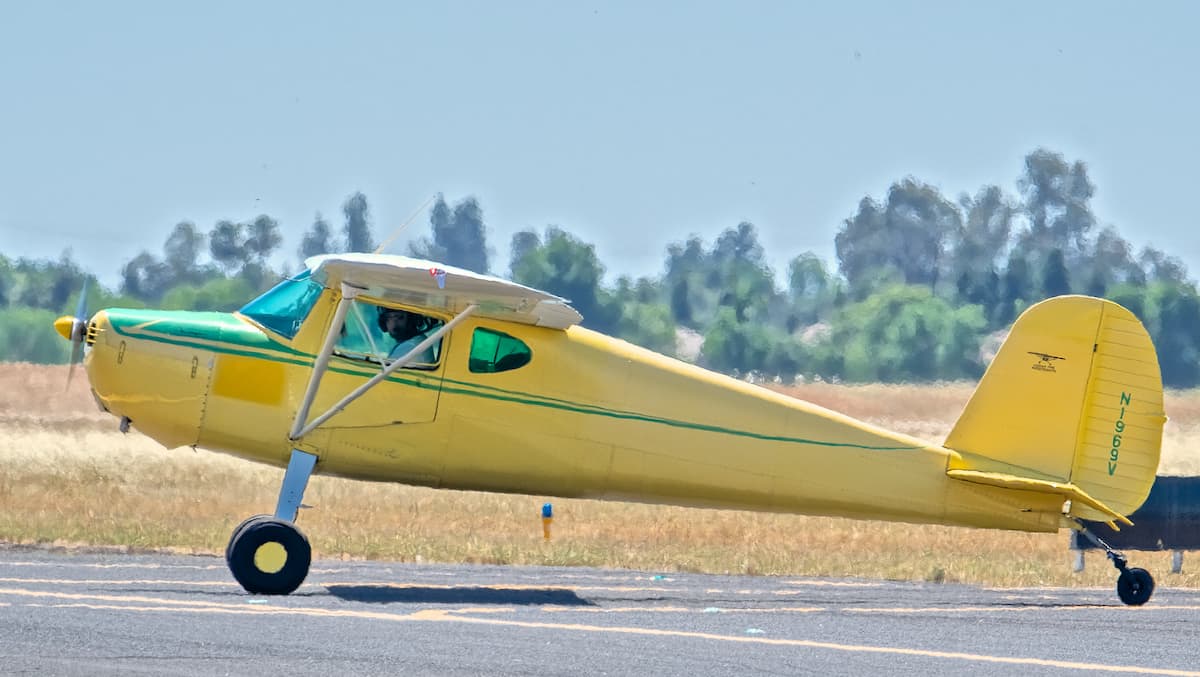
The very design of the airplane induced a sense of caution and care in those who came to love it.
As with all great designs, these engineers and their newer counterparts extended the risk factor with the introduction of similarly formed flaps and ailerons on the C-150, C-172, and C-182. By the mid-1950s the entire trailing edge of a Cessna wing could be considered a weapon.
Success!
Pilots and passengers began to adapt, as humans do when presented with a new and challenging risk. The baseball cap became standard apparel for general aviation enthusiasts. The long bill and thick fabric of the crown prevented the negligent individual from drawing blood. They still walked into the trailing edge cutting surface with startling regularity, but the cap saved them from severe injury.
That’s a win.

Many companies realized the commercial opportunity these hats offered and began branding them with their corporate logo. The additional stitching or patchwork provided even better protection. Ultimately, commerce and protective headwear combined to create an entirely new industry that appealed to millions who never threw or hit a baseball in their lives.
Guilt is a powerful motivator, however. It is rumored the son of a Cessna engineer was so traumatized by the knowledge of his family’s legacy, he began experimenting with closed cell polyethylene foams in an effort to restore dignity to the family name.
After years of experimentation, he found success.
Originally intended as a safety device, the plastic tool he developed was light enough and flexible enough to be stored in any Cessna aircraft. Colorful and easy to work with, the security devices could be slipped over the trailing edges of flaps and ailerons rendering them harmless and safe for the flying public.
Of course, publicly acknowledging the inherent danger of his forefather’s legacy was not part of the designer’s plan. So, a creative team was assembled which determined the Anti-Diamond Head device could be plausibly marketed as a floatation device for children. Which is why the name was changed to Pool Noodle and the product was marketed primarily through large retailers and dollar stores.
It remains to be seen if the Pool Noodle alliance will go to war with the baseball cap industry in an effort to dominate the market.

Thankfully, while that corporate battle wages, the rest of us can be happy knowing there are options we can use to protect our noggins as we prolong our love affair with the mighty Cessna line of magical flying machines.

Great job, JB.
How do you prevent the ‘foam snakes’ from blowing off of the ailerons/flaps after engine start, gorilla tape or super glue?…….
I used a pool noodle on the rear cargo compartment of a Citation Ultra. That sucker had a big knife-edge, uh, edge on it, and it, uh, sucked. Sucked blood outta me, is what it did. Obviously designed by a vicious psychopath at Cessna, the upper edge of this rear cargo hatch seemed to move, kinda clamping down on my head when I would withdraw from the compartment after carefully placing some large suitcase on top of some other large suircase. CLIP! OUCH! The edge drew blood several times. I bought a bike helmet and it was going to wear that but then I told somebody that I was going to do that and they said they would not trust a pilot who had to wear a helmet just to load luggage. Then my brother, a non-pilot, told me to try a pool noodle. So I’ve been wearing that ever since. You think people don’t trust a pilot wearing a bike helmet! I tried to explain to people about the baggage-door edge, and how the blood would run down my face and everything before I started wearing the pool noodle. But people remain skeptical, I can tell.
Having owned 5 airplanes in the past 50+ years, all of them by coincidence were low wingers. During my rental years, I flew high wingers. As usual, there is no perfect scenario. In my younger days, getting in and out of my Grumman AA1A was no problem. Now that I am 74 years old those Grummans, Pipers and Beechcrafts require dexterity that I am losing. Result? High wingers from now on. On the other side of this, I self-serve fuel. Needless to say, a high winger is more difficult at my age in having to drag a hose and climb a ladder to fuel a high winger and visually check the level of fuel, while a low wing refuel process is a snap in comparison including no “diamond” head factor. This just solidifies the old adage that there is no such thing as the perfect airplane. As a side note, during the years I DID become a member of the Cessna “diamond” club! Might have been better to remember to have worn the cap with the bill facing the front rather than the back—–Duhhhh!
I wear my scar with pride. A right of passage it is !
I like my high wing Cessna 175B for a number of reasons; [ 100% true !]
1. gravity flow to the carb, so no fuel pump to fail
2. a ‘both’ position on the fuel selector, so no switching tanks.
3. manual ‘johnson bar’ flaps, so no electrical power needed
4, a 12 volt electrical system, so the battery is 1/2 the ridiculous cost of a 24 volt battery.
5. 52 gallon tanks, so I have over 6 hours of fuel.
I can swivel my ball cap to block the Sun glare.
As ungainly as the low wing pre flight us, try machanicing on the damned things, especially with older knees. If I didn’t like the guy so well I’d try to get out of doing the annual on the only nose dragger in our clan, but he’s worthy. Still, I make him do most of the grunt work.
As for the “Diamond trap”, yeah, I’ve had pool noodles and fluorescent caution tape in my kit for decades. That said, even the manufacturers put great warning paint on those damned fancy Fowler flap hinges that jack down under the wing, right about where wisdom says “duck” to miss the trailing edge. Walk into that hinge on a Husky or my old Convair L13 and you may find yourself attacked by the gravity vortex. I’ve seen more than one sutured forehead from those. All that added up I’m with you on my preference for high wing. I have to apply a bit more practical add here. You’ll find very few low wing float planes or bush planes. Slips are a daily practice and wing tips need to … well, tip a lot more in those environments and striking the earth, both in wet form and dry is bad. Nope, high wing taildraggers rule in our world despite your rumored conspiracy.
Back when I flew Cessnas I quickly learned of the plight of being unwarranted of the dastardly trailing edge. Since then I have added a
piece of apparel to be worn during preflight, a deep-sea driver’s helmet! Works great, however it does reduce payload when stored aboard.
So , about 88% of the story is fiction ?
I also remove the top button from a cap. I also spray paint the underside of the bill with black paint, to eliminate any glare/ reflections…
Yeah the cap is a wonderful creation for protection of eyes and forehead. But at the same time, if your head is tilted down a bit, the bill completely hides potential objects resulting in collisions that probably would not have happened without a cap.
I have found that a baseball catcher’s mask prevents blood loss from the forehead quite well!
Yep … Cap saved me from a forehead laceration just last week
The designers of those baseball caps implemented their own nefarious plot – to dimple the tops of our heads with that damned button, made especially evident with the increased use of headsets. That’s the first thing to go when I get a new hat.
At OSH and other flight focus venues, you can tell which vendors truly live aviation if their free advertising giveaway chapeaus are sans button.