

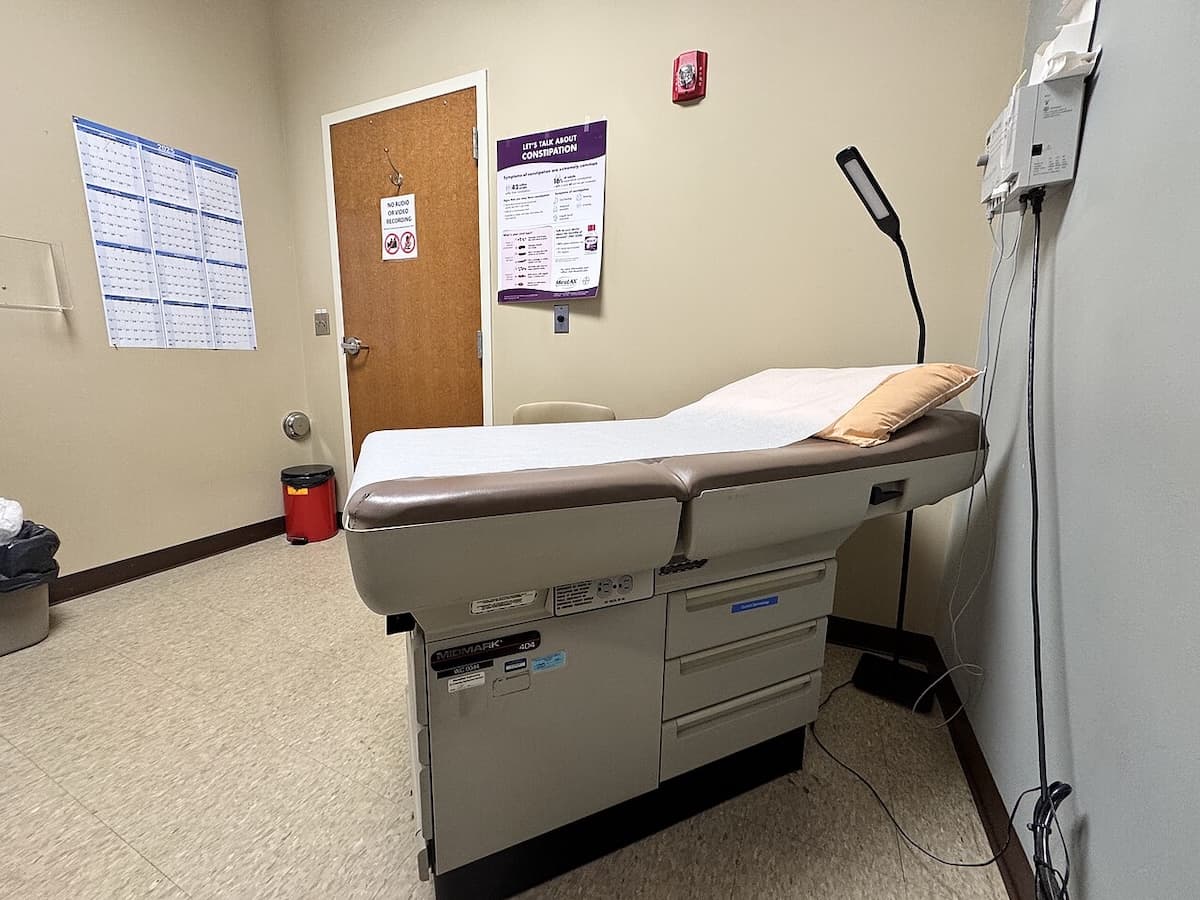
It can be slightly uncomfortable sitting on the crinkly white paper covering the examination table in a doctor’s office. Many of us experience white coat syndrome when we first enter the room and submit to a variety of minor, non-intrusive tests.
Our temperature, blood pressure, and heart rate are all being monitored and judged during those first minutes of an exam.
Is it any wonder we feel a certain level of stress?
Knowing this it came as no great surprise to me when the physician’s assistant checking me out mentioned that she is terrified to fly. Like most of us, she does board an aircraft from time to time. When airline service is the only practical means of transportation for the journey, even the most nervous fliers bolster their courage and make their way to an assigned seat.
A vacation in Europe isn’t a viable option if you’ve only got a week and traveling by air is off the table.
Many an anxious flier concerns themselves unnecessarily with the idea that an aircraft weighing thousands, or tens of thousands, or hundreds of thousands of pounds can get airborne at all. Yet these same folks will gladly jump on a cruise ship whose owners have strategically avoided American registration, to sail out to sea aboard a craft built of steel, loaded with thousands of passengers, hundreds of whom are there to enjoy the drink package.
Yes, people actually believe a 150,000 ton steel hulled vessel full of drunk passengers going to sea is perfectly safe. At the same time they think flying from Point A to any Point B in any type of aircraft is a life-threatening risk not to be taken lightly.
To be honest, I am of the belief that harboring a fear of flying is a perfectly reasonable perspective. But only initially.
There are valid reasons to be uncomfortable about flying. This is true of flying in transport category aircraft just as they may be a little freaked out to climb into a Cessna or Piper or Cirrus for a local jaunt.

It could be argued that it is a sign of having a functional intellect to feel apprehensive about getting airborne. Humans evolved as land animals. We’re most comfortable on a solid surface at ground level. We seek peace and quiet, especially as we age. Aviation is antithetical to our basic human nature.
Airplanes can be loud. Many humans (myself included) have a powerful fear of heights. The air is always in motion. There will generally be a certain amount of unwelcome and unexpected movement while in flight.
Anyone who flies regularly has certainly seen someone tense up and get quiet when even the slightest turbulence rustles the aircraft. That fear is understandable. It doesn’t have to be debilitating, however.
My advice to the physician’s assistant was to head out to our local airport and book an instructional flight. There’s no pressure. She’s not expected to perform at a high level. A discovery flight very well may give her insight and increase her confidence by having a better understanding of how the airplane works. Nothing beats the first-hand experience of holding the controls in flight and realizing how easy and enjoyable it is to guide the airplane in any direction.
She may also benefit from seeing the care the pilot takes before start-up, such as their use of checklists to be sure they don’t miss a step, as well as the run-up they do to verify that all systems are working correctly before takeoff.

Passengers know little of these things. Pilots can explain them, but a rundown of our commitment to safety may not be the most welcome topic at your next neighborhood barbecue.
Of course, many nervous passengers have a file system in their head containing graphic and largely incomplete records of every major crash the media reports on. A situation that is only made worse by the legacy media’s unfortunate commitment to superficial investigations, conjecture about causes, and virtually no productive follow-up on what makes flying safer due to the knowledge gained by every accident investigation.
Following the tragic crash of a military helicopter and a passenger transport in Washington D.C., a local affiliate brought on the chair of psychiatry at a local hospital to provide advice for those who might be apprehensive about flying after such an accident.
I found her response curious. She said, “Well, they maybe shouldn’t get back on an airplane right now unless they absolutely have to.”
Not exactly a comforting position to take.
The psychiatrist went on to suggest, “I think it’s not just going to be passengers that are going to be apprehensive, it’s going to be flight crew, pilots, and others…”
If the goal was to settle the nerves of anxious fliers, this strikes me as a big old whiff. The anchor doubled down on the fearmongering by asking how moms and dads can talk about the crash with their kids.
Do kids watch the news these days? Are they closely following NTSB investigations? Or is it possible there’s an effort underway to get clicks, to gain viewers by going with the old and unwelcome standard “if it bleeds it leads.”
It may not be an entirely convincing argument, but there is no doubt commercial aviation is the safest mode of travel available to us. A passenger would have to fly daily for roughly 25,000 years to be subject to the average risk of a crash.
That information is not hard to find. Certainly not for a professional news organization or a psychiatrist asked to speak publicly on the topic.
We in general aviation aspire to that level of safety. We accept that our aircraft are often less capable than transport category aircraft. We often fly with a single pilot rather than a crew. Our instrumentation may be just as good, or better, but we may lack the redundancy our bigger cousins at the Class B airports have. Yet, we train, we practice, we study, we put the safety of ourselves and our passengers at the forefront of every flight. Or at least most of us do. All of us should.
Fear of flying is a reasonable concern. It is a worry that can be alleviated, however, with education, experience, and support. For the life of me I can’t understand why a news organization and a mental health professional would choose to stoke the flames of fear.
Then again, maybe I can.

I read this most days and I have to say that t he number of times a plane crashes because of pilot error is significant. Fuel starvation the craziest of reasons.
In a ship if the engines quit if sits and bobbs up and down until somebody comes to get it but in as plane you have 1/8 inch of metal between your rear and a 10,000 ft drop.
The uninformed may fear flying but the informed may fear the pilot.
I know a retired pilot of 747 from a major airline who has never stepped on a plane since retiring. Asked Why? he knew too many pilots.
Actually the ship turns broadside to the waves and will capsize. Sea or air, results may vary.
Hate to tell you; but the metal between your rear and a 10,000 ft drop is more likely 1/32 of an inch (and often less). 1/8 inch is reserved for big iron and heavy duty structures.
Some aircraft, like the C172/C175 have a substantial structure of ribs and beams between the floor and belly skin. The bulkhead area has 4 large castings that the gear legs mount to .
Since given the possibilities beyond one’s control in real time during flight, fear of flight is rational. And if it’s rational, wouldn’t not having that fear be irrational? Then are we using the term fear in place of awareness and legitimate concern? We’re mandated to carry a certified and currently inspected ELT, are we not?
None of that worked on my wife for taking a GA flight. But at least she became completely relaxed on commercial flights when she saw I was unfazed by turbulence. A comparison of the possibility of bodily injury on I-95 to a GA flight may be more effective for some. 😉
Jamie wrote: “Our instrumentation may be just as good, or better, but we may lack the redundancy our bigger cousins at the Class B airports have. Yet, we train, we practice, we study, we put the safety of ourselves and our passengers at the forefront of every flight. Or at least most of us do. All of us should.”
That last sentence is the crucial one for me. I don’t worry about commercial airliners. However, it would take a lot of force to get me into a recreational GA airplane with a hobby pilot. I’d fear for my life. This news service chronicles daily GA crashes, many with loss of life. Investigations often point to ‘pilot error’ or some mechanical breakdown on the machine.
Blaming the media for the public’s resistance to flying is misplaced blame. The facts of the matters are the wreck and death. The NTSB report which comes a years later is no comfort when stated “To make sure this doesn’t happen again.” That won’t revive the bodies of the deceased. The statistic often cited about flying being the safest mode of transportation per passenger-mile only realistically applies to commercial airlines. The human toll is much greater and more likely in hobby GA.
Regards/J
The fears you have of the operations of “Hobby” pilots applies equally to the actions of “Hobby” automobile driver (ie: anyone without a CDL or better).
True enough. But bad enough also. The heightened danger of hobby GA is nonetheless real for me.
Regards/J
Have you seen the recent news as to who has been getting CDL license’s?
Jamie, one thing we fail to point out to the general travelling public is that aircraft are built to federal regulation standards, pilots are trained and receive recurrent training according to federal standards, mechanics are trained and receive recurrent training according to federal standards, flight attendants are trained and receive recurrent training according to federal standards, airspace rules and operations for airlines are carried out by Air Traffic Control according to federal standards. All pilots, mechanics, flight attendants and ATC personnel have federally established duty and rest limits and minimums. It is the most regulated field of endeavor that 99.99% of the planet’s population can depend on.
All agreeable. Cars also have Federal standards to be built to. Those industry professionals you cite are formally trained, yes. But mechanics still mistakes as chronicled on this news service. Formal training is not a 100 percent guarantee of air safety. Yes, car and truck drivers are amateurs also, and the annual highway carnage shows it.
Regards/J
You mean Gov. standards?