


General aviation pilots have a great many things in common. Among those things is the experience of a co-worker, neighbor, or acquaintance who asks, “How fast is your airplane?”
Humans are enamored of speed.
This question is a familiar one to so many of us who fly. Who among us hasn’t entertained that exact query? And how many of us have seen a look of disappointment on the face of our inquisitor when the answer involves a rate of speed somewhat less impressive than the speed of sound.
I’ve owned two airplanes that I loved dearly. One was a classic pre-war Piper J-3 Cub and the other was a late 20th century experimental AirCam. Both cruised along at a leisurely pace that can be fairly expressed as roughly 0.079 Mach.

No shame here. Not one bit. To a naysayer that may seem slow, but I’ve been around long enough and witnessed a sufficient slice of life that I have insight into what those Negative Nellies do not. Slow is a relative term.
For most of human history people and cargo traveled at the speed of walking. That’s something like 200,000 years of plodding along at a pace that would be perfectly appropriate in the vegetable section of your local supermarket. That’s not an issue when you’re searching for a perfectly ripe melon or a head of lettuce that’s still crispy and fresh. It’s a whole different story when you’re hoping to get to the other side of the mountain before dark sets in.
Walking is healthy. It’s natural. It’s a biped’s great superpower. But it isn’t going to get you to Munich in time for Oktoberfest if you’re on this side of the ocean.
Which brings us to the next great innovation in achieving speed while on the move. Let’s get off the land and plop ourselves down into the water.
Simple rafts could float with the current — unless there was a rock in the way, or a beaver’s dam, or a waterfall. Then things got difficult.
Something a little sleeker and more maneuverable probably came next. A canoe perhaps. A small boat that could be paddled more quickly than just floating on the current. It could be navigated from one place to another by steering with a simple wooden paddle. And it could carry a passenger or a small amount of freight.
The Vikings built on this concept to successfully sack portions of Europe and the British Isles. Perhaps this is the reason my very British and German lineage includes just a smidge of Nordic ancestry.
Speed was becoming a weapon as well as an economic powerhouse.
By the late 1700s the British Navy ruled the waves using ships that could carry cannons and soldiers across the globe. Under ideal conditions they could reach tremendous speeds, sometimes as much as 11 knots. A pace considered to be truly amazing, albeit temporary, since ideal conditions don’t occur all that often.
Why, at that speed a merchant of the day could move his wares from St. Augustine, Florida (the oldest European settlement on the continent) to New York City (for fashion week, no doubt) in only a matter of weeks.
Steam trains were the next big step forward in human transportation as we sought to move even more quickly across the landscape. Sure, thousands of men were required to lay track across barren landscapes, making the prep period a bit of an impediment to travel. But in a country as large as ours it was comforting to know that 2,000 miles of track could be set down and readied for use in as little as six years. Woo hoo! We’re really getting somewhere now.

Finally, it was possible to travel from the east coast of the United States to the west coast in just seven days. That is assuming weather, rockslides, hostiles along the route, and random herds of buffalo didn’t intervene to slow or stop the train along the way. And unfortunately, derailed cars and exploding boilers weren’t nearly as rare as the traveling public might have preferred them to be.
TSA isn’t the first or most invasive impediment to travel our nation has seen, you know.
What this all adds up to is the knowledge that for 99.95% of the time humans have existed, we couldn’t reliably or persistently achieve a speed of even 30 mph for more than a short burst. Travel was slow. Really slow. Information moved at roughly the same speed as a person could for most of that time.
The history of travel has been long, slow, frequently unsafe, and undeniably tedious. Until recently.
It’s only over the past century that folks like Bernie Pietenpol, a simple farmer, could build a machine in his barn that would take him up above the snow-clogged streets and deliver him to a destination 100 miles away, quickly and efficiently. Even better, he and his passenger got an inspirational view of the world below as they traveled.
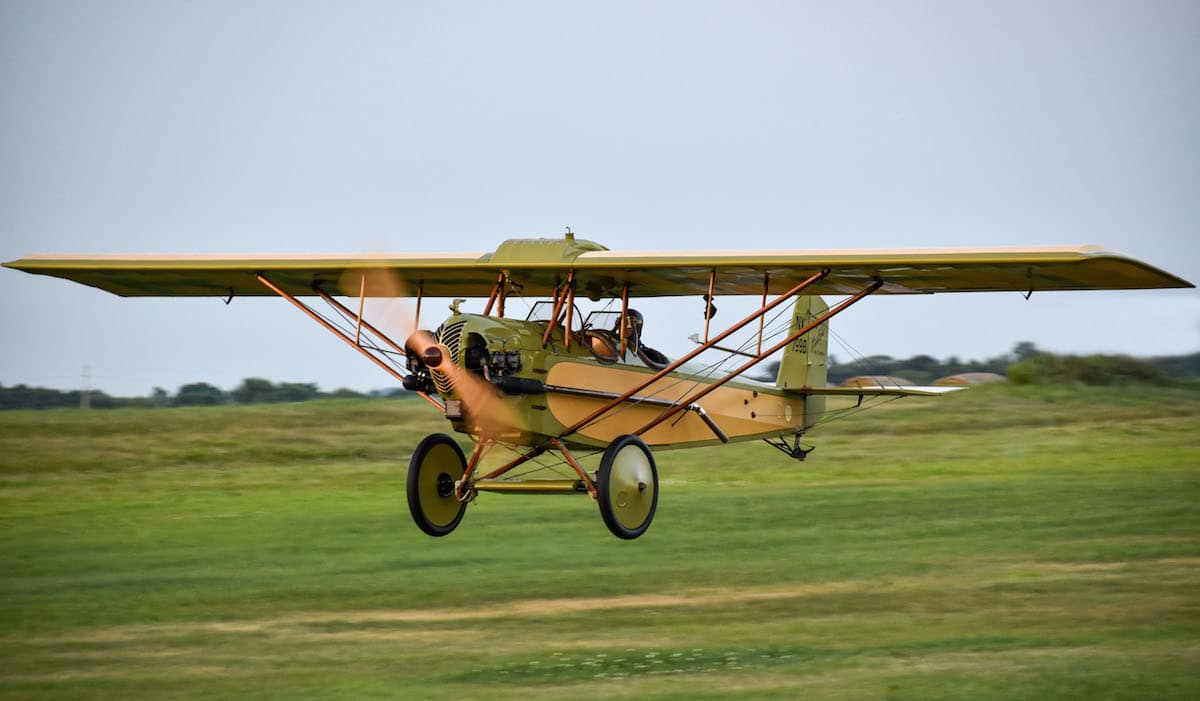
We may have to deal with a bit of turbulence now and then, but that’s a far cry from getting our wooden-wheeled wagon stuck in a mud pit on the way to grannie’s house for Thanksgiving.
There is hardly a trainer on the market that can’t complete a 200-mile leg with ease. Even slow classics can cross rivers and bays without re-routing to find a bridge or a ferry to get them across. We cruise in peaceful splendor over the world beneath our wings as we take a moment to enjoy the experience we’ve come to know and love so much.
Speed is a wonderful thing. But speed is relative. It is a function of discretionary income. For most of us, slower is better in so many ways.
Consider this: When my car and my airplane travel at roughly the same speed, the airplane wins. Highways become clogged and sluggish due to a thousand rubberneckers ogling a single driver struggling with a flat tire on the side of the road. My slow airplane just keeps on cruising as I take in the colorful Christmas spirit expressed by all those flashing brake lights strung along the highway below.
Happy Airplane Day. Those Wright boys from Ohio really started something.

Great to read these stories.
Are there any readers out there still flying at >age 80…? I am!
I have had my pilot license 47 years and treated myself with my own aircraft after raising my children. The Piper Warrior II was my choice and have taken many short trips to the gulf, upper Midwest, and a special trip with my grandson who is also has a pilot license out west for two weeks. The Warrior isn’t fast but stable and for me dependable. Slow but many good memories.
Totally relate to the slow flying mantra. When we got our 150 five years ago I found it quite an adjustment, getting used to ground speeds in the low 90’s (knots) in calm air or low 70’s with a good headwind. The 150 made 172’s look fast! Eventually I found it amusing to seek the big rigs passing us on Hwy 101 and savoring the view low down over the farmfields. I rarely ly to actually go anywhere so whether we’re making 90 or 120 really doesn’t matter much + the lower speed just pads my logbook on the occasions that have a real destination beyond the local strips. The 150 suits me just fine at this stage in life (I soloed in 1966 so you get the picture!!).
My airplane cruises at 150 mph. As much as I like the view, I find it quite boring. I’d love to be able to go much faster!
Airplanes are traveling machines. As Brian Wilson sang: Get there fast so you can take it slow!
Speed is king!
Anybody can fly slow.
Yes, my airplane is for sale!
I have no experience in high performance planes, but,, I gotta tell ya… cruising at 110-115 mph at 4500 MSL in my Ercoupe was sublime. Flying with the canopy wide open is as thrilling as cruising the highway top down in my ‘68 Mustang convertible. High above the heat of SE Texas.
And it was no problem to get up to 8500 or even 9500 feet on long cross countries, though it took a little while to get there.
Low and slow, or high and slow… slow is still a great way to go!
No one addresses the elephant in the room –
An aircraft with a stall speed near 40 mph can
be flown to a survivable off airport landing.
A stall speed over 60 nearly eliminates the possibility of off airport survival.
It almost follows that higher price – higher
speed – higher risk.
I agree, I fly and teach flying off an airport that has no suitable emergency landing sites in the pattern. What we do have are some smaller open areas in the trees/Forrest that I we could touch down and slow a bit before hitting the trees. I stress this is the better option that landing in the trees because at least we can reduce the speed significantly, below 40kts before contracting the tree line which would greatly increase survivability. It is sudden stop that kills, so the slower the better!
I have been flying PA-12s, J-3 Cubs and Champs for 30+ years. When people ask me “where do you go when you fly?”, I always answer: “Up!”.
As I’ve aged up, I find that slower airplanes are safer for me. They don’t move faster than I can think. When I was younger (lots younger) I flew a Mooney and even owned a share in a Pitts S2A for a while. The Pitts wasn’t that fast in a straight line, but it was twitchy as heck! It could go from straight and level to all messed up in a heartbeat. Nowadays I’m happy flying my Maule. It’s capable of flying long distances, you just have to be patient. It is the personification of the saying: “traveling in small planes is fine if you have extra time”. A planned 4 day flight from Washington State to Maryland last summer took 6 days as I zigged and zagged to avoid nasty weather. It was a long trip, but it resulted in lots of stories to share with my hosts when I arrived in Maryland. And that’s what flying has become for me – a generator of great stories and experiences rather than a mode of rapid transportation. As a retiree, that’s a fine outcome!
Also retired I now fly an XAir Falcon, cruises beautifully at 65kts, good visibility, lands short and importantly fairly easy access as in some low wing 2 seaters I find it difficult to climb aboard and exit.
Orville and Wilbur demonstrated controlled flight, but they had the rudder on the wrong end. [ positive feedback ].
Glenn Curtis got it right.
We have to thank Clyde Cessna, Bill Piper, Al Mooney, Walter Beech, Loyd Stearman, Bill Boeing, and many others for the GA aircraft that we all fly.!!
I have traveled between Sacramento, CA and the LA area a number of times, and using different vehicles….it’s 7 hours by car, and 6 hours by Southwest [ lots of waiting ], with the flight only 1.2 hours for the 400 miles.
I’ve flown our Cessna 175 from Marysville, KMYV, to Camarillo, KCMA in about 3 hours.
Cruise speed is 130 mph.
A friend’s RV-10 can get there in 2.1 hours at 190 mph, only 54 minutes less, and burning a lot more fuel.
So, slow, fast or very fast, I’m thankful for the choices.!!
Flying fast is not always an answer to enjoying flying. As a pilot, you see many wonderful things from the air. Many do not believe you but that is the gift that pilots acquire by becoming a pilot and flying airplanes. And the best possible way to see things around you and enjoy flying is to fly small aeroplanes that do not fly very fast. Not too slow and not too fast. “Low and Slow……Fast and High”are both dangerous for approach to land.
Times change . . .
Cairo to London – 100 AD, Fastest Route (Sea + Land):
Leg 1: Cairo → Alexandria (or coastal port) ~200 km overland or Nile transport, 1–2 days by caravan/boat
Leg 2: Alexandria → Roman Italy (e.g., Ostia, Puteoli) by Mediterranean sea, ~7–10 days depending on winds and season
Leg 3: Italy → Gaul → Britannia (overland via Roman roads), ~20–25 days,
Leg 4: Gaul → Londinium (London),~5–7 days
Total Estimated Travel Time: ~35–45 days in summer, fastest route. Survival not guaranteed either, bandits, disease, other hazards.
Cairo to London, 2025 AD:
Couple of hours by Airbus, they fed me and I slept a bit as well. Great scenery, too.
Thank you Orville and Wilbur!
Best Regards,
Miami Mike
“a thousand rubberneckers ogling a single driver”—good band bame