

While the general aviation industry hailed the passage of the FAA’s final Modernization of Special Airworthiness Certification (MOSAIC) rule in July 2025, many still remain confused about what it really means.
To help increase understanding, the FAA recently released a MOSAIC Fact Sheet that breaks down the important dates, the changes, and what is coming later in 2026.
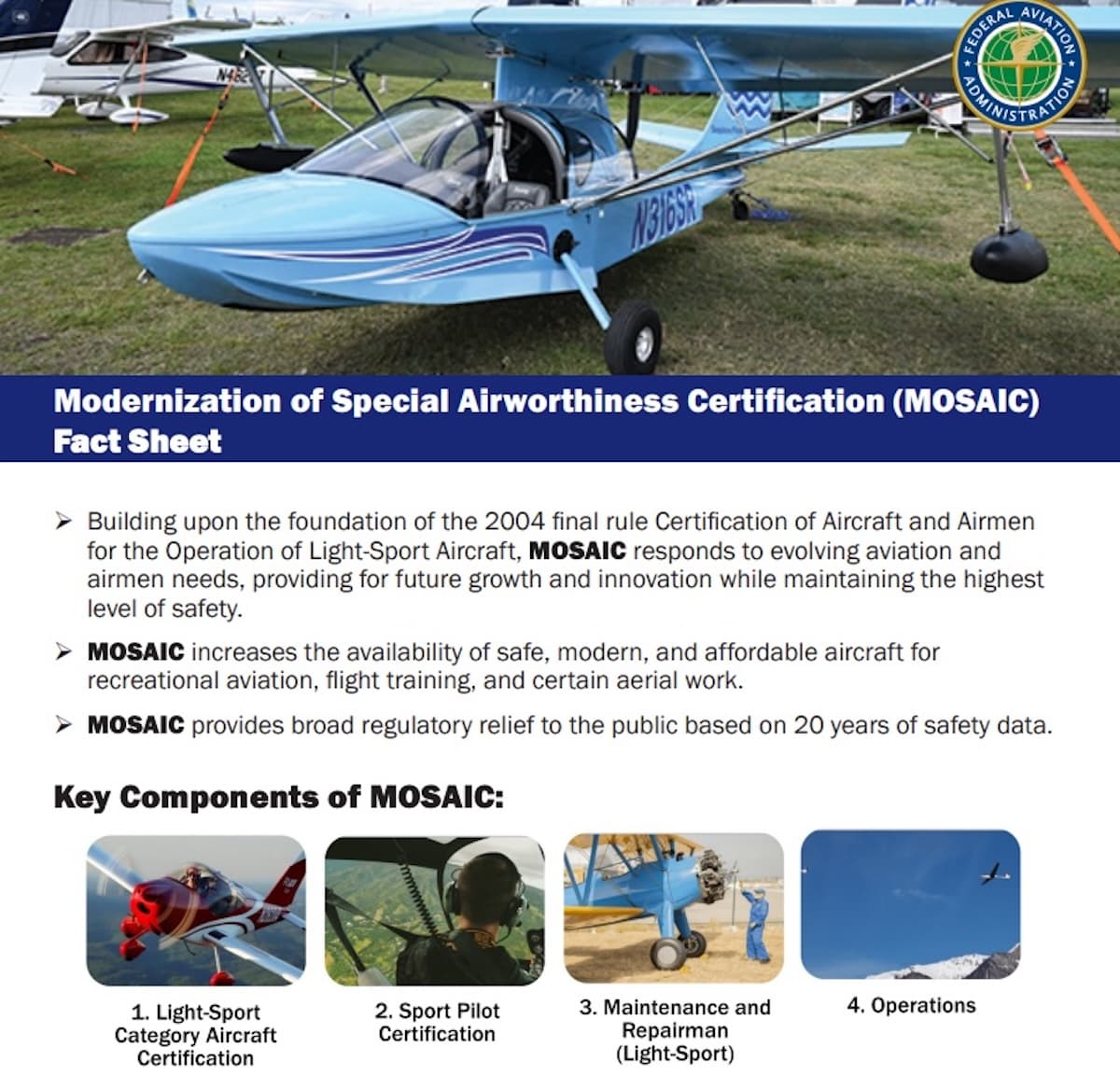
The rule’s first effective date, Oct. 22, 2025, brought changes to:
- Pilot training and certification rules and privileges
- Repairman certification, maintenance rules, and tow-hitch installation
- Class G airspace and right-of-way rules
The next round of changes will take effect July 24, 2026 and include the removal of the light-sport aircraft definition from 14 CFR § 1.1, airworthiness certification requirements, and operations (including operating limitations).
According to the Fact Sheet, MOSAIC amends 14 CFR part 21 and adds part 22 to:
- Adopt more performance-based rules to expand and enable innovation in the classes of aircraft that may be certificated as light-sport category aircraft using consensus standards. This includes emerging aircraft types.
- Allow manufacturers of light-sport category aircraft to design and manufacture a broader array of aircraft, including rotorcraft and powered-lift.
- Remove prescriptive weight limits that hinder incorporation of safety-enhancing designs and equipment.
- Increase the maximum stall speed for light-sport category airplanes (61 knots VS0) and gliders (45 knots VS0).
- Allow faster, higher-performing aircraft for personal travel.
- Enable more capable and robust aircraft for pilot training.
- Allow for increased capacities for passengers, fuel, and cargo.
- Allow new types of propulsion systems (like electric), any number of engines, new propeller types, and retractable landing gear.
- Allow aircraft with simplified flight controls, enabling reduced flight hours for pilot certification.
For Sport Pilot certification, MOSAIC 14 CFR part 61 Subpart J § 61.316 changes performance and design limitations, expanding what aircraft sport pilots can operate.
- Removes aircraft weight and airspeed limitation.
- Permits use of any powerplant type except turbo-jet powered.
- New VS1 maximum stall speed (flaps retracted) of 59 knots CAS.
- Allows operating aircraft with retractable landing gear.
- Allows operating airplanes with manual controllable pitch propeller.
- Allows use of 4-seat airplanes but retains 2 occupant limitation.
- Night operation privileges.
NOTE: The aircraft must meet the above requirements at the time of original certification.
The Fact Sheet delves deeper into other topics, including:
- Sport Pilot Practical Tests
- LSA Maintenance and Repairman requirements and training, and
- Experimental Aircraft Operations
You can see the Fact Sheet here.
I’ve owned my J-3 for twenty five years and my RV-4 for eleven years. I don’t see me changing planes anytime soon. I’ve been doing BasicMed since it became available after two Special Issuances. MOSAIC has simplified my aviation activities. The only plane I might buy would be a Stearman which fall under the new rules too.
I suppose it is all what folks want or need to do with their flying. My cross country is almost exclusively solo so RV-4 works for me. Occasionally I’ll fly my wife down to visit our older daughter and drop her off for a day or two and then retrieve her. I get a couple hours on the clock roundtrip and she has a one hour ride vs 3.5 drive. An hour is about her limit in a plane.
Both my brother and I plan to get our Sport Pilot Instructor rating just be able to perform tailwheel checkouts given we have 5,000 t/w hours combined. It will be fun to give back to the community now!
I am very confused about MOSAIC and have a hard time understanding what the real benefits will be. For a start, I don’t think we will see a flood of affordable GA airplanes. It will open the US market to high performance, very efficient European designs that might end up costing a mere 300k instead of 450k for a newish 172 – still far more than anybody outside the 1% club could justify to his or her spouse as a recreational vehicle!
In terms of enhancing the market for existing legacy (read old) aircraft that are suddenly MOSAIC compatible, I think the effect on prices and demand will be very limited (read hardly noticeable) unless many more pilots go the Sport Pilot route – right now its only around 4.5% of the pilot population. The only reason a student would elect to end their training at the Sport Pilot level would be if they were only interested in flying for recreation; I’m guessing this represents a very small percentage of the student body at all the flight schools in the US. My last point of confusion about MOSAIC involves safety. I would like the FAA to explain how it is suddenly a good idea to fly more complex, heavier and faster airplanes without a requirement to ever see a doctor every now and again. The present system of Basic Med works extremely well; unless you have a known disabling condition that would be quickly spotted on your next doctor visit (only required every 4 years!) why would you elect to fly on your drivers license instead of continuing to stay current with Basic Med, It may be a very small number of pilots that take advantage of this loophole but it is still a potentially unsafe way to circumvent the need for any outsider to confirm your fitness to fly. Tell me I’ve got this all wrong! My big regret is that pilots like myself trying to keep a 60 year old Cessna 150 in the air are still unable to take advantage of the insanely cheap, capable avionics available in the experimental category. If the FAA was really serious about helping rejuvenate the GA community and enhance safety, they would have found a way to encourage owners like myself to update old panels at a cost that doesn’t equal the hull value of the entire airplane.
People who own a Chevy lust after a Cadillac. Those who wear Timex watches pine after a Rolex. Then they get those items, and the weight of incremental costs and liability sets in. The Caddy gets stolen but you still owe the monthly payments on it. The Rolex disappears out of the gym locker. Then look back wistfully on the good old days of the Chevy and Timex. Simpler legacy designs and technology may be preferable in the overall picture. Time will tell for those moving up the ladder with beefier Cesnas, etc.
Regards/J
None of that is usually true.!!
I own a 25 YO Chevy, and like it because it does what I need. …gets 40 mpg and can travel 500 miles and still have fuel for another 50+ miles.
I fly a 65 YO Cessna and prefer it to newer, with its 6+ hours of fuel, manual flaps, gravity fuel so no pumps needed.
The sport pilots will be safer flying a somewhat larger certified aircraft, with demonstrated crash protection, with more structure around the cabin area.
We’ll see as sport pilots move to larger and certified aircraft….?
My thoughts are that sport pilots will be flying a number of GA aircraft, increasing the demand and the price of them, like Cessna 150,152,172, 182, as well are Piper, Mooney, etc.
So, I expect that existing light sport aircraft to decline in value and prices, as sport pilots move to more capable certified GA aircraft.
Maybe we’ll see new, larger, higher gross weight experimental aircraft ?