

Winter has just hit us again. Not that anyone would particularly notice in my Florida neighborhood. As I sit on the patio of my local coffee shop with a loose collection of fellow caffeine abusers, I take note of my surroundings. Some of my fellow customers wear coats. A few are sporting their one flannel shirt. About half of us are in long pants while the rest wear shorts. Sandals are well represented on the deck.
The thermometer reads a brisk 62°. I comfort myself in knowing that number will rise considerably after the sun comes up. Any minute now. It’s coming.
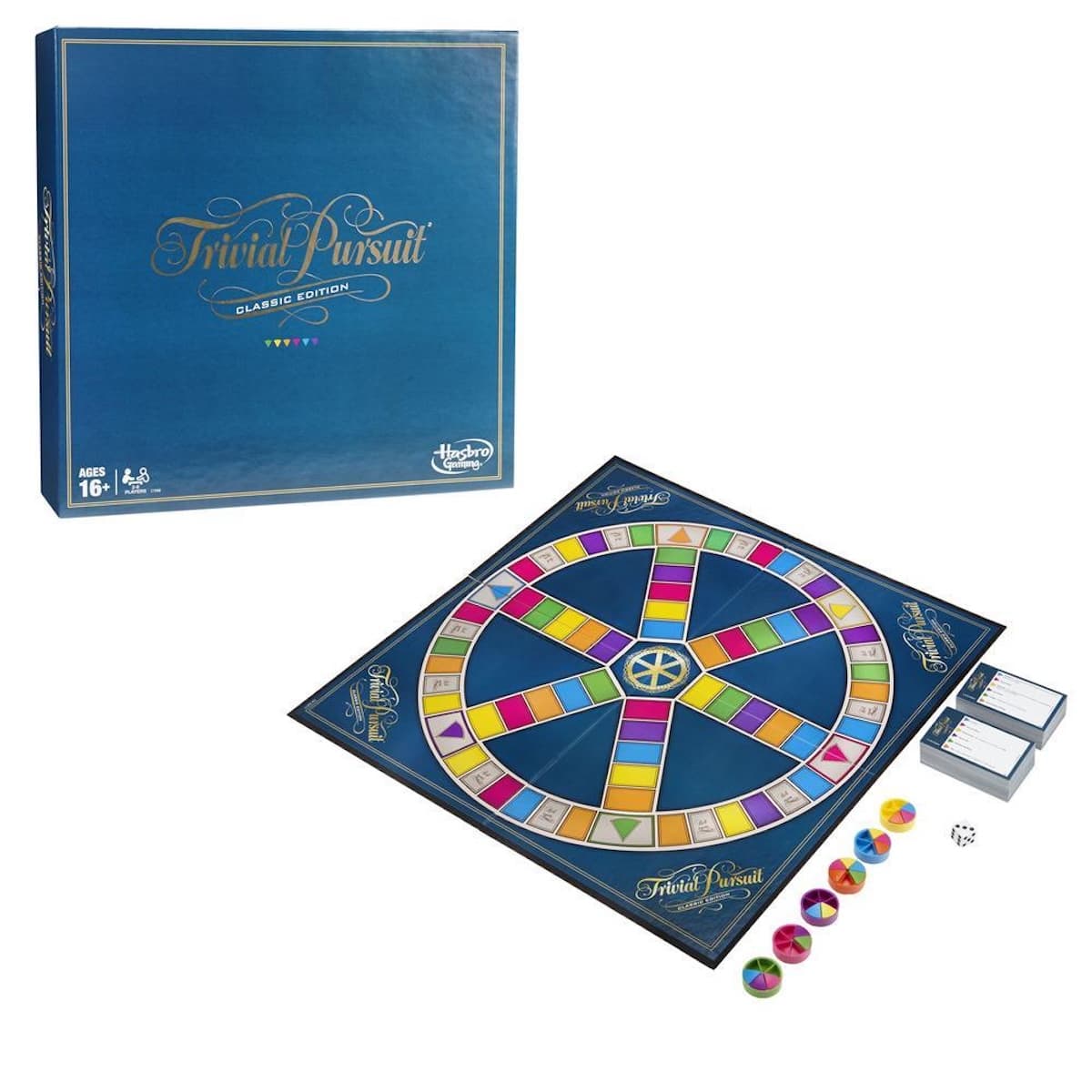
At a nearby table a group of four regulars begins a game of Trivial Pursuit. They are all retired. Three of them come from academia. Three are serious musicians. Their curiosity about the world and their command of the minute details of it are a source of pride for each of them.
Trivial Pursuit is a brilliant game produced by the Hasbro company. Launched a century ago in Providence, Rhode Island, the company grew and expanded over time. Today its east coast headquarters are in Boston, while its west coast offices are in Renton, Washington. It is a pretty big deal in the toy and game business.
From the table across the patio I hear, “What’s the largest airplane in the world by wingspan?”
Four answer options are offered. None are sure of the answer. The Boeing 747 tempts one. Another is considering the Howard Hughes’ built Hercules, which most people think of as the Spruce Goose. None of them seem to be familiar with the actual answer, the Stratolauncher named Roc. This beast comes from the imagination of Burt Rutan and was built by Scaled Composites. With a wingspan of 385 feet, it’s a whopper of an aircraft.

No worries. That’s some fairly esoteric information. Few outside aviation even knows of the Roc or what it does.

A few rounds later, I hear one of the players call out, “Jamie knows the answer to that one.” The question was something like, “What is ground effect?” The fact that I’m not participating in the game seems to be of little concern — the far more salient point being that someone on the patio knows the answer to a question. The players, for their part, simply use the game to learn from each other or potentially anyone else who happens to be sitting within earshot.
Well, as it happens, I do know what ground effect is. I also know what it isn’t. Far too many pilots were taught it references a cushion of air that develops under an airplane that is attempting to land. That is not true.
What ground effect truly is is a reduction of induced drag when an airplane is flying low, roughly within one wingspan’s height above the ground. The reduction of drag results in greater efficiency of flight. An airplane that is carrying a bit too much speed may tend to float rather than settle to the runway as expected.
I could go on and on about this sort of thing. Aerodynamics and the physics of flight just fascinates me. But I did not. I simply smiled and raised my coffee cup to the players across the patio. There’s no need for me to intercede and ruin their game, even if one of the players wants me to. The other three wore expressions that said they were perfectly content to consider the options on their own merits.
As it should be.
This left me thinking about the value of such a game. It also took me back to my flight school days. A handful of fellow flight students would gather in my apartment several nights a week to discuss and review the material we were expected to master. We thought of it as a study group. It could just as easily have been a Trivial Pursuit session focused on bits of information that may appear insignificant individually but have great importance when viewed as part of a larger, more complex picture.
Hasbro capitalized on the success of its game by creating editions that focused on both wider or more specific facets of life. There is a Master edition and a Harry Potter edition. You can get a version of the game that specializes in specific decades and another that queries information about various generations, such as Boomers, the Greatest Generation, and perhaps even Millenials and Gen Z. There is even a horror edition for those who are into that sort of thing.
I do not delude myself into thinking Hasbro would ever produce an aviator’s edition of the game, but what a gift that would have been to my fellow flight students and me back in the day.
Of course, it would be easy enough to create a version for ourselves if we chose to. A casual game for pilots gathered in the FBO when the weather isn’t conducive to flight. The Hangar Flying Edition. A perusal of the FARs could provide question and answer pairings. So could a flip through the Aircraft Flight Manual or Pilot’s Operating Handbook for specific makes and models.
What an opportunity for a type club to develop its own version for members to play. Do I see a Championship Round in our future for Aeronca, Cessna, Piper, and Mooney? A flashy trophy and some serious bragging rights would certainly incentivize a fair number of pilots to feel the burn as their competitive spirits get fired up.
In my wildest dreams I could see a version played by a large group of a few dozen pilots simultaneously. We could call it The Flight Review Edition.
I imagine a genial host could pose the questions, provide the answer options, and query attendees to find the correct answer. Celebration and prizes might accompany correct answers. Perhaps a point system could add or subtract from an attendee’s total to determine if they are able to successfully complete the game.
Gamification of educational material has long been used to inspire and motivate students to participate in a meaningful way. Perhaps it’s time we apply that tool for ourselves. For the safety of flight in general and, maybe, because a few more of us might involve ourselves in the educational process more actively, rather than simply looking for the quickest, cheapest, and least challenging flight review we can find.

Brilliant idea, Jamie. I hope Hasbro heard about this.
Great idea, Jamie! A game like that would help keep the FUN in learning! So it’s not just learning facts, but how to apply them, like scenario based training. There’s so much to know, depending on what kind of flying you do. A friendly challenge to see what you do and don’t know, so you know what to study, if you are ‘so inspired’ to get back Into ‘the books’ and review.. We all need to review something!
Good idea. A good way to get people to pay attention and stay engaged with something is to make a game of it. This is used constantly in marketing, it is called “gamification” and it works.
Maybe an aviation game based on Monopoly? Squares like “Get 100 gallons of 100LL free” or “Expensive AD note arrives” or “Passed your IFR checkride”.
We have too much time on our hands in the winter.
Could be a way to expand knowledge, as you mentioned different training charactures have been used in training manuals for years.
But I’ve often wondered in many accidents if wasn’t a lack of innate knowledge and a particular circumstance coming together. Especially when very high time pilots are involved.
Going to have to watch for this at the “Rusty Pilot” meeting in March!
It’s been a couple years now but Janice published the Scrabble game Lisa and I finished where we had thrown out the Scrabble dictionary and played with any aviation word, acronym or abbreviation. As it turned out we both used all our tiles and had almost matching scores. The boss at ASA sent us a pair of Aviation Dictionaries We can stretch ANY subject and have fun with it. I used to teach A&P subjects using Jeopardy style questions I’ll give you the answer and you tell me the question 😎. Excellent challenge. It’s wherever you make it.