


Something unusual is happening. Of course, that sentence can be applied at almost any time in almost any setting. Something unusual is always happening.
For those who fly, the unusual is something we try to avoid.
This week the ambient temperatures in Florida will be plummeting into a territory we rarely see. Frozen water will be outside of Margarita glasses and on the streets within spitting distance of Orlando. This is not just out of the ordinary. In this part of the world frosty mornings can be far more challenging than a New Englander might imagine.
Florida is the flight training capital of the world. At any given moment there are massive numbers of flight students with low time, high hopes, and relatively little understanding of the environment they’re operating in. That’s not a disparagement of their potential or their character. At one time I was one of those inexperienced neophytes.
People who are used to flying in hot humid conditions tend to develop a set of skills that are in line with the circumstances they most often see. They do not develop insightful judgment into circumstances they rarely, if ever, see.
Frost is a great example. Even when I was flying in New England, where I whined incessantly about the cold, I met pilots who were unaware of the danger those tiny ice crystals can present.
“It’s not heavy,” they’d say. “It’ll blow off when I get up to cruise.”
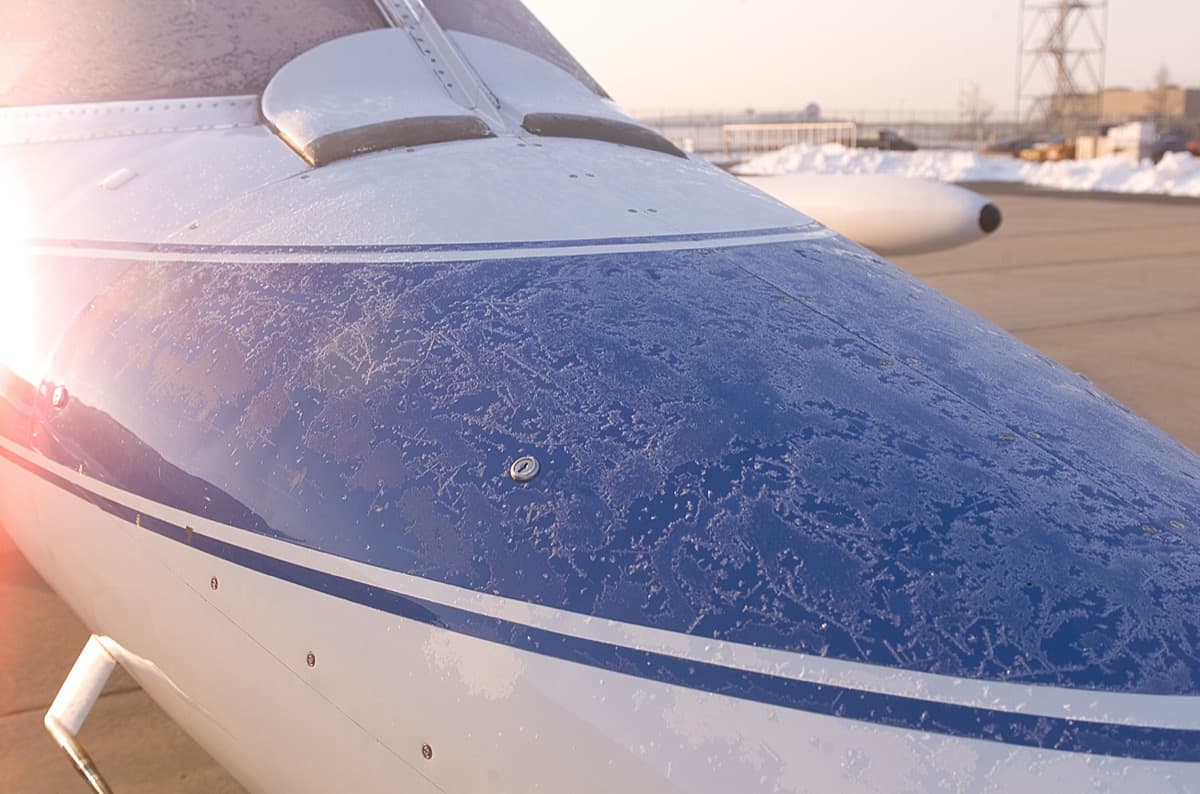
The problem with frost isn’t the weight of it. It’s the roughness. Those equally small air molecules are no longer flowing freely across the upper surface of our wings. Lift is spoiled. We may be able to generate enough lift to get into ground effect, but maybe no higher.
Anyone who has ever achieved flying speed without altitude as the trees at the end of the runway get bigger and bigger has a familiarity with a level of butt-clenching awe we hope the rest of you never experience.
Then again, the frost may blow off as some believe. It is unlikely it will blow off evenly, however. Having dramatically different levels of lift being produced by the left and right wings is not desirable. Having that imbalance changing erratically and unexpectedly isn’t any fun either.
Relatively few flight students in the south are aware of these dangers. Nor are they familiar with oil that flows like pudding, greased assemblies that become stiff, and batteries that seem to have magically lost their oomph overnight.
They’re going to be presented with these challenges this week for the first time in years. More importantly, so are their flight instructors. Many of whom trained in the south themselves.
It’s not exactly a case of the blind leading the blind. But it is closely related to the myopic leading a group with dilated pupils. They can both see, but not well enough to know what they’re looking at with any specificity.
This is a problem that must be addressed in the interest of safety.
It’s not all bad though. Flight students in the south who are used to seeing anemic climb rates on hot, humid afternoons will suddenly be astounded to see their vertical speed indicators registering previously unimaginable numbers. Cold air is denser than hot air. Dense air means more power from the engine, a better bite from the propeller, and more lift from the wings. Suddenly that typical 500 foot per minute climb is out the window in favor of more than double that rate.
Unusual circumstances lead to unusual results. That’s very true in the deep south when Chicago-like temperatures invade the land. It is equally true when the dog days of summer drop in on those who live well north of the sun-soaked southern states.
None of us is as good as we’d like to be at dealing with situations that only roll around once in a while. Familiarity breeds proficiency. If we practice often enough we tend to get good at something. That’s as true of flying safely as it is of playing Flight of the Bumblebee on the piano or building a structurally sound porch. Recency of experience plays a powerful role in the outcome of our efforts.
Complacency, on the other hand, has a tendency to lead us into clumsiness and misunderstandings that can devolve into full-blown incompetence. This is the exact reason pilots have currency limits. Those of us who have had the experience of instructing students, sometimes performing as many as 50 landings a day, tend to become quite adept at squeaking a landing onto the centerline even under challenging conditions.
Then again, as anyone who has actually gone 89 days without performing a takeoff and landing can tell you, it’s nerve-racking to settle into the left seat without a competent pilot in the right.
Incidentally, that’s a really bad idea. If you’re so far out of practice that you’re bumping up against the currency limits established by the FAA, your flying club, or common sense, don’t go solo. The risks just aren’t worth the reward.
The long and the short of it is we all face challenges in various forms over the course of our time in the air. Some are obvious, like southern pilots experiencing extreme cold for the first time ever — or at least for one of the few times they’ll see such conditions in their lives.
Others are less obvious. They require introspection. It’s our responsibility to be honest with ourselves. Is that ceiling really high enough for this VFR flight? Are these winds truly and consistently manageable? Is that engine that’s burning more oil than normal good to go on this flight over water or miles of dense forestlands?
Whatever the case, when we find ourselves saying, “well, that’s different,” perhaps we could step back, consider the situation seriously, and acknowledge that seeking insight into how to best deal with an unusual situation is the smart move. And it’s the smart move every damn time.

Great article—it perfectly captures the unique weather challenges in Florida. As a pilot who did my initial training in the Midwest before moving south, I experienced both sides of this. I was initially shocked by the performance hit from the heat and humidity, and I remember my first winter flight down here being surprised by how few pilots seemed prepared for even a light frost check.
The point about instructors also facing rare conditions is so important. For any CFIs reading this, are you planning to adjust your briefings or lesson plans this week to specifically address cold weather operations with your students, like pre-heating procedures or performance calculations?