

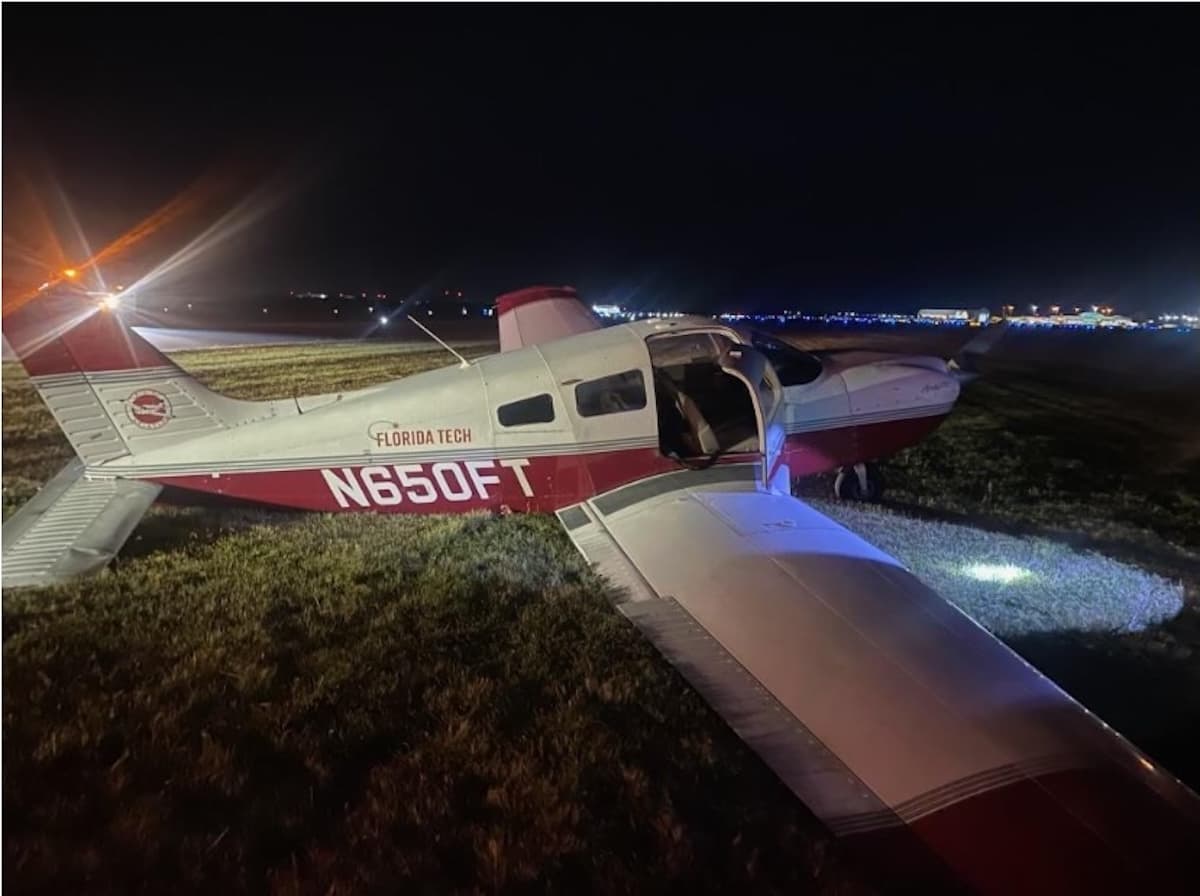
It was a routine night training flight. A CFI and two commercial students — one in the left seat, and one a “back-seater” — had just been cleared for takeoff at Melbourne Orlando International Airport (KMLB) in Florida.
The airplane, and its crew of three, would never even make it off the ground.
The Leadup to the Accident
The airplane, a 2013 Piper PA-28-181 Archer, belonged to a well-respected medium-sized collegiate 141 program. The trio loaded up on the college’s ramp, just east of mid-field on the south side of the airport, where they are initially given instructions to taxi to 27L at Victor, via Victor — straight up from the school for an intersection takeoff roughly a third of the way down the 10,181-foot-long, 150-foot-wide runway. Of possible note, this would have them going backwards up a high-speed exit, so their entry angle onto the runway would be at roughly 45°.
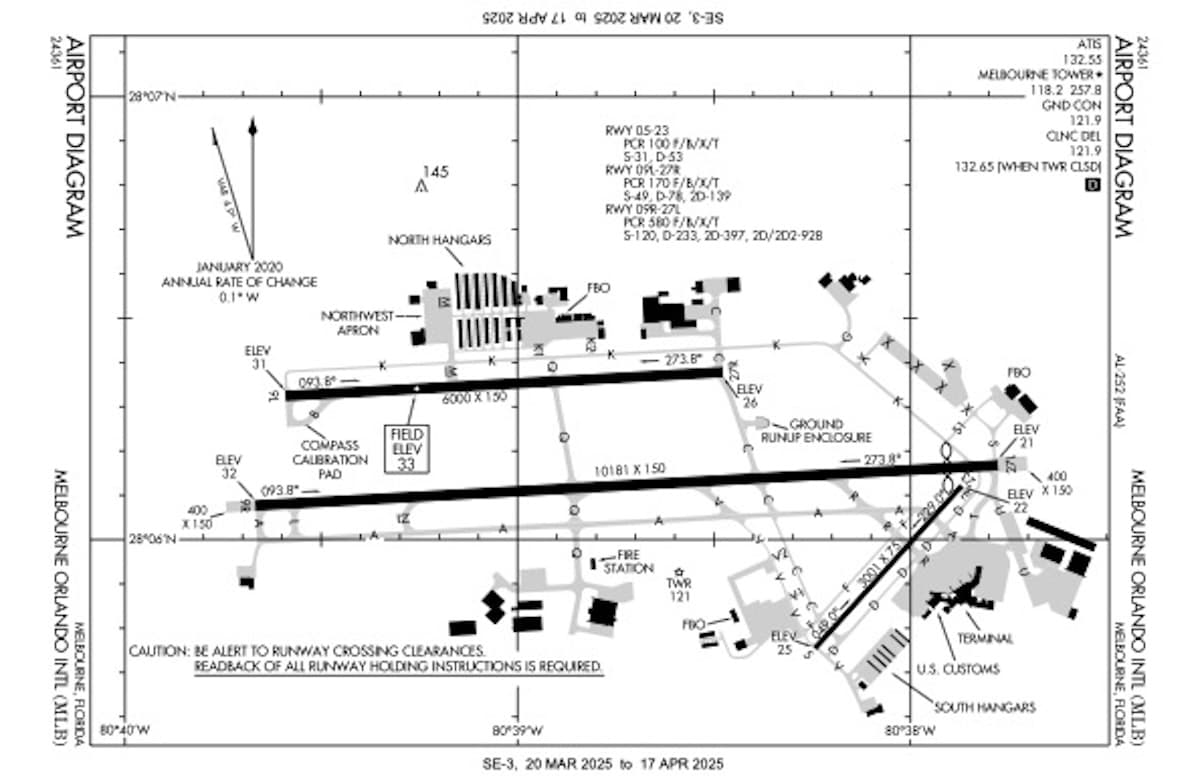
But before they get there, the wind changes, and Ground sends them to 9R at Quebec, via Victor, Alpha, Quebec. It’s now a mid-field takeoff, and a 90° right turn onto the runway — and in all his training, the left-seat pilot had not previously departed from this intersection.
Neither had his instructor.
The Accident
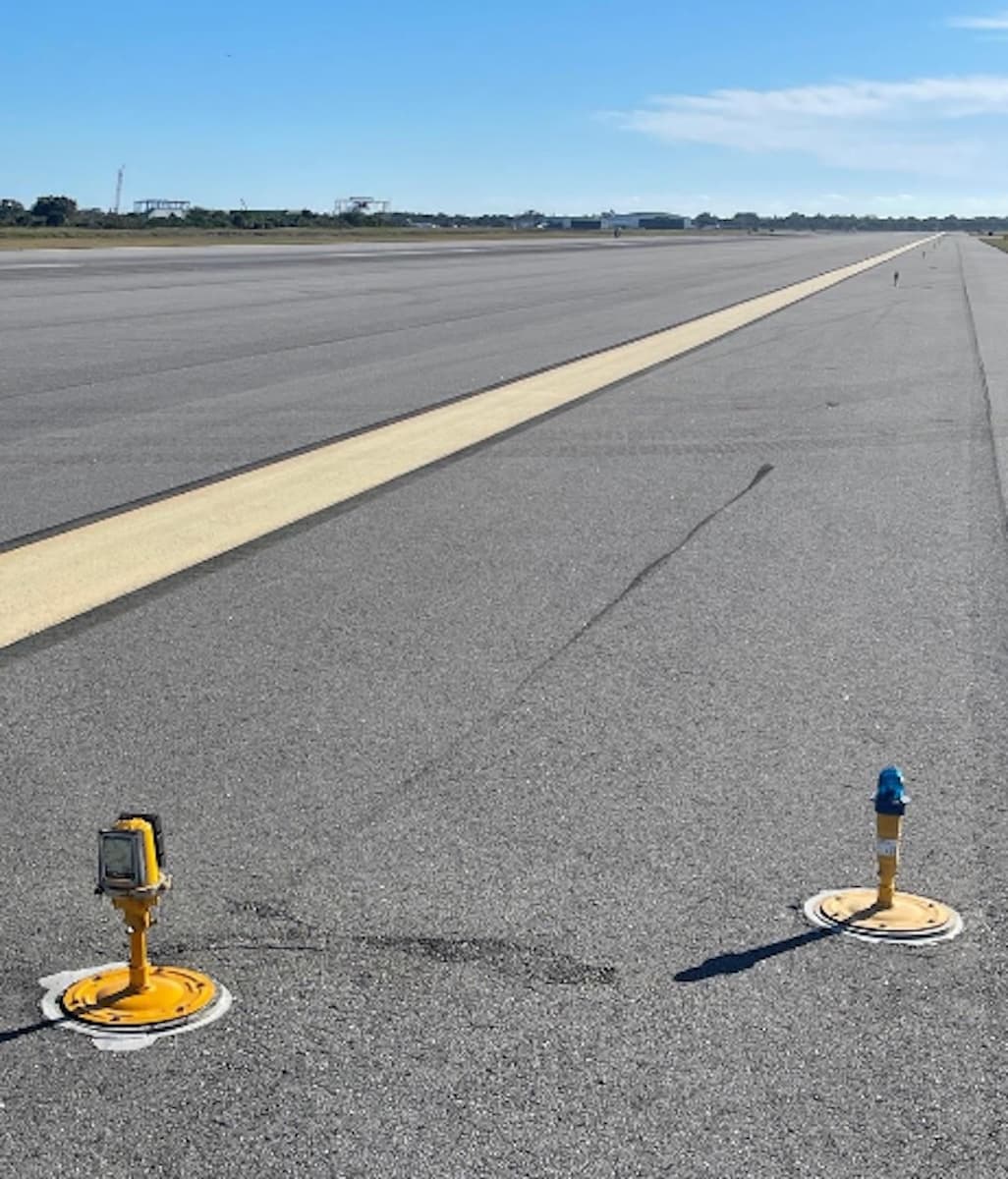
Cleared for takeoff, the student taxies onto the runway, but apparently he mistakes the right-hand runway edge line for the runway’s centerline — which is still some 75 feet away — powers up, and proceeds to take out a runway edge light, collapsing the landing gear, and skids off into the grass.
The excursion causes “substantial” damage to the airplane, and no doubt the same level of damage to the instructor’s career — the pilot shortage notwithstanding.
Okay…Seriously?
Quick pilot quiz: What’s the difference between runway edge stripes and runway centerline stripes?
Good. Glad to see all of you got that right: The center stripes are dashed lines, or, quoting the Aeronautical Information Manual, “uniform stripes and gaps,” while the side stripes are continuous lines. They are both white, granted — as are all runway markings — but it’s a little hard for me to understand how a certified private pilot, who is a student in a four-year aviation program, wouldn’t know the difference.
The Flight Crew
The college operated a mixed bag of Piper aircraft, all with varying types of “glass,” some Avidyne, some Garmin G-1000. The private-rated student at the controls had mainly flown Avidyne-equipped Warriors, but this night was in a Garmin G1000-equipped Archer, so the instructor was helping him out with the systems as they got ready to go.
That said, this wasn’t the student’s first Archer rodeo. He had 45 hours in make and model, with about 8 of those at night. He was 24 years old at the time of the accident, with 177 hours in his logbook. Airline-bound, he held a First Class medical certificate.
His instructor was a 27-year-old female with 1,108 hours. If she was a graduate of the college herself, she pretty much had her “airline hours” — which, depending on the distribution of her college credits, could be either 1,000 or 1,250 hours total time, with 200 of that needing to be cross-country, a metric not collected by the NTSB. Still, I think it’s safe to say she was closing in on the next phase of her career at the time.
We don’t have any data on the backseat student other than he was also a commercial-phase student of the flight instructor and had assisted on the preflight.
The Instructor’s Actions
It’s a proven fact that accidents like this are more common with “certified” students than with primary students, possibly because instructors let their guard down when it comes to the basics. But by her own admission, after being told by the Tower at the hold-short that they should expect a five-minute wait, she “pulled up the course syllabus on my phone to check the lesson time and completion standards, just to verify one more time before we departed.”
But they are cleared for takeoff after only two minutes. The instructor told the NTSB, “I was startled by the quick clearance.” She drops her phone, scrambles to get the door closed — in warm climates, it’s common for flight schools to leave the single door on the instructor side of the low-wing Piper cracked for ventilation until just before flight. While she’s securing the top and bottom latches, the student is on the roll. She then “made sure my belongings were secured” and that the multifunction display was on the proper page.
“My head was down for what felt like only a moment as I felt my student apply takeoff power,” she told NTSB investigators.
She gets her head out of the plane, sees that something isn’t quite right, but “by the time I processed, we had hit the runway edge light and the entire right-hand gear collapsed, causing us to lose control of the aircraft and slide off the runway.”
She said it was only a matter of “seconds” from the time they started taxiing until the flight ended in the grass. She says she didn’t have time to take the controls and credited the student for his quick reaction in pulling the power. She advised the tower they were off the runway, then shut the plane down and ordered the evacuation. None of the three are injured in the accident.
Analysis & Discussion
Apparently, the left-seat student started following the yellow taxiway centerline, but as he crossed the runway edge line, he decided it had to be the center line. Quoting his statement to the NTSB, “While proceeding along the center of the taxiway, I saw a white line, and thought it was a centerline, and aligned with it.” He verified his heading with the compass, “and put full power for takeoff.”
Two seconds later he hears the sound of his right main being torn off.
Most of his time was in Warriors, with a brighter nose-mounted landing light. The wing-mounted Archer lights were apparently dimmer than he was used to, but both the instructor and the other student agreed that it was “normal” for the make and model, and the left-seat student had previously flown Archers at night.
The Takeaway
Reading through all the documents my first thought about the student was to wonder if an over-emphasis and over-reliance on glass avionics in his flight training over-shadowed basic operational knowledge. Like, for instance, analog dashed-lines vs. analog continuous lines.
And I also had to wonder if airline-hour-itis had robbed the instructor of her edge. I’d love to see a “Killing Zone”-style study of accidents correlated to instructor hours. We certainly know that get-there-itis results in accidents. I guess this could be a wakeup call that there are likely all kinds of “itises” that are a danger to be alert to.
This could also be an example of what other industries call “routine complacency” — a flavor of complacency that comes out of doing the same actions over and over to the point of being on “auto pilot” and not paying attention. It’s sort of a flavor of normalization of deviance. But no takeoff should ever be regarded as routine.
The latest McSpadden Report from the Air Safety Institute shows us that takeoff accidents are not only the second most common type of GA accidents, but that they are one of the few types of accidents that are on the rise.
Of course, this really wasn’t routine, was it? The instructor had never personally taken off from this intersection. Should that have not inspired her to up her game a bit more than usual? It’s an appallingly bad choice to look at the syllabus she had been teaching from — probably for some time — to “verify one more time,” rather than focusing on situational awareness related to a new takeoff location.
And there’s some operational sloppiness to think about here, too. I mean, really, shouldn’t you button up your door and secure your belongings before you call the tower for your takeoff clearance? Had the CFI taken that basic, sensible step, her eyes would have been outside the airplane from the second it started rolling — and had that been the case, I doubt this accident would have happened.
The takeaway? For young airline-bound instructors: Mindfully keep your head in the game, especially as your logbook starts getting entry-level fat. You don’t want to cash in your career aspirations at the last moment with a wreck.
For the rest of us: Nothing is routine, especially in those zones that separate ground ops from air ops.
The Numbers
Want to read more? Download the NTSB’s final report here or view the items on docket here.

When did this accident actually occur?
I was told this is actually a three year old accident.
The accident occurred in February 2024. We base these reports off final NTSB reports, which take between 18 and 24 months to complete.
An unusual accident?…..Night was a factor and the last minute runway change as well as the CFI was not ready for the take off…..
I have to say with all my years flying…..I have learned when not ready, do not rush and tell the tower ….! “need a minute”…..
A good lesson for us all…..Do not rush ….
Regards to those involved
There is a saying applicable to all pilots: “Takeoff is optional. Landing is mandatory”.
So, you have a choice. Decide very well before takeoff.
Look if you are not comfortable with the assigned departure runway. Call tower and request full runway departure.
My instructor always drummed into my head you can’s use the runway behind you.
Just like you can’t use the fuel in the tanks on the ground.
You are PILOT in command.
With night time departures it is always best to use the full runway, should something go wrong with the airplane, This gives you more options.
Old school teachers and coaches coined the phrase, “Hey, dummy, get your head in the game” decades ago. It still works today. I use it on myself quite often…
“” The instructor told the NTSB, “I was startled by the quick clearance.” She drops her phone, scrambles to get the door closed — in warm climates, it’s common for flight schools to leave the single door on the instructor side of the low-wing Piper cracked for ventilation until just before flight. While she’s securing the top and bottom latches, the student is on the roll. She then “made sure my belongings were secured” and that the multifunction display was on the proper page. “”
The tower didn’t issue an EXPEDITE command, so why was she/they rushing the takeoff maneuver? Once the tower issues the clearance, the runway and departure airspace is the pilot’s for the procedure. No need to rush. Clean up the airplane and the cockpit and THEN release the brakes and advance the throttle to move ONTO the runway. The airport isn’t Indianapolis. No need to rush things. The lesson/log time doesn’t start until on runway centerline and the throttle advanced from there.
After 14700”+ hours I think back (at 88+ years) and thank God once again for all the guidance when my brain and the plane were not together.
How many of us have had similar escapades but got out Scott free.
Safety is always paramount but we are so fragile in mental acuity at times.
I fell sorry they had a very hard lesson and hope that it took hold in their minds. Being in a hurry is most often not correct.
Well stated!
First you need to look that no one else is on the runway, even tower controlled. Second make sure you’re evenly between the lights on the center line. Third at night slow things down, when pilots get rushed stuff happens. Fourth many pilots think their flying skill is better than it really is. Fifth interesting how many instructor accidents are happening these days.
Up until today, I had thought that instructor accidents had only become common in my country (Argentina) over the last few decades, even in spite of increased classroom time before the first training flight.
But the occurrence of these accidents in the US raises a host of red flags too. Flight instructors should perhaps focus more on the fundamental importance of supporting the student pilot’s present rather than their own future.
Yup, all that., AND there is a nice yellow taxi line to follow to the runway center line..!
Maybe the poor taxi lighting didn’t shine on the center line ?