

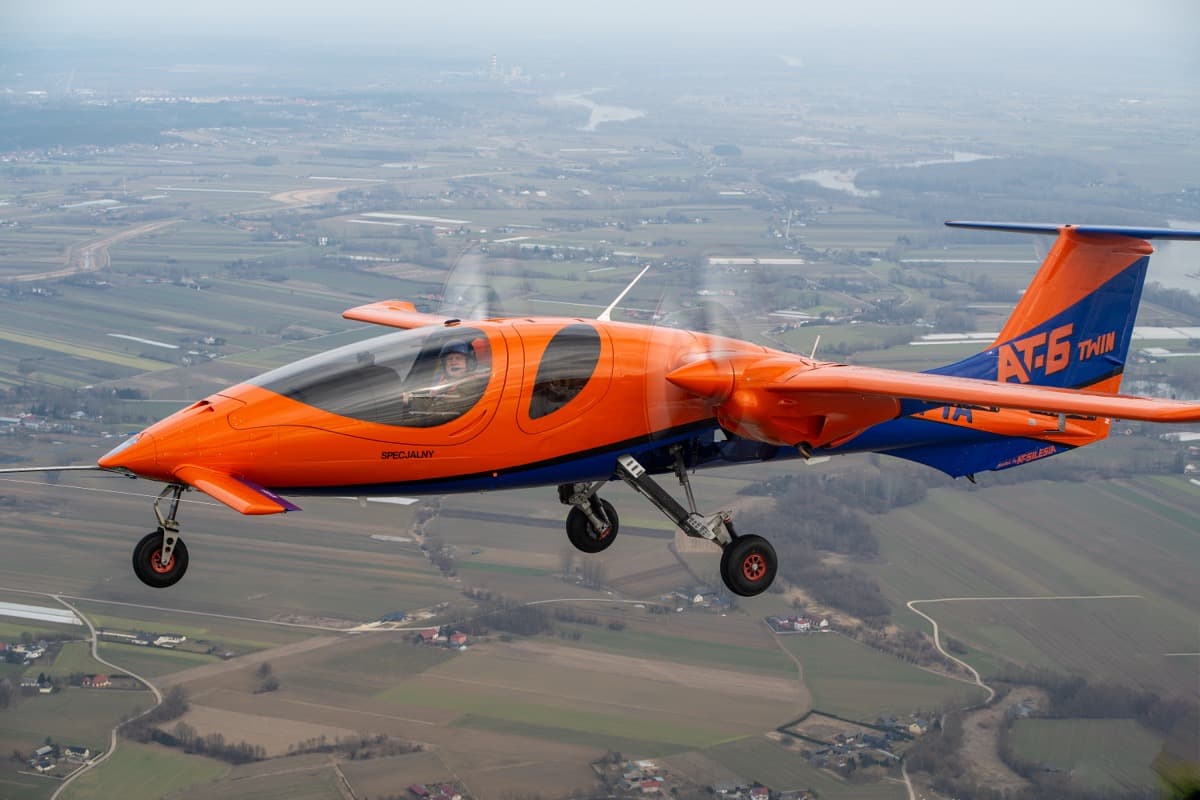
Flight testing has begun on the newest airplane from prominent Polish aeronautical engineer Tomasz Antoniewski.
The AT-6 Twin PSE began its first round of flight tests at Mielec Airport in Poland in early March 2026, according to Antoniewski, who has a legacy in aviation dating back to the 1990s.
His first aircraft, the AT-1, was the thesis for his degree at the Warsaw University of Technology. In 1994, he founded Aero AT, the company behind the AT-3, a certified Very Light Aircraft popular with European flight schools.
The next version of his aircraft family, the AT-4, made its debut in the United States in 2007 as the Gobosh G-700S, which was an American LSA version of the AT-4.
After leaving Aero AT several years ago, he founded AT-P Aviation to develop a new generation of trainers, including the AT-5 and the AT-6 Twin.
According to Antoniewski, his strategy is to provide a Zero to ATP family of aircraft, which would allow students to stay within the same design family.
His new designs are targeting the new MOSAIC (Modernization of Special Airworthiness Certification) regulations. Because MOSAIC removed previous restrictions like weight limits and fixed landing gear, Antoniewski’s more complex designs could be sold as LSAs in the United States.
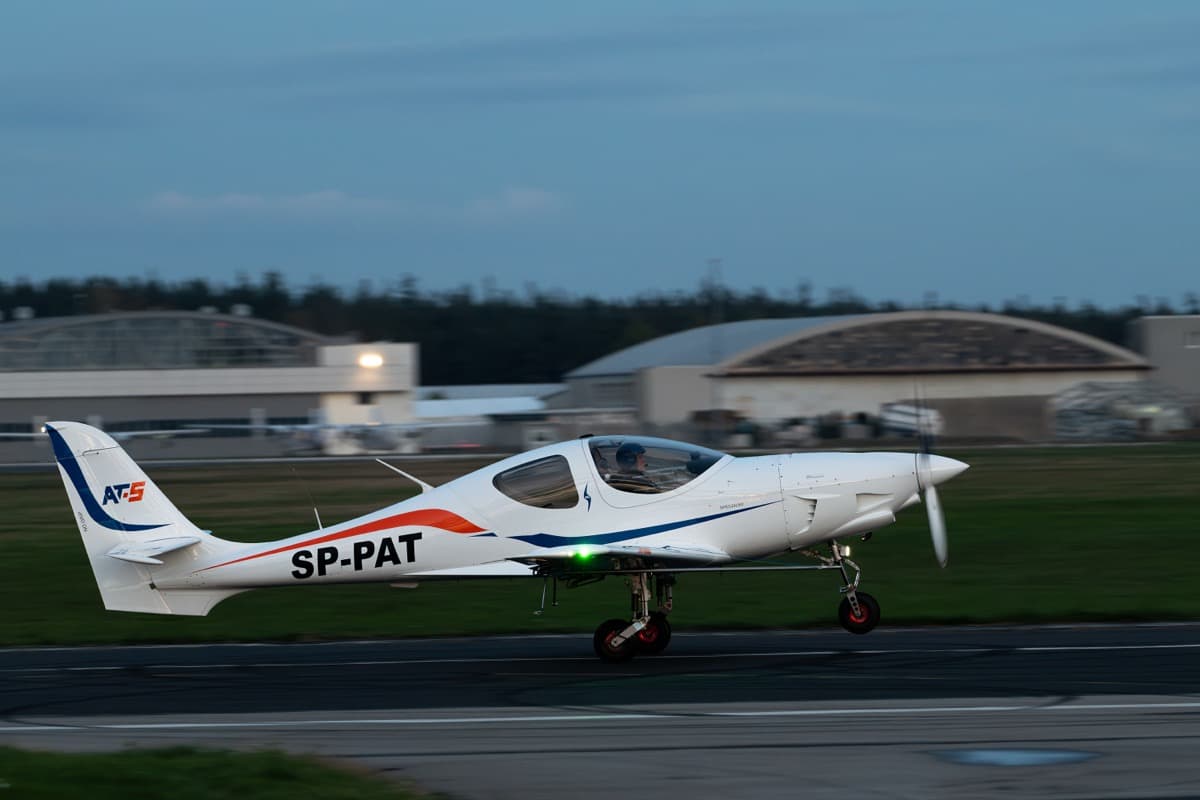
The AT-5 is a single-engine trainer with four seats, retractable landing gear, and a constant speed propeller. It also features a Ballistic Recovery System (BRS) parachute. It was designed specifically for training up to the commercial license.
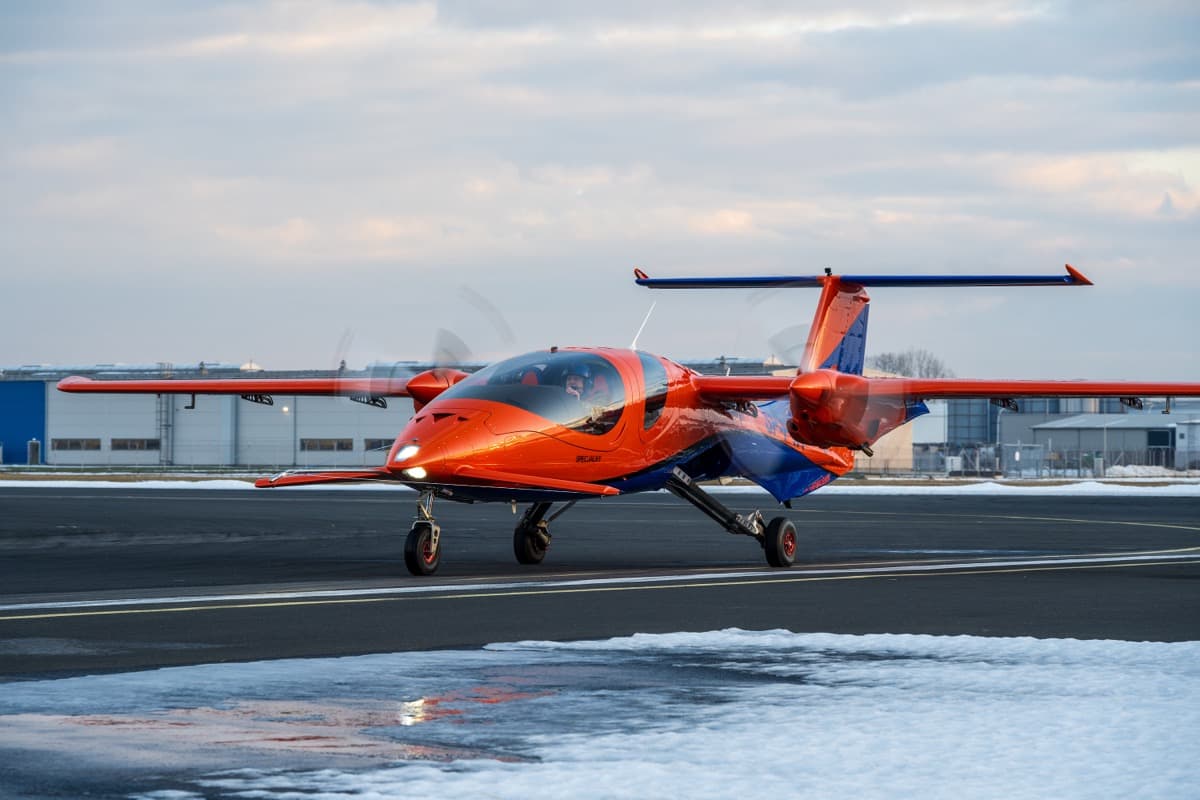
The AT-6 Twin is a four-seater aimed at IFR and multi-engine training. Under MOSAIC, it could become one of the few multi-engine aircraft available in the LSA category, making multi-engine ratings far more accessible — and affordable — for student pilots.
It features Rotax 916 engines, MT Propellers, Garmin avionics, and a Ballistic Parachute System.
Work began on the AT-6 in 2012 and was boosted in 2022 by a grant from the Polish Agency for Enterprise Development (PARP) to help the company go into production on the next generation twin trainer.
The project has had input from researchers at the Warsaw University of Technology, as well as the Military University of Technology, and the Łukasiewicz Research Network Institute of Aviation.
The all-metal AT-6 Twin features a “Three-Surface Aircraft” (TSA) design, with a canard installed at the front of the fuselage equipped with flaps that deploy in synchronization with the wing flaps. This configuration combines the properties of a conventional tail-aft layout and a canard layout to maximize stability across a wide center-of-gravity range.

Initial technical specifications for the twin call for a cruise speed of 160 knots, a stall speed of 59 knots, a service ceiling of 18,000 feet, and a range of 935 nm.
If all goes to plan, flight testing will wrap up in November 2026 and the aircraft could debut in the U.S. in 2027.
“If we achieve the parameters and performance required for the LSA category in our flight tests, we’ll exhibit at SUN ’n FUN and Oshkosh next year, hoping for quite good sales,” Antoniewski said.
For more information: AT5.pl

Extrem interesting Airplanedesign
Hopefully it will be launche in time and for a fair Pricerange
🙏🙏🙏
Great to see a new twin with excellent pilot visibility. Unlike the current crop recently introduced.