

In 1965 a car dealership in Connecticut ran an ad that said buyers could take home a Pontiac Tempest for just 1,395 bananas. It was a cute ad. Mass marketing at its finest. As it was designed to do, the ad grabbed the attention of potential buyers.
Unfortunately for the dealership, one potential buyer took the ad literally. She showed up with a bunch of bananas she intended to use as a down payment. The dealer balked. The customer insisted. She was responding to an ad in which they’d specifically said fruit was an acceptable method of payment.
Uh oh. Things were about to get sticky.
The back and forth was spirited and emotionally driven, surely. But when the Connecticut Department of Consumer Protection stepped in, the whole deal became national news and serious business.
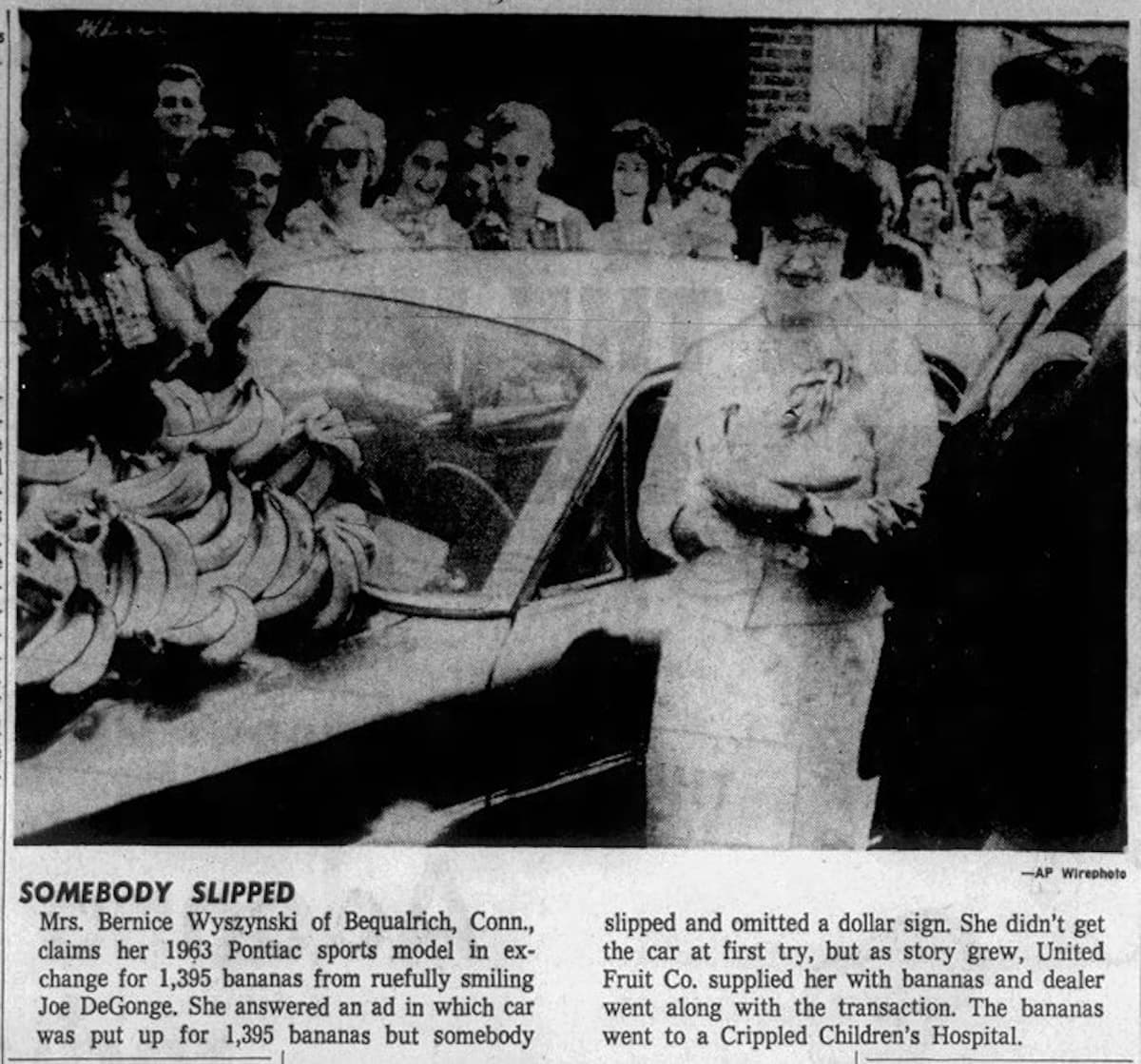
Ultimately, the dealer honored its ad. The woman was able to swap bananas for a car — a circumstance made even sweeter by the fact a fruit company donated the bananas, undoubtedly hoping to secure some of the high intensity spotlight focused on this messy deal.
The bananas were ultimately donated to a children’s hospital. So there’s that.
The lesson in all this just might be to caution businesses when they consider running ads or marketing their products and services to potential clients.
Be honest. Hyperbole can come at a high price. Leading potential customers astray through creative wording, catchy phrases, or promises that can’t reasonably be kept can lead to serious trouble.
This past week, while the 2026 SUN ‘n FUN Aerospace Expo was in full swing in central Florida, an acquaintance posted a photo to social media. The image was of an A-frame sign sitting on the ground at the show. The message was concise and clear. It was just three lines. It implied they could transform the average man or woman off the street into a career pilot in less than six months.
The comments left below that social media post were not kind. They weren’t wrong either.
Taken literally, can a flight school realistically turn a zero-time individual with no aeronautical background into a professional pilot in less than six months? Maybe. It’s within the realm of possibility.

Is it a likely outcome, however? No. To keep that pace the student would need to be a quick study, the training would have to be exceptional and timely, and every possible variable would have to fall in favor of the student for 25 weeks in a row. No maintenance issues. No cancellations due to weather. No illness or personal issues to distract or delay the student’s progress. To be that lucky for that long is exceptionally improbable.
There are flight schools making this claim today. Heck, several decades ago I attended an excellent flight school that made a similar claim. Rather than the advertised six months, I finished in nine months. Several of the students who were already there when I arrived were still there working on completing their training when I left.
There are plenty of people in the world who can give an aspiring pilot bad advice based on ignorance, malice, or an out-of-control ego. Flight schools shouldn’t be included in that group.
Like most people who seek a future in the left seat of an aircraft, I had no clear impression of what would be required of me to succeed. Even though I had been dabbling in flight training at Part 61 flight schools for a couple of years before getting serious, I was still largely naïve about the process and the content of the material I’d be required to master.
Let’s consider that point. To become a commercial pilot one must become not just familiar, but conversant and reasonably adept, on topics like aerodynamics, meteorology, navigation, flight planning, performance charts, human factors, emergency procedures, electric, pneumatic, and hydraulic aircraft systems, engines, fuel, weight and balance, and federal regulations.
Now, how likely is it that any of us could reasonably expect to complete that course of study in just 25 weeks? Especially when in between classes and study time, we’re tasked with the demands of learning how to operate an aircraft in flight — a process where we’ll be expected to manage the aircraft safely and proficiently through various configurations, airspeeds, bank angles, loss of lift, spins, inclement weather, and systems issues. No problem, right?
Making the claim that students with no prior training or experience can become professional pilots in six months or less may not be entirely analogous to the offer of selling a car for 1,395 bananas. But it’s not so far off the mark that a reasonable person can’t see the similarity.
Can the school and their students meet their self-imposed standard? Occasionally, perhaps. Can they guarantee such a result? No. Can they produce large numbers of former students who have met the challenge? Doubtful.
So why make the claim if the business is unlikely to be able to faithfully deliver? It’s the same idea the advertising agency had with the cars for bananas deal. The goal is to drive new customers through the door into the waiting arms of a motivated salesperson.
Frankly, it would be far better for all concerned if the motivation was to produce high-quality pilots, rather than a high quantity of students.
What if flight schools walked away from the swift completion model, instead touting the proficiency and safety record of their graduates? They could just as easily promote a mentorship program that leads students to gain real insight, worthwhile experience at the controls, and become truly thoughtful, safety-oriented pilots.
What are the odds that someone who was stocking shelves in a supermarket in January could become an experienced pilot of real character by June? Have they ever experienced an engine failure? An electrical system dropping out on them? A flat tire on landing? A downwind takeoff or landing issued from ATC? Or even a significant quantity of actual flight time in IMC?
Probably not.
Graduates with no more than 300 total flight hours haven’t faced those challenges or benefited from the lessons they can leave us with. They simply aren’t part of the curriculum — if for no other reason than there isn’t enough time to expose them to these and other issues pertinent to the task of becoming a commercial pilot and developing good judgment.
We should do better than this as an industry. But until those of us who have been down this road start pushing back on unreasonable claims, the odds of the training system improving significantly in favor of their clients is slim. And that should concern all of us.

Homogenized thinking omitting I can’t but he can.
I’m sure you had something in mind when you posted, Scott. But after reading your comment several times I’m left with just one response.
Huh?
For someone who wants to become a private pilot or go on further to become a commercial pilot with instrument rating and multi engine endorsement needs to focus on few things.
01. He/she must be goal oriented.
02. Must have motivation. A will do study, work hard and perseverance.
03. Mental flying or chair flying should be done.
04. Choose a good school.
The list can go on. But there are flying schools that put up commercial flying advertisements in magazines. A few years ago, there was one I read, “commercial pilot license. USD 6000. License guaranteed.”
What does ‘license guaranteed ‘ mean? In many cases, the owner of the school is also a DFTE of the State. Regardless of the aptitude, knowledge and progress skill of the trainee, he gets a flying license when finishes his last cent. License is guaranteed. Imparting the above knowledge to a student and converting from a zero to a commercial pilot in six months is not possible.
Happy landings.
…Lufthansa’s run the best civilian ab initio programs for more than six decades. But. Male and female students began entrance exams in the German equivalent of junior and senior high school years, along with physical and psyche evals. Upon graduation (there was no college degree requirement) the picks of that litter were flown to Arizona (Goodyear to be specific) and after intense ground school began their first flight training hours in A36 Bonanzas. Multi training took place in Barons and upset training in T-34s. They “graduated” in six tough months with single, multi, instrument and commercial tickets, and were flown to the company’s Bremen facility for turbine transition in Cheyennes, along with 737 sim time. Six months of that and they’re flying the line… with $80k 1990s-era USD paid back out of their salary. The result is one of the best safety records in history. JAL and at least two mainland China operators started, and maintain, their own ab initio programs after several classes of their crews graduated from Lufthansa’s ATCA. That’s how it should work. Here in Phoenix/DVT, AEROGuard has a student population that is for the most part sponsored by their Asian carriers, but their “finishing schools” with turbine transition and full motion, full size sim time, are back in the home country. Thinking that you’re going to self-finance enough time and ratings for a seat in Part 121 in six months just isn’t going to happen, no matter how high the credit limit on your Saphire card might be.
As an older instructor that currently trains instructors in one of these large 141 schools, I was going to write my insider opinion but the above post by Jim Roberts is right on and needs no further comment. But I will add that when the FAA removed the 2 year requirement for instructors to train instructors last year they killed the opportunity we older and experienced instructors had to transfer some of that experience to these young instructors. Time will tell as to the effectiveness of the current future airline pilot training programs but I guess you can assume what my opinion is. I think most of these new professional pilots will get up to speed fine but a number of them maybe wont and the consequences will become clear at some time in the future.
Good analysis, Jamie. IMO, the current system some Part 141 schools use is fatally flawed. As a friend and long time pilot observed, it’s “children training children.” God help us when these neophytes with no real world experience, situational awareness, or air sense make it into the cockpit with trusting innocents riding along behind them. The only hope is that if it’s a Part 121 operation, they might have amassed some semblance of experience, and the person in the left seat will be seasoned enough to mentor them. We can hope.
“Let’s be honest — this is misleading marketing, plain and simple. Promising that someone with no experience can become a professional pilot in under six months is not just unrealistic, it’s irresponsible. It sells a fantasy to young, motivated people who are willing to invest their time, money, and trust into a career path they don’t yet fully understand.
These kinds of claims prey on ambition while downplaying the reality: aviation demands time, repetition, exposure to real-world situations, and the gradual development of judgment. None of that can be rushed without consequences.
Yes, a small number of students might achieve it under near-perfect conditions. But advertising that outcome as if it were standard is misleading at best, and exploitative at worst.
If the goal is to produce safe, competent pilots, then honesty should come before sales. Because in aviation, cutting corners doesn’t just cost money — it can cost lives.”
While I agree with the spirit and intent of the article, there is an exception to Mr. Becketts generalization of, “Graduates with no more than 300 total flight hours haven’t faced those challenges…,” and that would be military (Air Force, Navy, Army) undergraduate pilot training. In 49 weeks and with about 180 hours of flight time, all the listed topics are covered in depth with the addition of intense physiological training, with experience (all in challenging turbine aircraft) in all types of weather, aircraft malfunctions (both simulated and actual), and a multitude of flying environment types to include precise aerobatics, formation, and low level. Upon graduation, the 180-hour pilot is qualified to enter training (with few special exceptions) in high-performance aircraft ranging from the F-16 to the C-17 and many more.