

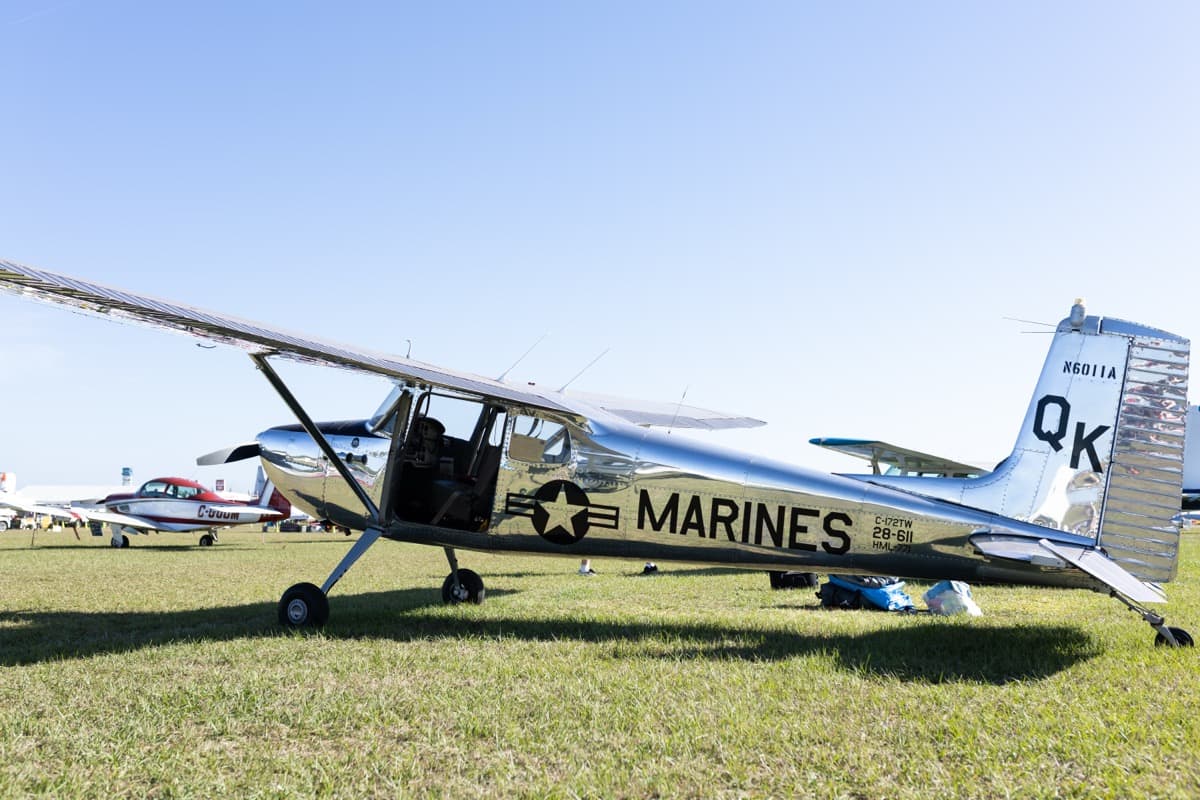
There is something about a polished aluminum airplane that attracts the eye. An almost palpable romance to the look reminiscent of World War II-era fighters, bold young men in stylish leather jackets, and the idea that anything is possible. The military connection is almost undeniable.
So, it was when I first encountered N6011A shining like a new dime in the Florida sunshine at the 2026 SUN ‘n FUN Aerospace Expo. The unpainted airframe gives the impression this Cessna 172 is sleeker than it should be. Crisp lines, a squared-away cockpit, and markings that suggest it might be a U.S. Marine vet made this particular airplane stand out from the crowd.
But wait, there’s something wrong. For all its classic airframe splendor and military pride, the two-letter abbreviation on the tail “QK” doesn’t make any sense. That designation belongs to the Hummers, a Marine light helicopter squadron that folded its tent for the last time way back in 1994. They flew UH-1E and UH-1N Hueys. And as beautiful as this aircraft is, it ain’t no Huey.
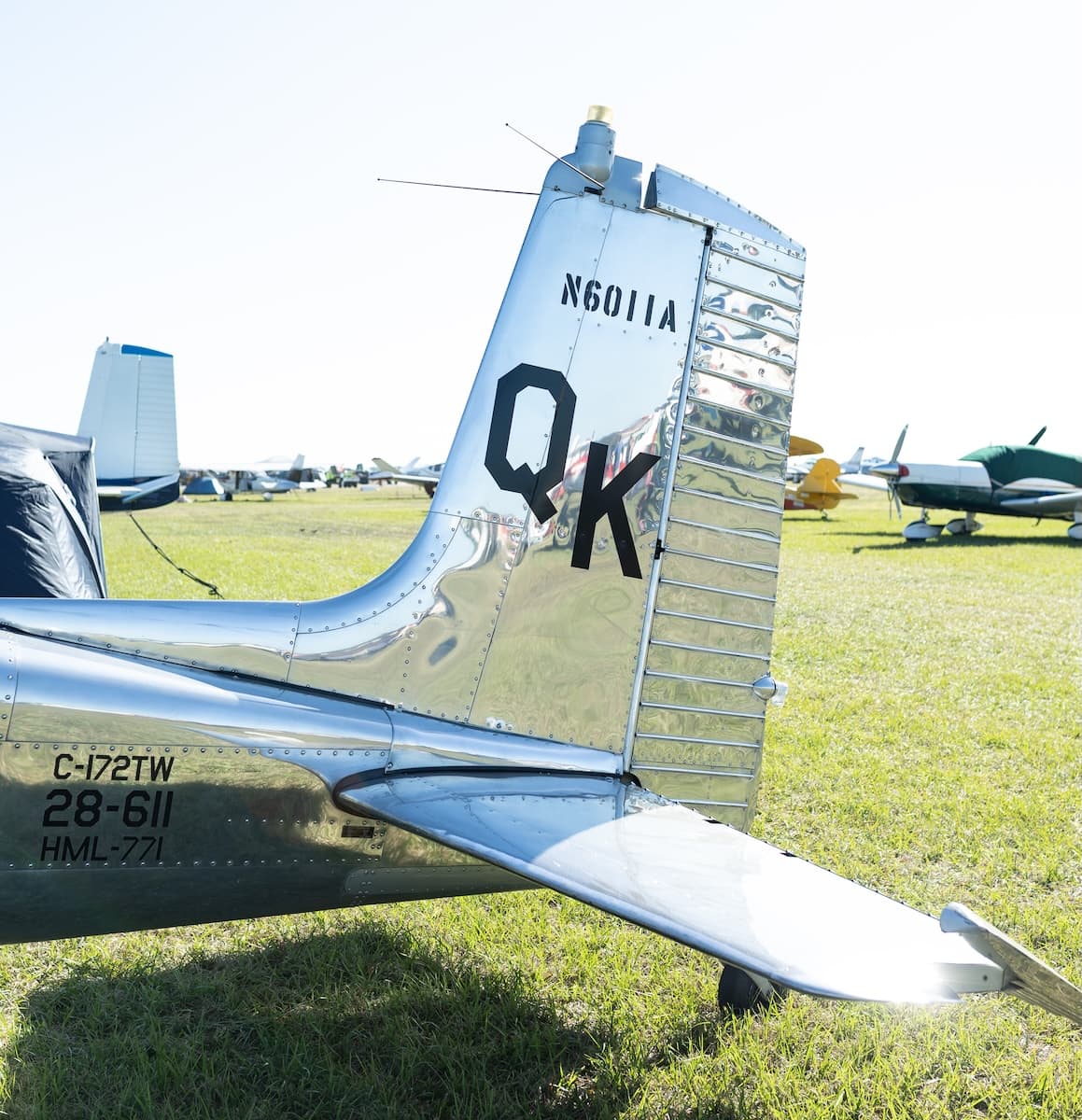
It’s also a taildragger. C-172s came from the factory sitting atop tricycle gear. The case of this luminous silver beast had become more and more curious.
I had questions. Fortunately, the tent under the right wing indicated a dedicated owner wouldn’t be too far away. The small cluster of folding chairs beside it were filled by a social gathering of pilots who had plenty of stories to tell. Most prominent among them was Frank Gallagher.
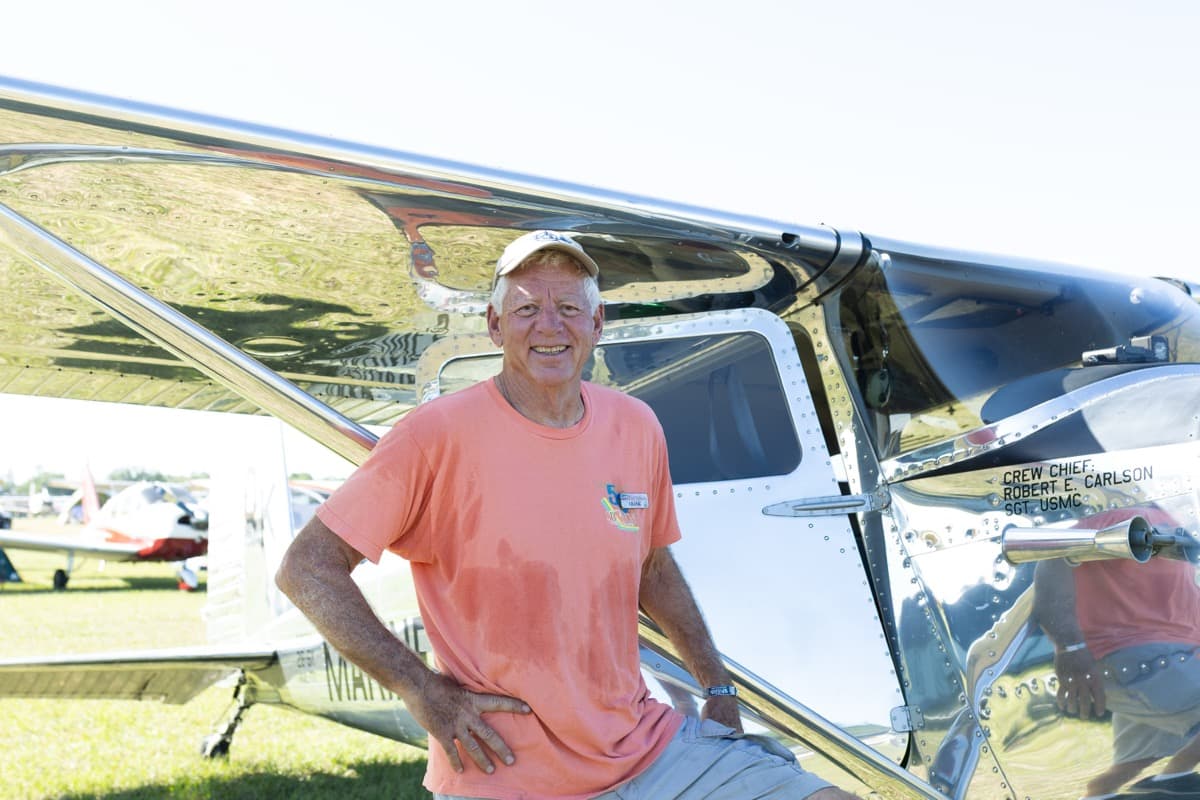
In the interest of full disclosure, I must point out that Frank and I go back. Way back. In 1992 Frank hired me to instruct at Meriden Aviation in Connecticut. It was the second flying job of my career and my introduction to the best mentor this young CFI could hope for.
A graduate of Annapolis, he retired from the United States Marines as a full bird Colonel. A former test pilot for Sikorsky Aircraft, a designated pilot examiner for 45 years with privileges in fixed wing and helicopters, and a business owner, his resume holds more accolades than I can count.
I am entirely biased in my opinion of Frank. I am in awe of the man. That is still true after the well over 30 years we have known each other.
At 77 years old he is profoundly energetic. Tall, lean, always smiling. Frank is the embodiment of a Marine.
“There are no ex-Marines,” Frank reminds me. “When you’re a Marine, you’re a Marine for life.”
To understand Frank, it’s necessary to understand the three things in Frank’s life that are of great importance to him: Aviation, the Marine Corps, and his friends. One of the most prominent of those friends is fellow Marine Rob Carlson.
“We formed Meriden Aviation in 1990,” Frank explains.
Rob and Frank met at just 6 years old. They lived in the same neighborhood.
“We grew up together. He joined the Marines and I went to the Naval Academy.”
To this day they remain connected. More on that later.
I met Frank at one of the undeniable low points of his life. Then a Lt. Colonel in the U.S. Marine Reserves, he had just returned from a deployment to Desert Storm that lasted nearly a year. His business was on the rocks, his bills were sky high, and he was burnt out from a workload that just wouldn’t quit.
I had no idea. You see, Frank was then and continues to be an impressively energetic and unfailingly upbeat man. He speaks in rapid-fire bursts, peppering the listener with amazing stories of his exploits that can easily leave one immobilized with fits of laughter. Even as he relates memories of the hard times, he’s often funny and self-effacing.
“We were bankrupt when I came back,” Frank reflects on the time we first met. “My house was in foreclosure. People don’t realize the high price that’s paid when reservists are activated.”
A good example of the resiliency Frank finds through humor can be understood when he reflects on his time in the Marine Corps. His affection for that institution is readily apparent, yet his willingness to tweak his own history with the outfit and the hardships it can present can be summed up in the following sentence: “The H in United States Marines stands for happiness,” he proclaims.
This line makes me laugh uncontrollably. It’s dry and may take a minute, but this line is a profound statement of honesty, respect, and humor all wrapped in one tidy sentence.
Even through the tough times Frank always found a way to show up at the FBO with a smile on his face and a heaping helping of leadership at the ready. He ran a tight ship. A thoroughly enjoyable one too. Frank ran the flight school and FBO. Rob managed maintenance. It was very much a family operation, although the two men at the helm weren’t technically related.
The last time I saw Frank was several years ago at his home near Melbourne, Florida. He owned a classic Cessna 195 then. A real beauty. But while perusing ads he came across the polished aluminum dream machine he flies today.
“I’ve owned it four years,” says Frank. “I found it about 30 miles north of Tucson, Arizona. A guy named Lee Trucas had it. He took six years to rebuild it.”
Gallagher’s enthusiasm for the airplane is apparent in conversation. As is his appreciation for Lee’s efforts.
“He made it a wonderful flying airplane,” he says.
The airplane is a 1956 Cessna C-172. Frank is more specific: “This is not a Skyhawk, this is a 172.”
As it happens, 1956 was the first year Cessna produced the 172 model. Previously it had been known for the popular and well regarded 170, a taildragger that bore a remarkable resemblance to the tricycle gear 172. This was not a coincidence. Early on in the production run, 170B fuselages were commonly used in the construction of 172s. The tricycle gear configuration quickly outsold the taildraggers, making the blending of the production lines an obvious choice.
For the markings Frank researched the Marine Observation Squadron VMO6, but included his helicopter squadron markings on the tail. Hence, the previously mysterious QK.
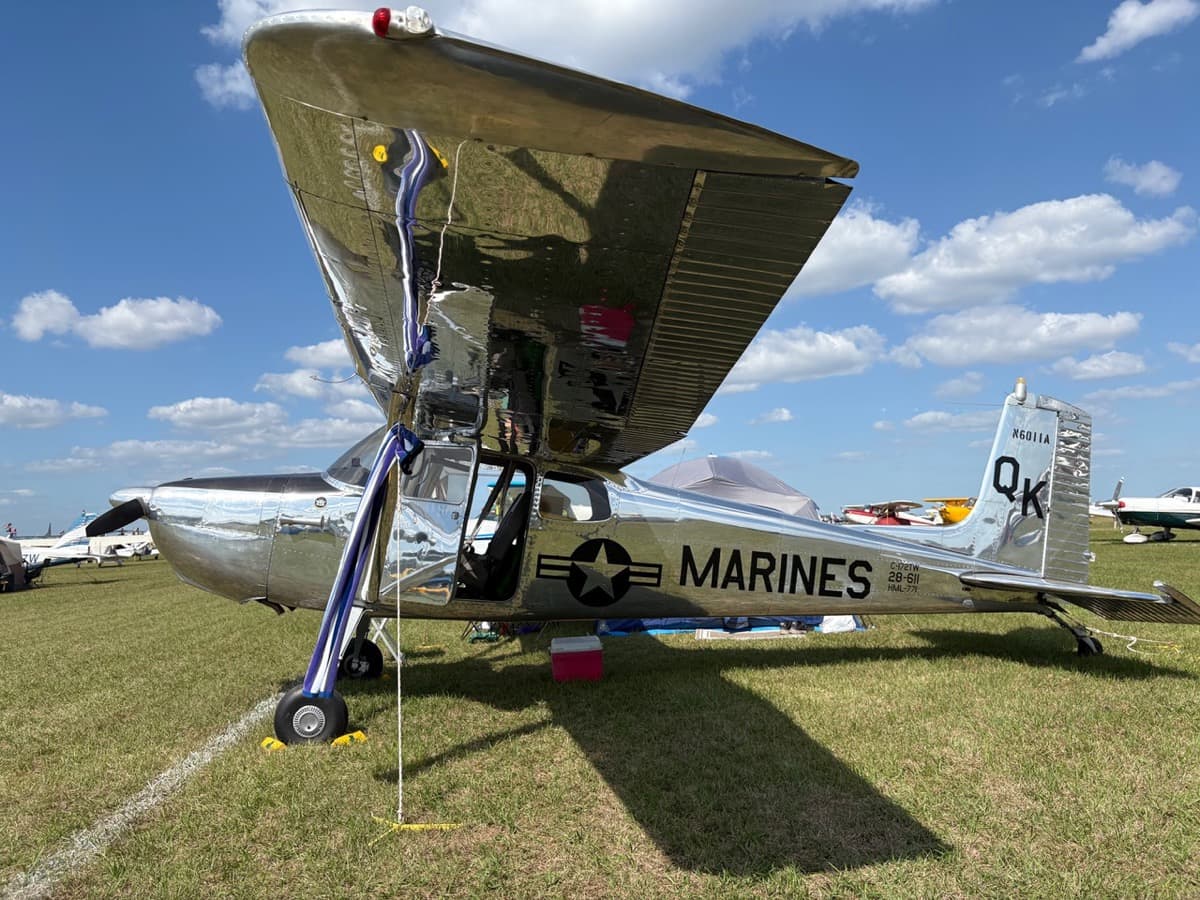
The largest letters on the airplane spell out “MARINES.” It’s unmistakable what the driving force in the owners’ life might be. I suspect a great many Marines can relate.
He didn’t stop there, however. Big and bold is definitely in Frank’s wheelhouse. But tradition goes deeper than the military itself. On the right side of the fuselage just above the venturi, in crisp black lettering are the words, “Crew Chief: Robert E. Carlson, Sgt. USMC.” A heartfelt honor to his lifelong friend and business partner.
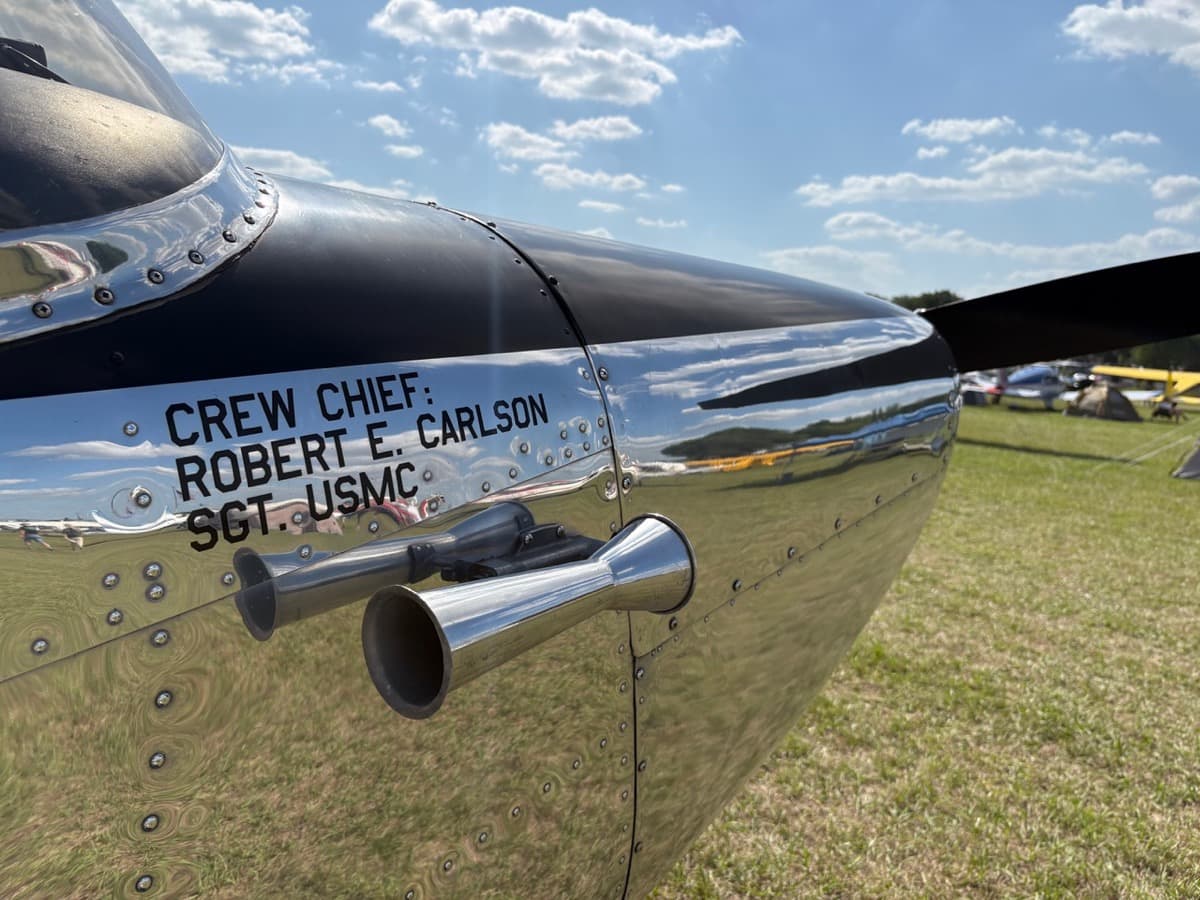
Rob Carlson passed away in September 2020.
“He had 29 air medals,” Frank says. “He flew hundreds of missions in Viet Nam and was shot down twice.”
Carlson flew the Sikorsky H-34, dubbed the Seahorse, as well as the Boeing CH-46 Sea Knight during his military service.
There is real honor and respect in the decision to carry Rob’s name on his airplane.
“I was blessed to work for 20 years with my best friend. Of all the people I ever worked with, he was a natural,” says Frank. “I’m a very analytical kind of guy. He was a natural.”
As for retirement, that’s not in the cards for Frank.
“Retired?” he says. “It’s not in the bible. Re-tired, I get four new tires and I’m rolling.”
Personally, I’m inclined to believe him.

Like a lot of GAN’s other “usual suspect” commenters, I love to see my name in print.
Plus, with an ego fueled by my unique career as a fighter pilot …and a bomber pilot (I may have mentioned that before…), and my work as an airport planner, a CFI, and an AOPA presenter/instructor …I tend to sound a bit …haughty.
But when it comes to Colonel Gallagher’s gorgeous N6011A; I would gladly ‘work for food’, or even chain myself to a gear leg, if it got me a ride in it. Did I mention I went to FIT in Melbourne?
“Gallagher” is also one of the surnames in my family tree! So, I wonder; if we traced it back far enough…?
Good to see you, Frank. What a super job you’ve done. Keep on going . (If you want to help restoring my latest sports car, let me know. if you get bored. )
I’m into the second year of undoing/correcting some less than stellar work that it received over the decades.
OOOH-RAHHH!!!
Beautiful piece. What makes stories like this resonate so strongly in aviation is that they capture something the industry often struggles to quantify the emotional connection between people, aircraft, and lifelong purpose. Frank Gallagher’s relationship with that 1956 Cessna 172 isn’t just ownership; it’s stewardship of history, discipline, craftsmanship, and memory all rolled into one airframe.
The article also highlights something deeply authentic about general aviation culture: aircraft become extensions of personal identity over decades. The maintenance, restoration details, and pride in preserving a classic taildragger reflect the mindset that keeps aviation heritage alive long after most machines would have disappeared into museums or scrapyards. In many ways, these aircraft survive because their owners see them as living history rather than equipment.
At The NSN Distributor, we spend a great deal of time around aerospace sustainment and lifecycle support, so stories like this stand out because they remind people that aviation is ultimately built around passion and continuity as much as engineering. Exceptional storytelling and a fantastic tribute to both aviation culture and the people who keep it alive.