

Some pilots have 1,000 hours of experience. Some pilots have one hour of experience repeated 1,000 times. I’ve heard this claim throughout my career in general aviation.
Is it true?
I’m not so sure. Aviation is remarkably mission dependent. Just as aircraft are designed, built, tested, and sold to fill a particular niche in the market, the same can be said for the role of a pilot.
Is it reasonable to judge another pilot’s abilities simply by observing their flying habits and making a decision about their potential? Perhaps we see an individual who routinely takes off early in the morning. They only fly on calm days with relatively clear skies. We see them take off, climb out, and disappear into the distance. The scenario never changes.
We might take the attitude that pilot is what can euphemistically be called a fair-weather flier. The flights we’ve witnessed would appear to support that perspective. We’ve never seen them pull out their airplane when the winds are 10 knots directly across the runway. We haven’t seen them work the pattern when the ceilings are just above the legal limit, or the visibility is down to VFR minimums.
I’m thinking of a specific pilot as I write this. A pilot who fits this description pretty darned well. A pilot who disproves the disparaging beliefs of others.
His choice of airplane might seem to indicate he’s a marginal pilot. It was small and underpowered. It could best be described as a trainer. The engine under the cowl can only dream of producing 100 horsepower. In reality, it puts out just over half that.
All evidence suggests he is logging one mundane hour at a time. No significant challenges. No adverse conditions. We might come to the conclusion he’s somehow less of a pilot than we are.
Is that true?
Is he afraid to fly in more challenging conditions? Perhaps he’s aware his talents are stretched thin even on the best of days. Is it possible he owns that airplane to do nothing more impressive than to get airborne for a time, navigate to the practice area, and navigate back again?
Or maybe, just maybe, there’s another possibility.
I’m thinking of a man who flew with a level of precision few of us can match. The type of man who could do a slow roll at low altitude with such exactness that its outcome was never in question. Yet he was the epitome of the individual who might be maligned by bystanders for being less than stellar behind the controls.
I’m thinking of Duane Cole. One of the old guard. Cole came into this world in 1914 and left it 89 years later, having accomplished more in a little trainer than most of us could ever imagine. He was an air show performer along with his brothers Arnold, Lester, and Marion for a decade and a half. It was Duane who left the team following the death of his 24-year-old son Rolly in the crash of a Stearman. He’d been practicing for an air show when the tragedy took him.
The airplane Duane most famously flew was a Taylorcraft BF-50. Heavily modified, the airplane was powered by an engine that was beefed up to a whopping 65 hp. The wing was shortened to facilitate a faster roll rate. And the pilot’s seat was moved to the center of the fuselage to better accommodate aerobatic work.
You can see that airplane today at the EAA Aviation Museum in Oshkosh, Wisconsin.
From the porch of the FBO, none of this was evident. The Tcraft looked more or less like any other of its class. Except for the shorter wing, but who needs to take notice of details when we’re judging others?
We might watch the early morning takeoff into calm, clear skies with minimal interest. We might see Duane return an hour later. He might make a squeaker of a three-point landing right on the centerline, but we’d hardly notice that. We’d already made up our minds that Duane wasn’t much of a pilot. After all, he wasn’t really challenging himself. Not like we do.
It might be only then we notice the large red lettering on the side of the airplane looks odd. It’s not the N-Number. That’s clearly marked in three-inch black lettering on the tail. No, the print on the fuselage is much larger. It’s the same bright red color that covers the nose and stretches back along the spine of the airplane to the leading edge of the tail.
It’s only after careful inspection from our distant location we realize why the lettering looks peculiar. It’s upside down.
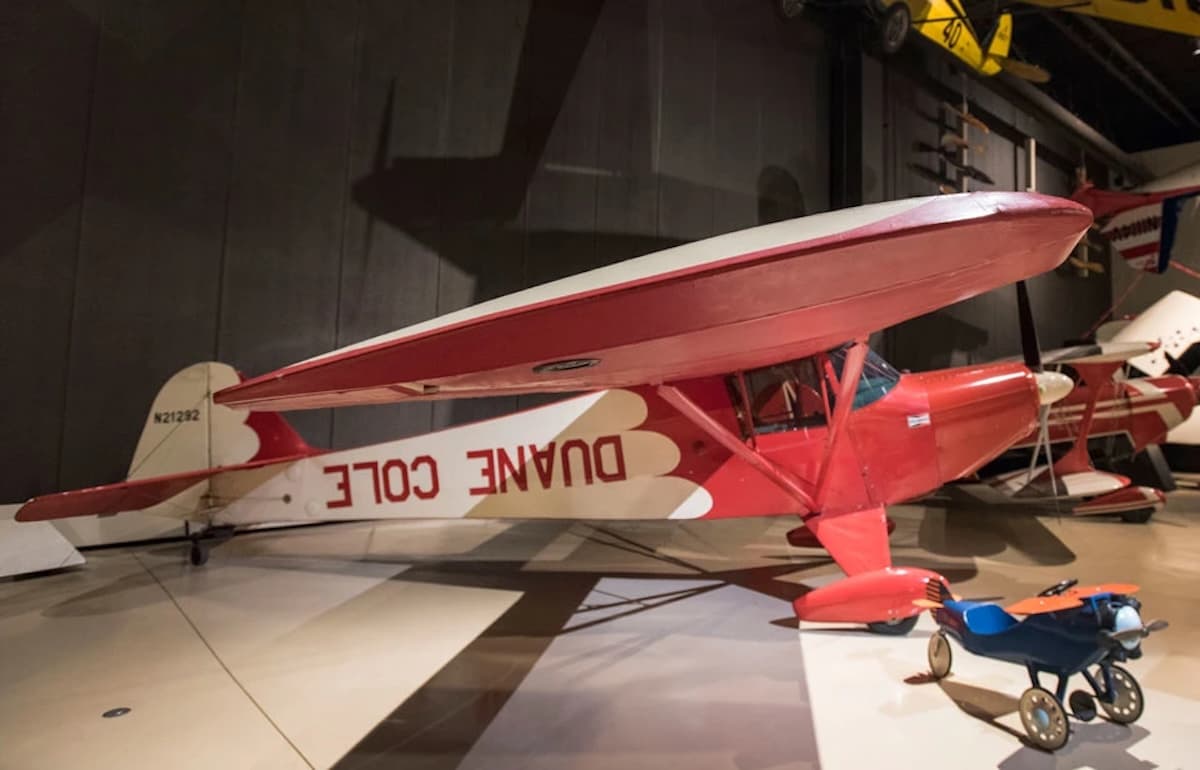
Duane Cole emblazoned his name upside down on the sides of his heavily modified Taylorcraft because during much of his air show routine he was inverted. The name was clear and easy to read as he passed along show center.
Assumptions can be a dangerous thing. Certainly, there was only one Duane Cole. Just as there was only one Bob Hoover. Or Charles Lindbergh, Jimmy Doolittle, or Roscoe Brown Jr. None was known for big talk, loud outbursts, or taking risk lightly.

Cole was an air show performer with real talent. Hoover knew his airplane and its potential better than anyone alive. Lindbergh planned meticulously to do the impossible. Doolittle put science and technology ahead of ego to fly by instruments all the way to landing — a feat so unimaginable as to be tantamount to magic at the time. And Brown led his Tuskegee Airmen into battle as a unified crew who put mission ahead of individual glory. He was also the first man to shoot down a German jet fighter from the seat of a piston-powered Mustang. Not that he would ever mention it himself.
I do not believe it is possible to fly an airplane for an hour under any conditions without learning something of value. This is how we hone our skills and develop good judgment.
And perhaps one day when I decide my flights will be made only on still mornings under clear skies to enjoy the view from on high, I will not be judged as lazy or lacking talent by those who remain sitting on the ground observing. I’ll be doing what I love to do on my own terms.
That seems to me like a darned good way to go. Think what you will.

Best book ever written by a pilot
“Fate is the Hunter”. Ernest Gann
Duane Cole along with Bob Hoover are my personal favorite best airplane pilots that have ever lived! There are many many more great pilots but those two are my favorites! May they both rest in peace!
I was working at Washington County Airport, PA in 1979 and met Duane Cole when he stopped for fuel. After I fueled his plane he checked that the fuel cap was on tight and walked around the airplane doing an inspection. He was polite and thanked me. To me he seemed to be a cautious pilot and a gentleman.
Once again, well said, sir. Well said, indeed.
I had the honor of announcing the NWEAA Fly-In with Duane and his outspoken common sense is a part of my aviation mindset. His best book is Happy Flying, Safely, which is page after page of hints for VFR pilots. Such as not flying far from roads. Every so often we lose a plane over the Cascades that is taking a direct VFR route, only to be undiscovered for days far from help. Or respecting weather and time. He flew thousands of VFR hours going from show to show. His voice has not been replaced.
Amen.
Three books on my ‘top shelf’ (…along with
“Stick and Rudder”):
“We”; by Charles Lindbergh
“I Could Never Be So Lucky Again”; by Jimmy Doolittle
“Conquest of Lines and Symmetry”; by Duane Cole
Sad thing is the book ‘Conquest of Lines and Symmetry’ is out of print and only one Amazon has for sale is $512 !!
Mornin’ Jamie. Well written. When I had my fbo I’d listen to my young flight instructors or line people chat about some of the guys that, at that point, were “fair weather” flyers. I always kept fresh coffee on and encouraged those “old guys” to share their stories. Many were Viet Nam bullet catchers and others …. well, there was a lot of respect around that coffee pot and woe onto the new kid that thought he was the next ace…. Ya’ never know… but then, one of those line people did get to fly w the Thunderbirds and “drive” one o’ them space shots (Polaris Dawn). Some that shared that pot are world champion airshow pilots. Funny what a little back woods NH airport brings out on a fair weather day.
Wow! Great article ! Didn’t see it coming