


George, a commercial pilot in Iowa, writes: In a recent column, “Slow To The Party,” in talking about the history of flight training, you said that while flight training hasn’t changed much over time, systems have become more complex. Don’t we really still have the same systems? Other than instruments, aren’t airplanes pretty much the same? We have powerplant, fuel, electrical, pitot-static systems…“
You are correct, George, that the systems are the same — at least in name — but they have changed in significant ways.
Let’s start with the electrical system, which has been evolving for some time.
Back in the day — post World War II — the battery/generator duo was the heart of the electrical system. The battery ran the starter (still true today) but also, in most airplanes, the battery ran the rest of the ship too. That would have consisted of the radio and lights and, later, a turn coordinator.
But over time, cockpit power needs started to grow. So the first major change to the electrical system was replacing the generator with an alternator. Unlike the generator, alternators can provide power output across a range of RPM, while a generator, at low power, doesn’t put out much juice.
Why does this matter? During a really long low-RPM taxi in a generator-driven electrical system at a large airport, a hungry radio deck could suck the battery dry — leaving you with no radios at the hold short. Alternators took care of that.
At some point, they also moved to the front of the line, directly powering the ship. The battery fell from master and commander to a start-up role only, along with a (very) limited emergency power role if the alternator crapped out.
Alternators themselves evolved too, swapping out their magnets for electromagnets to save weight. That means they don’t work if the battery is fully and truly dead. The pair are fully codependent.
But back to the basic electrical system. Power needs continued to grow with evolving technology. We went from lights and radios in a typical training airplane to complex electrical nav systems to glass run by more onboard computers than the Space Shuttle. All that tech is power hungry.
Behind the panel, too, the power grid part of the electrical system evolved and grew. Take the bus bar for instance. Bus bars — quite literally bars FYI — can be thought of as power strips that you plug devices into. Early airplanes had one. The modern Cessna 172, the most common training aircraft, has six. Knowing what is connected to what and how a partial failure affects the electrically powered gear? That’s a lot to learn, just sayin’…
Early electrical systems were protected from power surges by glass fuses. Some airplanes had only one or two of them. At some point, the easier-to-deal-with-if-it-pops circuit breaker replaced the fuse. And, as the power demands of the cockpit increased, the volume of circuit breakers spread like an invasive species.
Have you seen how many circuit breakers the Cirrus has? According to a mechanic who works on one, the Cirrus aircraft with an Avidyne panel has 38 circuit breakers, while those with a Perspective panel have about 52.

Yeah. That’s a lot to learn too. Plus, depending on the airplane, the addition of electric flaps, electric landing gear, and electric trim. And I’m sure I left a few things out.
Somewhat related to power are mags, that not-so-trusty farm tractor tech from the early 1900s that delivers spark to our engines. Many of the latest GA airplanes rolling off of the assembly lines have either one — or both — mags replaced with solid-state “e-mags.”
Consider the irony here. We started with airplanes with no electrical systems. Spin the prop and go. Now we have completely power-dependent airplanes. If the battery is dead, you can’t start the airplane. We’ve gone from no juice to go to no juice, no go.
But, more critically for flight training, there is simply more to understand as the details multiply, and that takes time.
Speaking of the engine, while pilots complain that piston airplane engines haven’t changed since the 1930s, that’s not really true. While it is true that they haven’t kept pace with car engines, we still have a number of new complexities. Take fuel injection, for instance. Or turbochargers on GA airplanes. And what about glass engine monitors that look at a dozen parameters, replacing a few simple analog temperature gauges? That’s more to learn and more to pay attention to in flight.
We touched on flight instruments indirectly with the power needed for glass cockpits, but if we go back in time, flight instruments were powered by moving air sucked out of the atmosphere, using externally mounted venturi tubes. Later, these were replaced by vacuum systems. Then, like some sort of evolutionary off-shoot of the family tree that didn’t adapt to the changing environment and died out, now many planes don’t have either.
Even our propeller systems have evolved. Just last week, I was checking out a basic trainer that had a sexy, curved, carbon-fiber, ground-adjustable prop on its snout. It’s so light weight the engine-starting techniques are different. As is ground handling. No pushing or pulling on the prop.
Feeding that prop is, of course, fuel. Did you know that if both the fuel pumps in a modern high-wing Skyhawk fail, the engine can’t run? So much for gravity-fed fuel knowledge. The fuel system has become so complex that even gravity cannot defeat it.
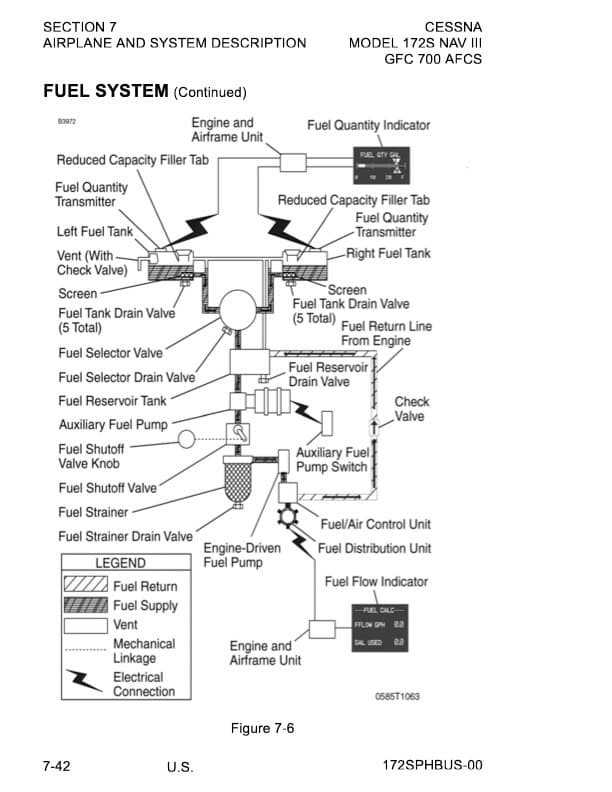
But the poor student, to pass his or her oral exam, must be able to intelligently discuss its mouse maze of tubes and pipes. At least in rote theory. If you want to get a blank stare, ask a new pilot where, exactly, the fuel lines between the tanks and the fuel selector are to be found in the actual airplane. (They go through the door posts.)
As to the pitot-static system, that’s still largely unchanged. At least structurally. But it doesn’t have nearly the same job duties as it did in the old days. The humble pitot still provides ram-air data to even the most complex of glass-panel flight computers, but that’s about it.
So, yeah, in one way, the systems themselves — in their overall functions — are unchanged, but most are devilishly more complex and complicated than back in the day. Meaning there’s more to study and more to learn. That’s one reason it takes longer to get a pilot certificate today than in yesteryear.
Well, that, and regulations. When the regulations were new, in the late 1920s, they were a slim volume of only 30-something pages. Compare that to the more than 400 pages we ask the new student pilot to absorb today.

Leave a Reply