

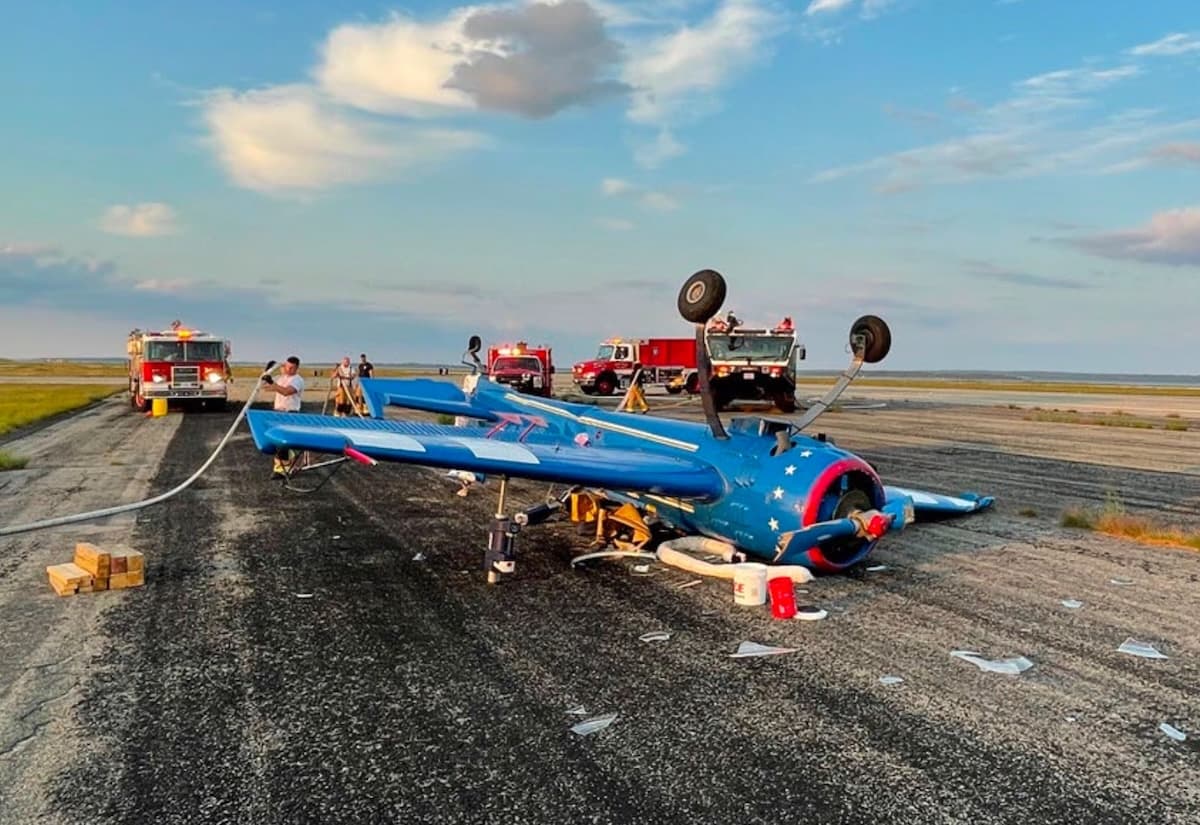
The engine had settled down, but the pilot decided to divert from his cross-country course to Quonset State (KOQU) in North Kingstown, Rhode Island, and make a precautionary landing. Just to be on the safe side.
That was a good call.
But every decision he made after that point and — as you’ll soon see — every decision he made leading up to that point was not as good.
But I’m getting ahead of myself. Back to the inbound pilot.
Quonset features two runways. The larger, 16-34, at over 7,500 feet long and 150 feet wide, would certainly make a nice emergency landing field. That’s a big runway for an airport 18 feet above sea level. There is also the more petite 5-23, at 4,000 feet in length and 75 feet wide, still more than respectable for a GA airplane, even a somewhat hot one like the acrobatic Yakovlev YAK-55M the pilot was bringing in.
The active runway was 23, with winds 270° at 14 knots, making the crosswind component somewhere around 9 knots. Still, when the pilot radioed in that he was having engine trouble, he was about four miles out and lined up almost perfectly for Runway 5, so the controller gave him the option, with the caution that this would give him a quartering tailwind from the left. The pilot selected Runway 5.
The controller described what happened next: “The aircraft bounced once on the runway before touching down. It then started to ground loop. This pulled the aircraft left off the runway, hitting some runway lighting. The pilot then appeared to over-correct, tipping sideways hitting the left wingtip. Then it tipped the other way, hitting the right wingtip. The aircraft continued going further away from the runway before flipping forward and landing upside down. It appeared the pilot may have hit the brakes hard, inducing the flip.”
Another pilot, quickly re-positioned by the tower for the emergency traffic, also witnessed the crash. She said that the Yak porpoised on landing, hitting hard enough that she thought he bent the gear. She then had a few heart-stopping seconds as the out-of-control high-performance single-seat tailwheel careened toward her in its ground loop. But the plane flipped over on its back before hitting her. She shut down her own ride, and she and her two passengers bailed out and rushed to the wreck to attend to the pilot, who while stunned, suffered no major injuries.
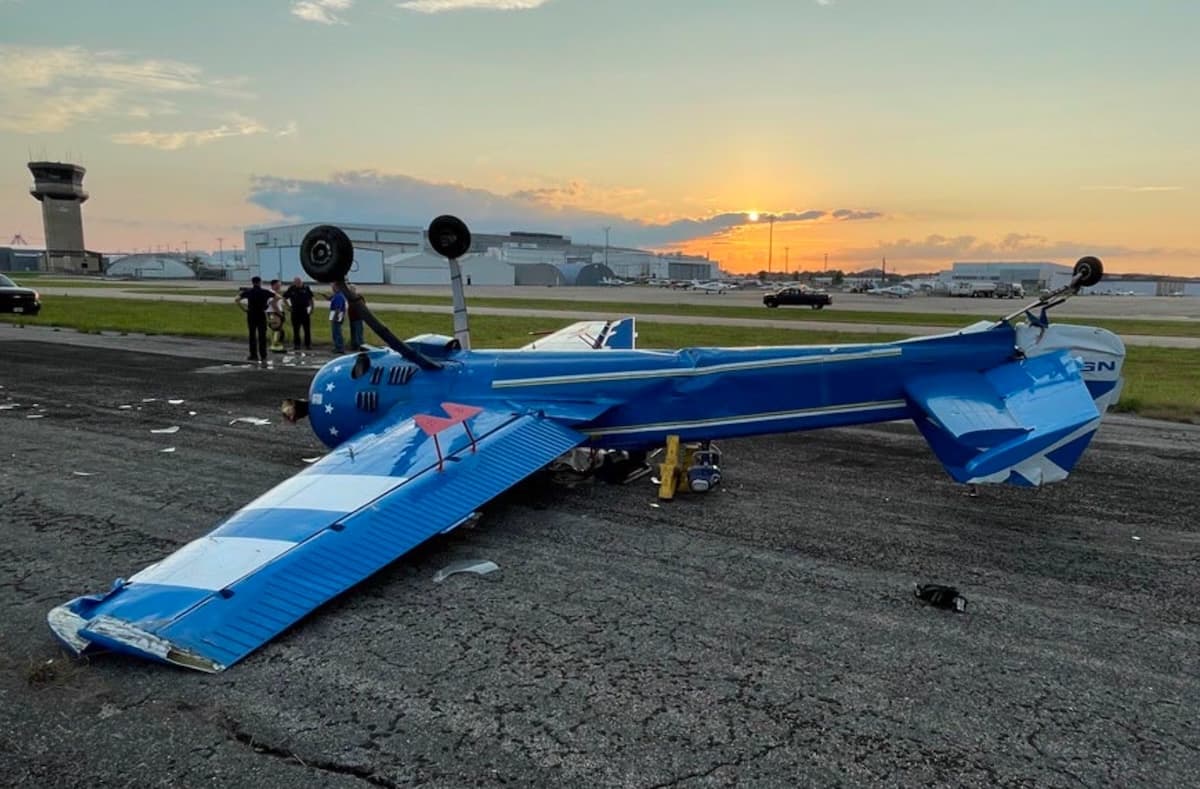
The pilot had only purchased the plane about 40 minutes before the crash and this was his first-ever flight in it.
…and his first-ever flight in a high-performance airplane.
…and, for that matter, his first-ever flight in a tailwheel airplane.
Did I mention that he did not have a pilot’s certificate?
The “Pilot”
The pilot was a 38-year-old male, and that’s about all we know about him, beyond a few logbook excerpts from crude scans he sent to an FAA Safety Inspector after more than one request for the records.
They show he had a total of 49.4 hours. He took 20 flights in a Cessna 172 in 2015 — the accident happened in August of 2024 — then there was a gap until 2022, when he did four flights in a PA-28 Cherokee and one in a PA-22 Tripacer. And then another gap followed by eight flights in the PA-22 again in 2024 before the crash.
His logbook shows he only flew cross-country six times before the accident flight, and had only ever been to three different airports in his flying career, all close to home in Virginia. His longest flight prior to the accident flight was 109 miles. He traveled about 70 miles from purchase to crash.
The NTSB
Investigators could find nothing wrong with the Yak’s 9-cylinder radial Vedeneyev M14P engine. But the wreck substantially damaged the airplane’s airframe, including cracking the wing spars in the right wing.
The official Probable Cause statement was: “The non-certificated pilot’s lack of experience in the tailwheel-equipped airplane and his decision to land in a quartering tailwind, which resulted in a loss of directional control on landing.”
And I will add to this his lack of experience in a high-performance airplane as a contributing factor. The Skyhawk is a 180-horse airplane, and the Cherokee was logged as a 180-horse model. The Tripacer, his most recent ride, was 115-horse.
The Yak, by comparison — even though it is only marginally heavier than the Skyhawk — has a 360-horse engine.
Analysis & Discussion
I marvel at the mind that decides that — given his lack of certificate, lack of tailwheel endorsement, lack of high-performance endorsement, and lack of any relevant experience whatsoever — it will be OK to jump into a high-performance, tailwheel, acrobatic airplane and fly it from one place to another.
Yeah. There’s a hazardous attitude for that. It’s called anti-authority.
Too bad. If he had “followed the rules” and taken his training more seriously, perhaps he would have learned about the effects of tailwinds. He might have understood energy management better. Been more adept at rudder control. Gained a better understanding of aircraft systems. Grasped the turning tendencies associated with monster radials on light airframes and internalized the fact that Soviet-designed engines have reverse turning tendencies, as they spin the opposite direction from what we are used to. He might have known the protocol for contacting the tower before you’re on their doorstep. And perhaps he might have developed the wisdom to know to choose the longest, widest runway.
Hell, even in a perfectly running airplane, you can never have too much runway for the first landing of any new-to-you airplane. Yes, that’s right. The seller told investigators that he was quite surprised when the new owner flew off into the sunset (metaphorically as all of this happened in the early afternoon) without doing any touch-and-goes to get the feel of his new airplane.
All he did were a handful of high-speed taxis, during which, initially, the seller said he “had issues overcontrolling” the aircraft, but that toward the end “seemed to get the hang of it.”
And in one final gem — despite two attempts on the part of the NTSB, including twice sending the un-certified pilot the required paperwork by two-day UPS, and a letter saying, among other things, “failure to file the required report can subject you to a fine of up to $1,000 per day” — the pilot did not submit the required Form 6120 following an accident. I’m not surprised. Well, it’s not like it’s a federal law or anything.
Oh. Wait. Yes it is.
It happens to be 49 USC §1155(a)(1), for those who are interested. Now, for those readers more used to Code of Federal Regulations (CFR) citations, USC stands for United States Code, the actual federal laws enacted by Congress. Our humble CFRs are regulations issued by executive branch agencies detailing how they will administer and enforce the USC. The USC is the true law.
The Takeaway
What could possibly be the takeaway for the rest of us from this accident starring the new poster boy for hazardous attitudes?
I think it is an excellent — if exaggerated — reminder that our training has value. All of it. The knowledge. The varied skills. Even the time and difficulty involved in obtaining a certificate.
There is a reason we have pilot certificates. They are more than the capstone of the complete learning process. They shape the very learning process itself because the certificate shapes the test, and the test shapes the course of training. And it is the training that is the mold used to cast the pilot. Skipping the certificate entails missing part of the training, leaving an incomplete pilot.
The takeaway? I think all pilots have at least some degree of anti-authority attitude in our blood. It’s probably a side effect of the self-reliance required to be PIC. This accident can show us what that attitude — left unchecked — can evolve into.
So next time you feel yourself chafing at a “stupid” requirement, or find some “silly” piece of knowledge or activity is “worthless” to you, just remember, everything in the pilot “curriculum” is there for a reason. We need all that “is required of us” and we should accept that with grace.
The Numbers
Want to read more? Download the NTSB’s final report here or view the items on docket here.

I’ve often wondered whose photo is by the definition of “idiot” in the Merriam Webster. Now I know.
Sorry to be so blunt, but it’s deserved.
So that’s it? $1,000.00 fine per day?
Not enough. He should face jail time for flying without a license,
On top of that, he risks danger to himself along with other pilots, airplanes , people in general and property.
On top of that, he has strengthened the negative perception of what some of the non -flying public perceives of private pilots and general aviation.
He is reckless, arrogant, narcissistic and juvenile—all traits that he would have plenty of
time to review in a jail cell.
If you tend to embrace reckless arrogance you probably should not try an unforgiving pursuit like flying.
It worked fine on the simulator at home!
A CFI should assess humility. In the face of risk, perhaps even an assessment of mortality knowledge. Apparently some folks with enough money lack those psychological traits. It’s more than anti-authority.
Thank you, William. Great story!
„There are old pilots and there are bold pilots – but there are no old bold pilots.“
Not much more to say.
At our airport a person with a 20-year-old student pilot certificate and a few hours of experience and no tail wheel experience purchased a Decathlon, lost control during the takeoff and destroyed the airplane. Who are these people? What goes on in their brains?
Another hazardous attitude: “Macho.” The guy exhibited that attitude, I believe, when he said to himself, “I got this.” I could be wrong.