

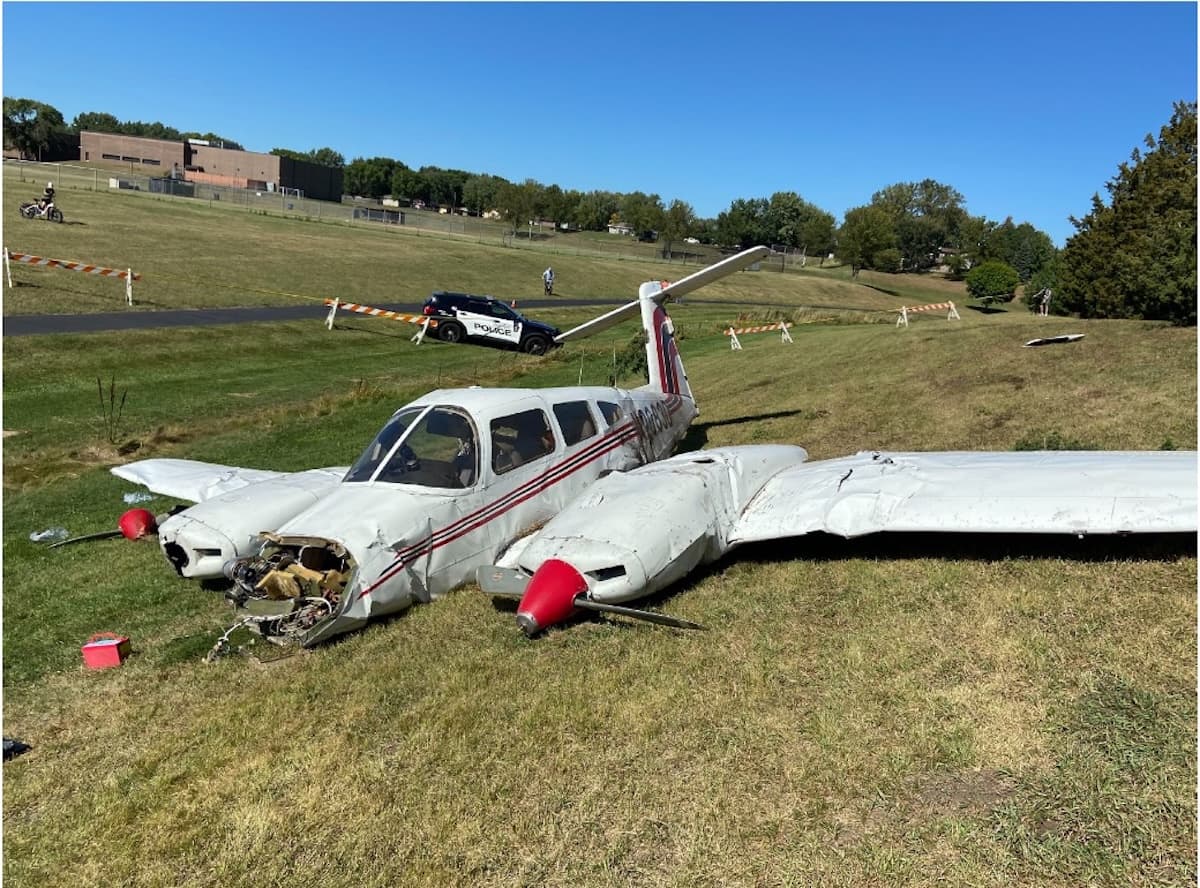
One of the pilots, a flight instructor, was recently hired to instruct in the Piper PA-44-180 and was receiving a checkout flight from the assistant chief flight instructor.
According to both pilots, they departed Flying Cloud Airport (KFCM) in Eden Prairie, Minnesota, for a local one-hour flight. The run-up, taxi, and takeoff were all normal. The airplane departed to the southwest and climbed to about 5,500 feet mean sea level.
The flight instructor receiving the checkout performed several flight maneuvers in the airplane, then began a descent and proceeded back to KFCM.
About three miles from KFCM, and about 800 feet to 1,000 feet above ground level, the right engine began to lose power, followed by a loss of manifold pressure. Shortly after, the left engine lost power accompanied by a decrease in manifold pressure. Then both engines lost power completely.
The assistant chief flight instructor took control of the airplane while the other pilot pushed the mixture, propeller, and throttle controls to their full forward position, but the airplane continued to lose altitude. The pilots executed a forced landing to a field southwest of KFCM.
The assistant chief flight instructor stated that they did not execute an emergency checklist because there was no checklist for a dual engine failure, nor did they have time due to their proximity to the ground.
The wings, fuselage, and empennage sustained substantial damage in the accident, while both pilots were seriously injured.
A post-accident examination revealed that there were about 25 gallons of fuel in each nacelle and both fuel selectors were in the “on” position. No water was detected in the fuel contained in either engine carburetor float bowl.
Valvetrain continuity was established in both engines. Compression was achieved on all cylinders when the crankshaft was rotated in each engine. The magnetos on both engines produced spark when their respective impulse couplings were rotated.
The carburetor heat for both engines was in the up or “off” position.
The temperature, 24°C, and dew point, 12°C, recorded at the destination airport were conducive to “serious icing” at a glide power setting.
According to the pilot operating handbook for the airplane, carburetor heat should be used “as required” during approach and landing and if engine roughness occurs.
Probable Cause: The pilots’ failure to apply carburetor heat during the descent, which resulted in a loss of power on both engines due to carburetor ice.
To download the final report. Click here. This will trigger a PDF download to your device.
This September 2024 accident report is provided by the National Transportation Safety Board. Published as an educational tool, it is intended to help pilots learn from the misfortunes of others.
Demon Ice has caught a lot of good men ! Did he remember three green!
That one gets everybody else.
Dream airplane; Ercoupe with fuel injection so no CARB ice,wont stall,no rudders to confuse things,fixed gear so three green refers to a Christmas tree !
Any body have that stc?
Never go below 15 inches in a long decent…….so temperature was 80F at the airport?….24+24+30…..?Ice ??
Absentee owner of a flight school hired a buddy to manage the place. Said buddy boasted that HE flew sports teams around in 737s, he was a big jet charter pilot and knew everything about airplanes. Said he didn’t see ANY need for carb heat because he’d never needed any in a 737, so why are we teaching our C150 pilots about it? (Florida, by the way).
I said OK, you’re the boss and continued to teach about carb heat and the need for it anyway. I saw the writing on the wall and resigned. Place went out of business shortly thereafter. Horses for courses, but he was the wrong end of the horse for this course.
I had this very same thing happen once. decending out of altitude in a Cessna 172RG, west of Denver in the mountains, started to get a rough running engine. Looked at everything, checked mags drop, no pressure losses, plenty of fuel press, then it dawned on me.. CARB ICE! Slowly applied carb heat and gradually the engine smoothed out.. Its a daunting thing to see the RPM gauge fluttering around and the sound of an engine being choked out by ice.. :/
For want of one and a half inches of control knob application, an airframe is destroyed. Remind me not to use either of those guys as instructors.
Pilots with carburetor engines if you lose power the first thing is to pull the carb heat on. Any waiting looses the hot air from the engine to melt the ice out. Better yet if flying a carburetor engine get a carb temp gage installed and use it. Sad that the most misunderstood system on a plane is the carb heat and when it should be used.
Next get a glider license and really learn to fly. Looks like this plane was stalled in or driven into this hill side.
So it looks like using carb heat must not be taught any more.