

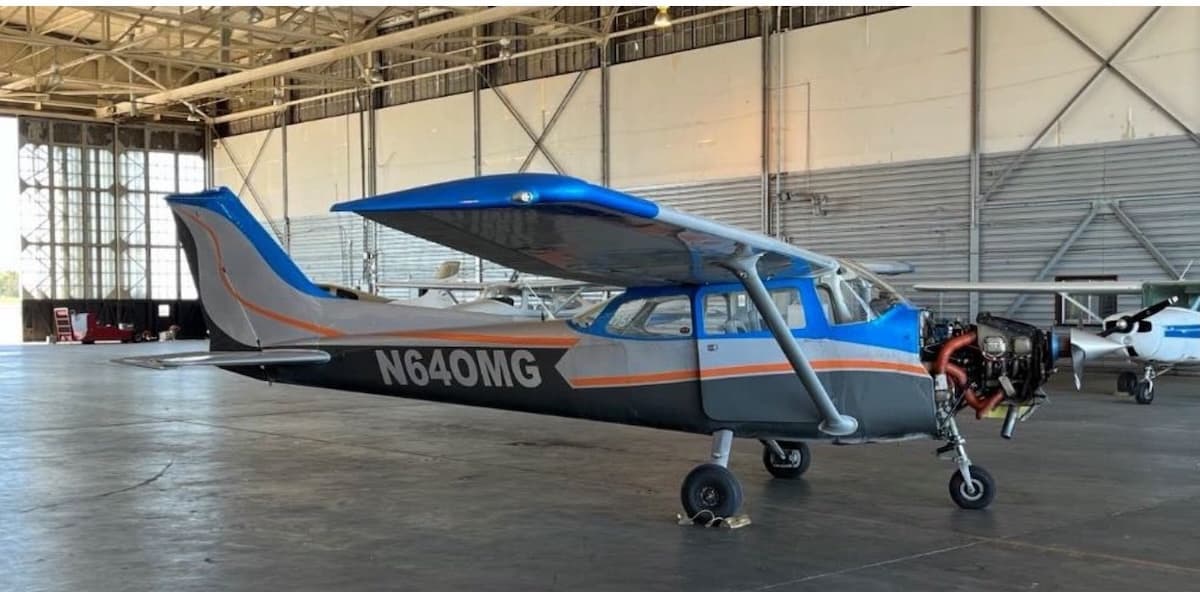
The pilot told investigators that she rented the Cessna 172 to gain proficiency flying from the right seat and asked the flight instructor to sit in the left seat during the flight.
While maneuvering the airplane through the final approach leg of the traffic pattern at the airport in Louisville, Kentucky, she reported making control adjustments to recover from a low and slow approach to land.
She attempted to initiate a go-around, but utilizing muscle memory from flying from the left seat, she inadvertently reduced throttle and pushed the yoke forward, resulting in a hard landing. The airplane bounced and she applied full power, after which the flight instructor took control of the airplane. The flight instructor flew another traffic pattern and landed the airplane without further incident.
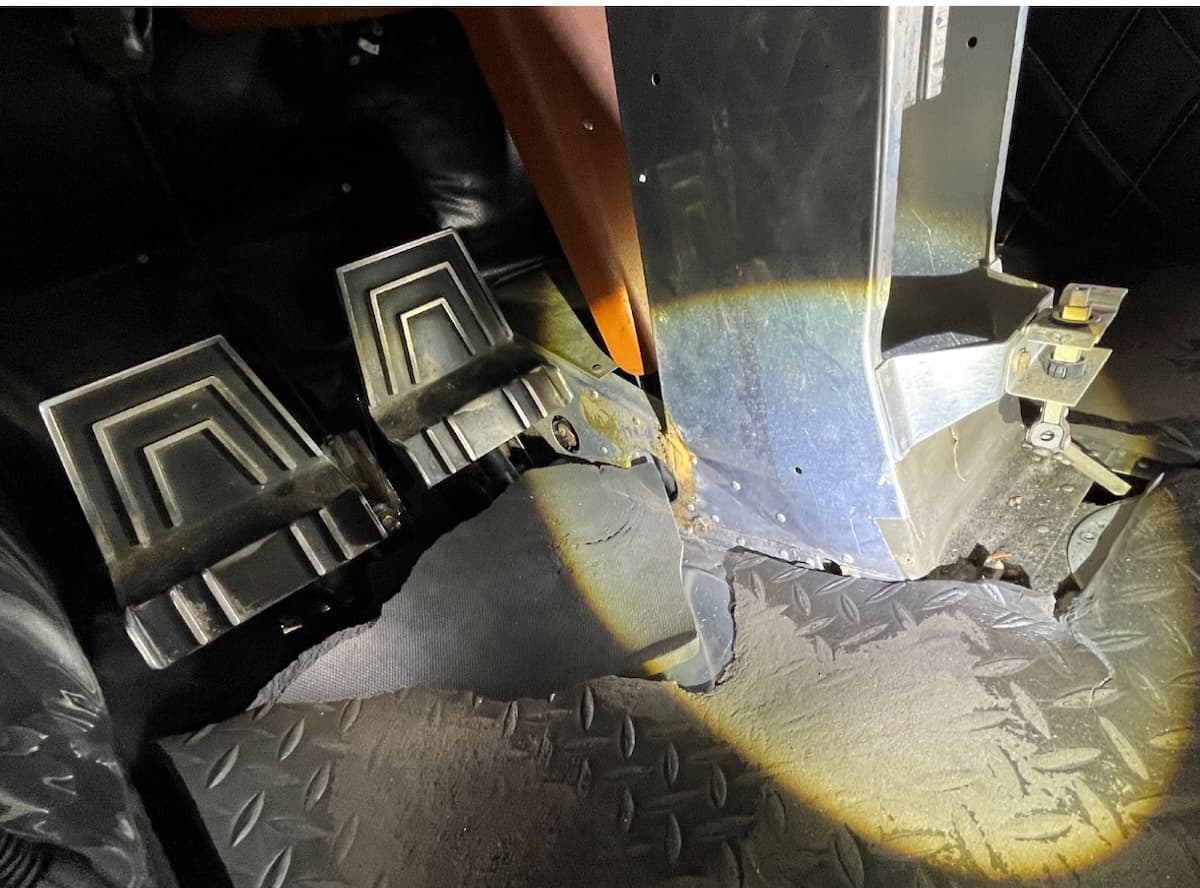
The airplane’s floorboards and internal structure were later found to be substantially damaged.
Both the pilot and the flight instructor reported that there were no pre-impact mechanical malfunctions or failures with the airplane that would have precluded normal operation.
Probable Cause: The pilot’s improper landing flare and control inputs, which resulted in a hard landing. Contributing was the flight instructor’s delayed remedial action.
To download the final report. Click here. This will trigger a PDF download to your device.
This October 2024 accident report is provided by the National Transportation Safety Board. Published as an educational tool, it is intended to help pilots learn from the misfortunes of others.
Another head-scratcher: This flight raises several RED flags, starting with uncertainty about its intended purpose.
There’s nothing illegal about a 34-year-old, 292-hour Commercial-rated pilot (“student”), with 0.8 hours in make and model, flying with a 23-year-old, 482-hour CFI …who has 119 hours of dual given, but only 10 hours in make and model. However…
The student’s comments in the NTSB Form 6120.1 are somewhat ambiguous and suggest a ‘disconnect’ about the flight’s purpose.
NTSB Summary: “The pilot reported that she rented the accident airplane to gain proficiency flying from the right seat and had asked the flight instructor to sit in the left seat during the flight.”
The student’s comments make it sound like this was an instructional flight toward earning her CFI: “I was receiving my first instructional flight in the right seat.”
However, asking a CFI to “sit in the left seat” is not quite the same as planning and conducting a formal training flight geared toward meeting specific Part 61 requirements.
Does someone wanting to ‘check out’ in the right seat always mean they are officially working towards their CFI rating? Absolutely not, but in this scenario, given the aircraft ‘Operator’ was a large flight school, I’m betting that was her intent. If that’s true, it looks like they might be missing a syllabus/lesson plan that would have addressed her issues: “Prior to this flight, I asked multiple CFIs about transitioning to the right seat, and none of them, including my left-seat CFI, mentioned concerns about muscle memory issues.” If she had those concerns beforehand, why did she even get in the plane?
She then blames the CFI …understandably …for her muscle memory-induced “hard landing”:
“This could have been prevented if there was more familiarization with right seat flying prior to operation, educational requirements for CFIs to teach about potential issues of muscle memory for transitioning to the right seat and ultimately had the CFI recognized the unstable approach and taken over the flight controls.”
This accident happened in October 2024; just before the “new” 14 CFR Part 61.195 requirements for a CFI to teach an initial flight instructor applicant took effect in December 2024. Under the “old” rules, the requirements allowed just two possible “paths”:
1) Experience & Time:
– Hold a flight instructor certificate for at least 24 calendar months.
– Have given at least 200 hours of flight training as a flight instructor (or 80 hours if training in a glider).
2) Pass-Rate / Track Record:
– Have trained and endorsed at least 5 applicants for a practical test within the preceding 24 calendar months.
– Achieved at least an 80% first-attempt pass rate on those practical tests.
I have doubts as to whether her instructor was qualified to provide initial CFI instruction. Since he only had 119 hour as a CFI, he would’ve had to meet the “80% Pass-Rate / Track Record” requirements. Was that possible…yes. Was it likely …no comment.
Regardless; based on the CFI’s failure to take timely corrective action while she clearly struggled with a/c control: He wasn’t ready to instruct someone in the right seat …and her “muscle memory” excuse is good for one-time only.
We all have had hard landings……However the CFI is responsible for letting it happen……
First time flying from the right seat. With most people, the switch in hand control is definitely going to be awkward. She was on all of the controls and was apparently struggling. Maybe introducing one control at a time, with the instructor sharing workload and closely monitoring what the learner was doing, would have worked better.
If parts or systems are stressed beyond their design limits, things will break…there is a tradeoff between the engineering design for strength vs weight.
An aircraft could be designed to tolerate a drop from 20 ft, but it would weight so much that it may not be able to fly, or carry much if it did.
I, have seen quite a bit of damaged aircraft as a 30+ years in General Aviation, but I have never seen this kind of damage shown in this photograph.
I, would think the firewall, engine mount are buckled and bent.
If, the aircraft in the first photo is the same one, that is a strange one.
Just….good grief.