

Two global safety restraint industry leaders — Aircraft Belts, Incorporated (ABI) and Key Safety Systems (KSS) — have joined forces to create Aviation Occupant Safety (AOS), a joint venture to bring automotive airbag safety to general aviation.
AOS will focus on offering the general aviation market inflatable protection solutions at the OEM level as well as the aftermarket segment of aircraft owner/operators, company officials said.
 Drawing on decades of experience from each parent company, AOS will act as a single source in the engineering, development, production and testing of its inflatable restraint product line. Established in May, AOS will be exhibiting at this year’s National Business Aviation Association trade show Oct. 30-Nov. 1 in Orlando.
The headquarters and primary development and testing center of AOS are located in Sterling Heights, Michigan. The operational facility is in Creedmoor, North Carolina, with additional testing and development centers in Frankfurt, Germany, and Shanghai, China.
Initial product development for AOS will focus on forward facing inflatable restraint solutions for passengers and crew in a typical forward facing seat configuration and side facing inflatable solutions for passengers occupying a divan typically found on larger business aircraft.
Forward facing inflatable solutions from AOS feature the inflatable device embedded into woven tubular webbing presented in a two or three point inflatable lap belt.
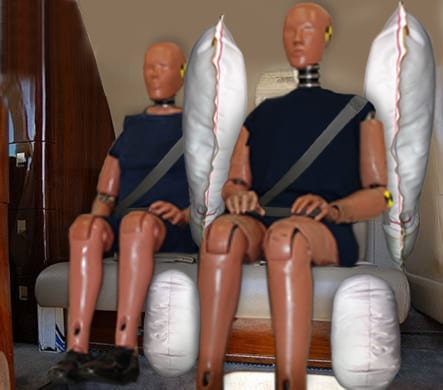 AOS forward facing solutions also incorporate Key Safety Systems proprietary impact sensing and diagnostics technology, as well as mistake-proof buckling that ensures aircraft crew won’t inadvertently buckle the wrong belt into the wrong buckling receiver, company officials said.
Key Safety Systems (KSS) is a global leader in the design, development and manufacturing of automotive safety-critical components and systems including airbags, seatbelts, and steering wheels. Its products are featured in more than 300 vehicle models produced by more than 60 companies worldwide. KSS also supplies a wide variety of non-automotive businesses, including military and commercial vehicles.
Since 1981 Aircraft Belts has provided aircraft belts and restraints to many aircraft manufactures including Cessna, Bell-Boeing, Agusta, Piaggio, Twin Commander, Sikorsky and several military programs. The company provides restraints (re-web and new) to Gulfstream, Bombardier, Dassault, Embraer, Hawker and to many other interior completion centers in the aftermarket through its repair station. ABI operates from a 70,000-square-foot facility located in the Raleigh/Durham area of North Carolina.
For more information: AviationOccupantSafety.com
