

Lisa, a sport pilot in New Mexico, asked me the other day: “There are all kinds of ways of knowing when a TFR starts, but how do I know when one ends?”
To which I said, “Oh my gosh, will you look at the time? I’m running late for my appointment to change the water filter in my Keurig!” (Lisa has an amazing knack for asking me questions that I do not know the answers to.)
But this is a really interesting and timely question, particularly with the political season heating up early, like a cultural version of global warming. She also asked it before the recent misadventures of an improperly extended TFR in Chicago, and after reading about that, I had some remorse that I didn’t dig into this subject sooner. My excuse this time is more legit than the Keurig excuse — it turns out there’s quite a bit of confusion around this subject.
Because, as it turns out, while, as Lisa said, there are all kinds of ways of knowing when a TFR will start (10 by my count), it appears that there is only one reliable way to know if it has really ended.
And that way is not without problems.
But before we even attempt to land this plane, let’s back up and run the checklist.
For new students, TFR stands for Temporary Flight Restriction, a process where one — or more — types of charted airspace in a geographic area are temporarily converted by the FAA into Restricted Airspace. There are a myriad of reasons for TFRs, but they are generally related to safety and security, either for us in the air or for those on the ground.
For instance, in the fire season in the west, TFRs are established around wild fires so that firefighting aircraft don’t need to be on the lookout for lookie-loos. Likewise, any disaster area with an ongoing emergency response gets one, as do air shows and — gulp — plane crashes. Large open air assemblies of people —think football games — rate them, as does the President of the United States (POTUS) and some other government officials.
It’s these last ones — officially called “VIP TFRs” — that prove to be the biggest headache for GA pilots, for several reasons. First off, they are HUGE, covering a bit over 3,700 square miles. GA flights are absolutely prohibited in the center third or so, and highly restricted over the rest of it, with many kinds of flying being banned. If you accidentally enter one without following all the proper procedures, you will be intercepted by military aircraft. Fully armed military aircraft.

Why all the fuss? How much damage can a small GA airplane possibly do? Well, consider that most Shahed-type drones are smaller than a Piper Cub, and can pack a hell of a punch, so small and slow radar targets can still be a threat, and I guess someone with ill intent could fill a GA airplane with high explosives Kamikaze-style, so it makes sense for the government to be prudent.
Anyway, back to the headache. Not only are these POTUS TFRs large, they show up where you might not expect to see one. You can see that the forest is on fire. If there is a disaster in your area, you probably already know about it. If there is an air show, you probably already have tickets. A stadium with a full parking lot is obvious. But you might not know that POTUS has decided to visit the local John Deere factory.
But wait, you say, didn’t you tell me that there are 10 ways for pilots to know about a TFR-induced change of airspace? Why, yes. Yes I did. Here’s how that works.
While various government agencies can request a TFR, the FAA has the sole authority to issue them, although which part of the FAA does so depends on the type of TFR. Still, once the high-level decision to establish one is made, the TFR itself is issued through the National Flight Data Center, which publishes it as a NOTAM (Notice to Airmen). Some, like those related to disasters, take effect at once, while others, like the VIP or air show type, are announced in advance, with both projected start and end times so pilots can plan ahead for them.
Once the NOTAM is published, how are pilots made aware of them? In no particular order, a pilot can learn about a VIP NOTAM from:
- A dedicated section of the FAA website.
- Electronic Flight Bag apps (EFBs).
- Air Traffic Control.
- Leidos/Flight Service.
- The U.S. Airforce 601st Air Operations Center’s Outreach Program.
- The FAA’s email-based notification system.
- Email alerts from the Aircraft Owners and Pilots Association (AOPA).
- Company Dispatch (for Part 121 and 135 operators).
- Monitoring “Guard” for warning messages to other aircraft.
- Warning signs posted on gates or taxiways by local airport management.
With all of that, how could a pilot NOT know about a TFR? Honestly, I ask myself that question frequently, as there are an incredible number of TFR busts by GA pilots every year, so there’s certainly a problem. Part of it may be that many pilots are used to just hopping into their airplanes and enjoying the freedom to fly that we usually have. Especially if it’s a short impromptu local hop, often looking outside the kitchen window is as effective for checking weather as is calling Leidos, and if you weren’t originally planning to fly, you might not be tuned into your email.
Another possible source of the problem is that pilots are becoming increasingly EFB-dependent, but there are a host of issues with using an EFB as the primary source of TFR information that are not widely understood, including — depending on the “make and model” of the EFB — data latency both in getting the information from the FAA to the provider and how often the EFB app checks in with its provider for updates, which commonly is around four times per hour. Another “gotcha” issue is the need to ensure that the TFR alerts are enabled on the EFB. On top of all of that, some EFBs only pull TFR data when they are connected to the internet, so depending on your setup, you might not get updates in flight at all.
Yet another facet of the problem, especially with VIP TFRs, is that their times frequently change. While they are generally announced three days or so in advance, the President’s schedule isn’t exactly carved in stone. I’m always amused seeing how many time change emails AOPA sends me on local TFRs (and hey, AOPA, a request: It would be helpful if your change announcements instead of just giving me the updated time included the old time, such as changed from xx time to xx time. That would help for my situational awareness: Is it now earlier or later?).
Anyway, back to our topic at hand — not beginnings, but endings. VIP TFRs are issued with both a start time and an end time. But what if POTUS is running late? Or what if the president is having a good time and decides to stay longer? What if the VIP changes his or her mind and doesn’t go at all? What if the VIP leaves early?
In theory, the NOTAM will either be extended, canceled, or closed early. Great. But if any of those three happen, how will we know? Most of the 10 ways of learning about TFRs are essentially early warning systems, and while they will work for advanced cancelations, they aren’t really designed for last-minute change notifications, especially for a TFR that’s already active. So that pretty much rules out the 601st, and FAA and AOPA emails. And as most of us don’t have company Dispatch, so we won’t waste time on that. Likewise, monitoring guard does no good if someone isn’t screwing up, and if the TFR is over, there’s nothing to screw up. And lastly, the handy warning signs on airport property require the person who put them up to know about the change which, as you are beginning to see, is no easy thing, plus, if we are airborne already, the signs are moot.
That leaves us with the FAA’s TFR website, EFBs, ATC, and Leidos/Flight Service as the best potential options for knowing if a TFR is over. But as you will see, not all is as it seems.
In all of its literature, the FAA says that its TFR website is updated in REAL time. Well, this sounds great. No latency, no worries, this is hard data right from the horse’s mouth.
Uh… actually… no.
When I went there today, there was a brick-red warning banner at the bottom, saying, among other disclaimers, “Due to system processing delays, recently entered NOTAMs may not be displayed.”
Great.
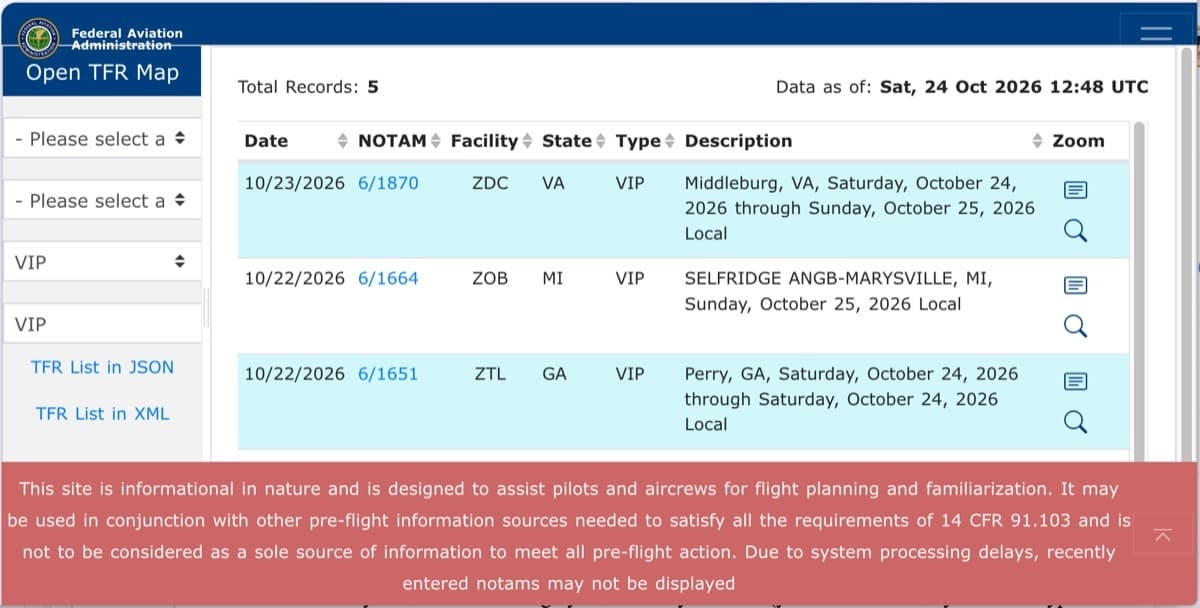
Besides which, getting the times of a TFR through the FAA website is no easy thing in the first place. At the website you have to search for TFRs by state, FSDO, or TFR type. Then, when you find one, the header doesn’t give you the times. When you click on the text, it’s too long to fit on your computer screen. You gotta scroll. The times are buried somewhere in the middle.
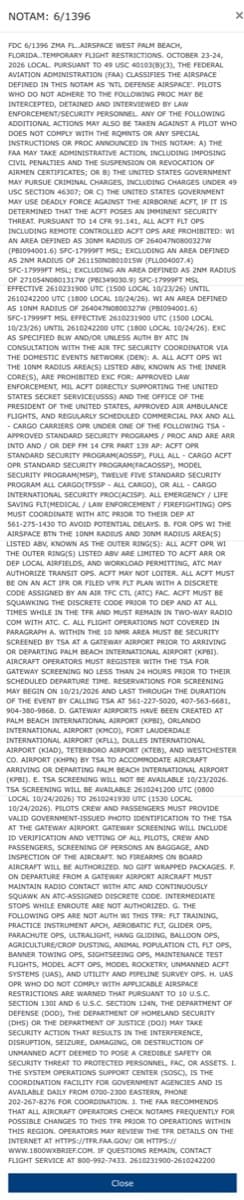
On top of that, figuring out where the TFR is actually physically located is hard. The official NOTAM describes the location as a radius from a lat-long or navaid, and not all of them have an accompanying graphic, which is probably why most pilots prefer the EFB, which — through the provider — translates the text into a graphic that shows the approximate location of the TFR, overlaid on the pilot’s map of choice (keep away from the edge, such graphics are less accurate than most pilots think).
But, on top of all the TFR issues with EFBs we covered earlier, if you are in flight, most EFBs are set up more like an egg timer than a realtime information feed. When the TFR reaches its originally announced expiration time, it disappears from your screen, as most of the systems have no way of knowing about a change once airborne or lack the capability to convert FIS-B (the broadcast component of the ADS-B system) NOTAM updates into a graphic representation.
ATC should know, although whether or not it will communicate that to you depends on what service you are getting and how busy the workload is. Like EFBs, many pilots over-rely on Flight Following, which is only intended as a VFR traffic advisory service and then only on a time-available basis.
So realistically, as it turns out, Flight Service is the only source of near real-time data on TFR endings. It’s fair to say that there is a blurred line between Flight Service and Leidos’ 1-800WX Brief. Leidos is the FAA contractor for Flight Service, except in Alaska, where it’s still run by government employees. The primary way to reach Leidos — by design — is via web, with telephone being secondary, so most pilots don’t generally connect with Leidos beyond an “official” preflight briefing, if they even get one.
And, of course, that itself is a process. You can’t just call Leidos and say, “Hey, any update on that TFR over _____________?” And even if you do jump through all the hoops, when should you do it? And how often should we be calling them to see if something changed? Before flight would be a no brainer, but when exactly? Before leaving home? When arriving at the airport?
Then, what about after engine start? During run-up? What if you have an old-fashioned passive headset with no Bluetooth for your cell phone?
Then, we get to the real problem, in-flight information, where Flight Service — as a reliable source of information about a TFR — has almost as many barriers as the EFB. So few pilots radio Flight Service nowadays, that the vast bulk of the old Remote Communication Outlet (RCO) network for reaching Flight Service was shuttered by the FAA in September 2026 (674 of the original 936 are now gone, only leaving us with 262 receivers in the country).
And, be honest, when was the last time you contacted Flight Service by radio in the air? Do you even remember the frequency? Do you know how high you have to be above the ground to reach them with the reduced number of com outlets? (The default frequency is 122.2 MHz. For reliable “connection” you need to be +5K AGL.)
And even if we can reach them in flight, how often can we realistically be expected to radio them? “Is there a change in the TFR?” could become the pilot version of the annoying child serial question “Are we there yet?”
So where does this leave us? Knowing a TFR is supposed to start is pretty easy, with many options. Knowing when it ends? Honestly? You might be better off just staying at home and changing your coffee pot’s water filter.

Leave a Reply