

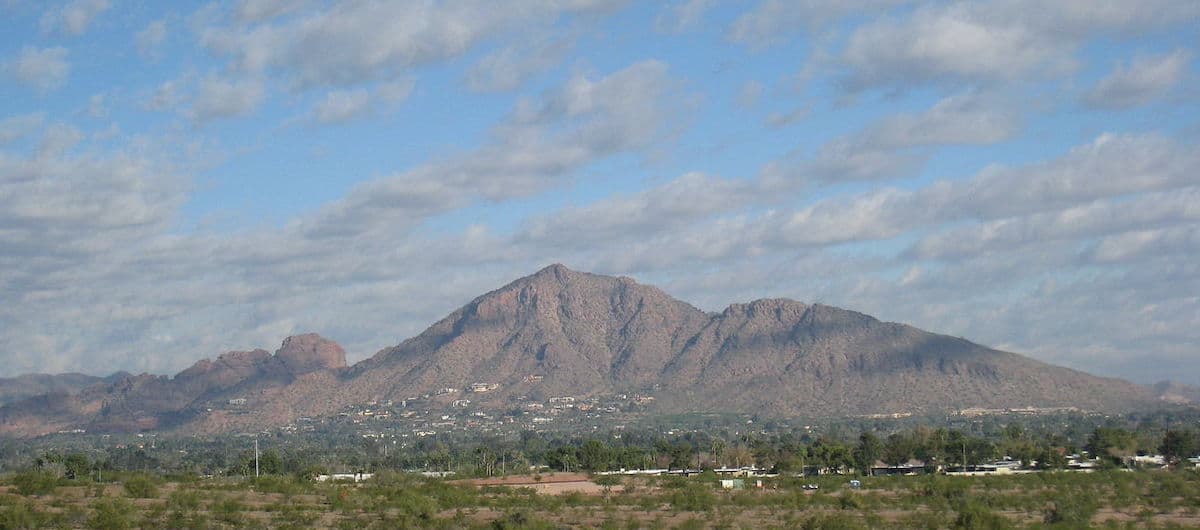
Standing majestically in the desert of Arizona is Camelback Mountain. This massive edifice of sandstone and granite isn’t hidden away in some distant corner of the Sonoran Desert, however. It is in the heart of Phoenix. A city that has grown significantly since Alfred Hitchcock shot the opening scene of the classic thriller Psycho there in the late 1950s.
Today Camelback Mountain is a city park. The upper reaches of the mountain are off-limits to developers. It is largely as it was in centuries past when the Hohokam tribe used it for ceremonial purposes, its caves providing shelter from the heat of the midday sun.
The mountain served a purpose then that is still appreciated today. It provides a 360° view of the city that has grown up around it, as it gave the hiker of days gone by a perspective on the world below that couldn’t be matched from ground level.
Humans are drawn to an awe-inspiring view. They always have been. They always will be. It’s in our nature. Hence, we position homes on hillsides. Sharp developers create housing on the coasts that face outward, to the sea. We build skyscrapers that reach up above the heights of the buildings surrounding them.
All these real estate developments are priced higher than equivalent spaces placed in less desirable locations. They’re at a premium compared to the homes in the valley, or half a mile from the beach, or on the lower floors closer to the lobby.
A better view has real value. For some that value is monetary. For others it is spiritual. Whatever our value system, we prize altitude. We always have.
If you doubt the draw of a good view, consider the London Eye. At one time the largest structure of its type in the world, it is not marketed as a Ferris wheel, although that is undoubtedly where the idea originated. The London Eye is marketed as an observation wheel. Same thing, different name.
The marketing team wins again.
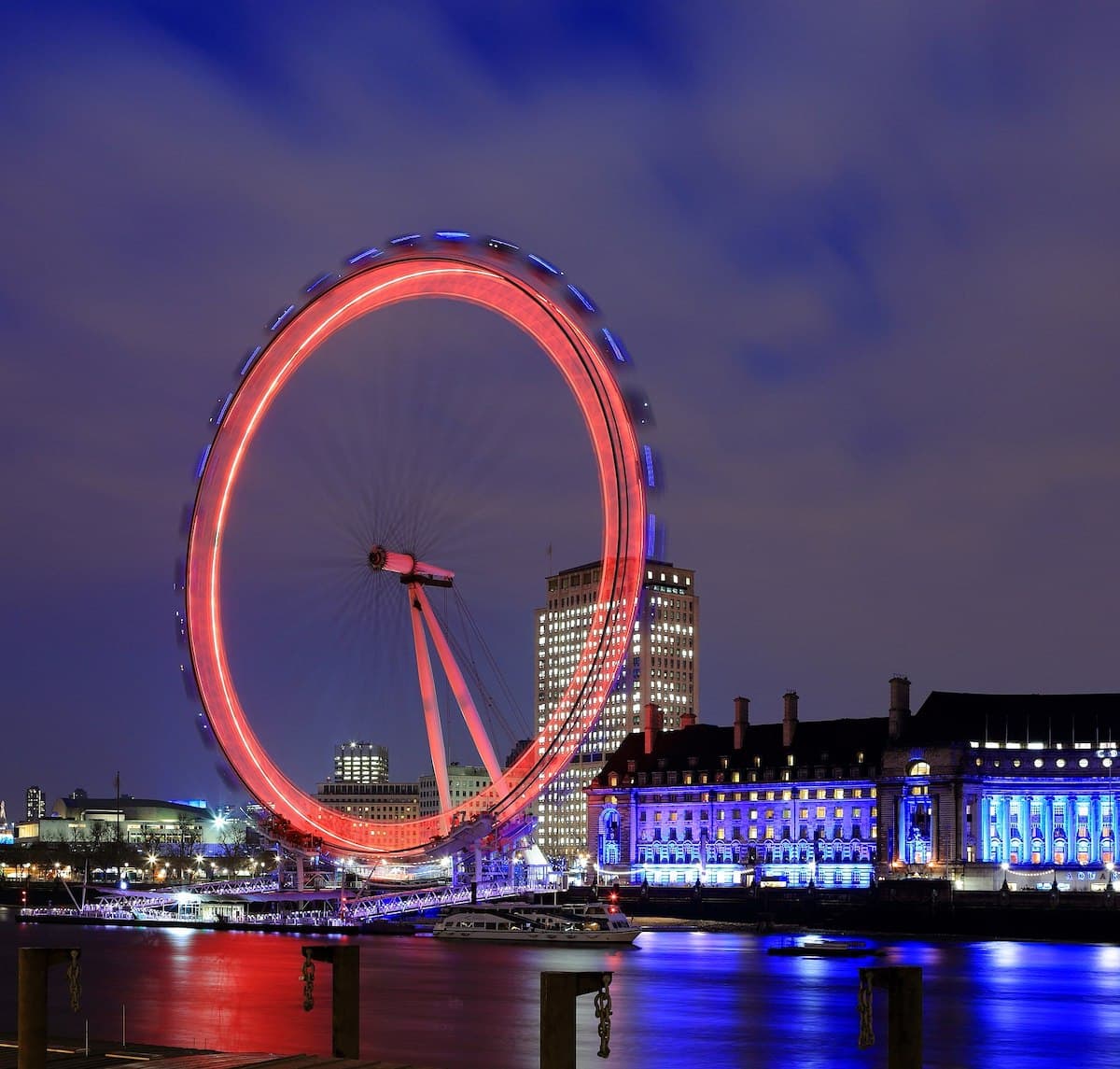
Originally known as the Millenium Wheel, the Eye wasn’t intended to be a permanent structure. Yet in a city the size of London, few ever get to experience a wide open, unobstructed view of this historic hub of commerce along the Thames — a fact that caused this temporary spectacle to become a highly sought after destination for tourists and locals alike.
Today, for something in the neighborhood of $40 to $50 each, you can walk right up, buy a ticket, and rise to the dizzying height of 443 feet.
Amazing!
Success tends to breed imitation and that has certainly been the case when it comes to getting pedestrians to altitude. Las Vegas now has the High Roller. The Singapore Flyer came along in 2008. Dubai beat them all by going even higher with the Ain Dubai clocking in at 820 feet tall. Even Orlando jumped on the bandwagon with the Orlando Eye.
There’s no doubt the general public is willing to pay good money to get a better view — to push their visible horizon out a bit further.
A couple walking up to the Orlando Eye can buy tickets and ride for roughly $80. The ride lasts roughly 20 minutes. When it’s over you’ll find yourself in the exact same spot you were in when you left. Amused perhaps but not enriched in any way beyond seeing the sights of Orlando from 400 feet above the street.
Is it possible, just possible, that general aviation could benefit from a marketing campaign that extols the virtues of flying as a recreational activity to be enjoyed by the whole family?
You meet the nicest people on a Honda.
In 1963 a Japanese motorcycle manufacturer with anemic sales in the U.S. launched an advertising campaign designed to convince Jane and Joe America that motorcycles weren’t just for thugs and ne’er do wells. Bikers weren’t gang members. They were your neighbor. Your college roommate. They were you.
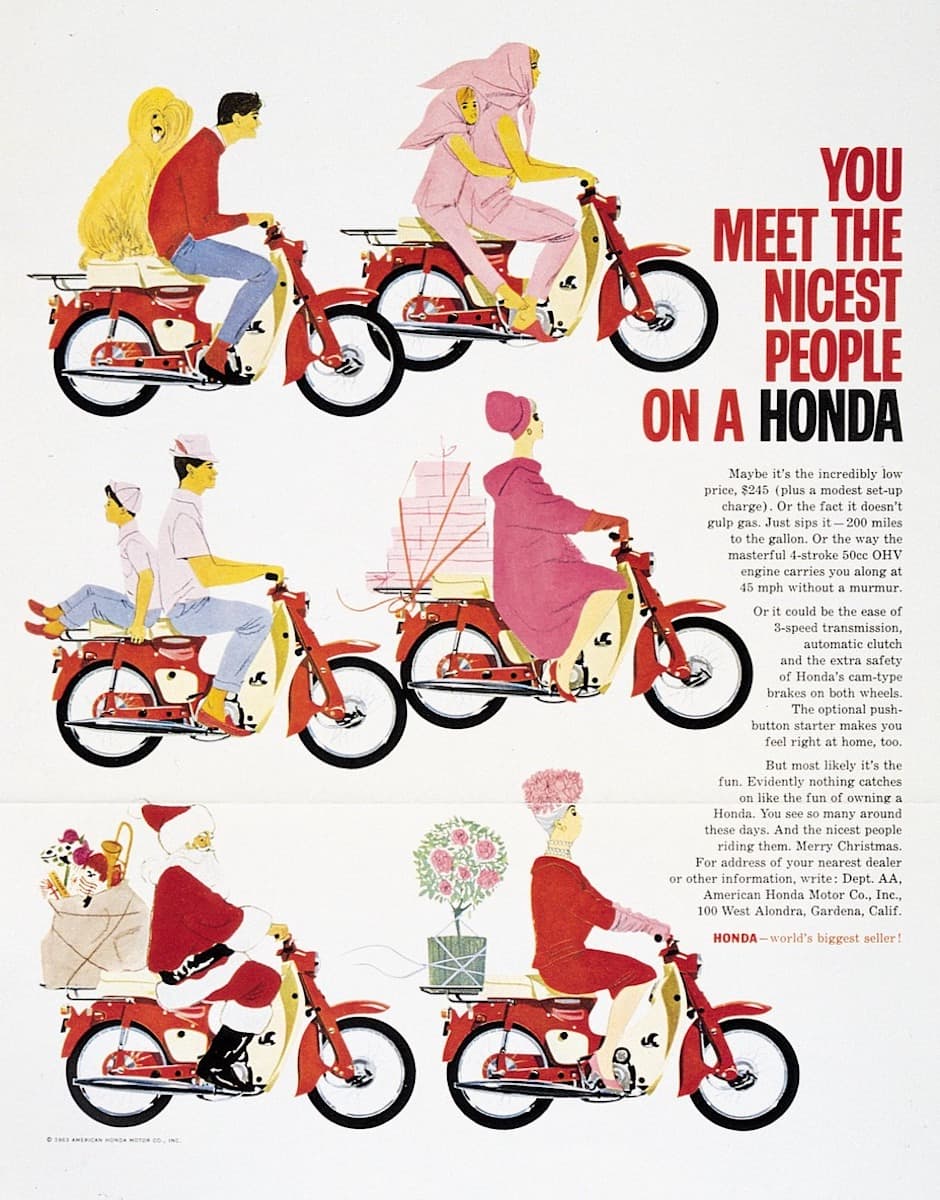
In 1959 foreign-built motorcycles imported to the U.S. totaled slightly more than 6,000, roughly 10% of the motorcycle market. That’s not an impressive number.
Then Honda got creative with its “You meet the nicest people on a Honda” campaign. By 1963 that campaign proved so successful Honda alone sold 100,000 motorcycles in the United States. It took over half the overall market in just four years.
That is what is known in business circles as explosive growth.
People like to travel. We know that to be true. People like to see the world from an elevated vantage point. That’s true as well. And for all the gloom and doom of the news telling us how hard life is and that our economy is on the precipice of disaster, the United States is home to roughly 24 million millionaires.
Let’s see if we have this right. There are approximately 700,000 pilots in the United States, but there are 24 million millionaires. Something in that math isn’t making sense. Clearly the population of people who can afford to become pilots and aircraft owners far outstrips the actual number of people who have earned a pilot certificate.
Could it be that we’re selling our products and services in the wrong way? Is there at least a possibility that our limited reach into the market isn’t the failure of our products and services, but instead a failure of reaching the public in a way they find palatable, or even desirable, inspirational, and motivational?
Honda found success by marketing a niche product that was largely seen as anti-social and dangerous to the general public as a machine that would allow virtually anyone to enjoy an efficient, safe experience they’d never considered before. And it wasn’t selling expensive cruisers or custom shop choppers. It sold small displacement fun machines that were relatively inexpensive to buy and operate.
MOSAIC has opened the door for us. Now it’s our turn to walk-out a marketing campaign that lets the other 330 million Americans who don’t fly know that now is their chance to step into a whole new life.
Might I humbly suggest something to the effect of “Your best life starts right here,” combined with a photo of a smiling couple buzzing along at 1,000 AGL in an inexpensive, low-powered, high fun-factor airplane.
If even half a percent of the overall population was swayed, we’d have the largest boom in aeronautical activity in history.

Ah yes, sport pilot, and MOSAIC euphoria. More complex aircraft permitted, and less pilot
training required. No change in human nature that causes over 70% of accidents. What could possibly go wrong. Wait for the future accident statistics to publish.
Maybe if we could just get everyone to binge watch “The Jetsons” on Hulu…?
You can do it for a lot less than you’d expect. Basic Med, 2 seat aircraft with folding wings (garage at home), runs on car gas. (OK EAA, start designing!) Sport pilot license. Some states don’t have an annual tax on aircraft. It isn’t all doom and gloom, it CAN be done. No, you aren’t going 200 KIAS in heavy IFR with six passengers for this kind of money, but if you are flying for fun and you know your way around (or somebody shows you), it isn’t a “rich person’s hobby” any more. Today I read that 53% of the families in the US have an income of $150K+ a year (which astounded me), so basically, if you are willing to forget that second gas hog SUV, you can go flying instead!
If we market this right, the biggest advantage I see is that a flight school no longer has to own an LSA to train sport pilots. Any flight school with a C-152, C-172, etc can now do sport pilot training, which means people can get their certificate in half the time it takes for a private. You also can be a sport pilot instructor without being a full blown CFI. So how do we make sure that flight schools know about this opportunity, especially ones at smaller airports?
The cost of admittance and the continuous costs may be a factor……you cited entertainment and spontaneous choices…..one and done…. however with becoming a Certified aviator…at $200-250 per hour…a time commitment of six months to a year…then with new aircraft from $200-1,000,000 ..landing fees..flight reviews, abysmal pass rates, medical exams….poor rental choices, yearly City, county, state taxes and forms…and so on and so on..fuel at $6.00 per gallon ….one can go to a boat dealer at 10….drive out with a new boat at noon…be in the water at one…….. aviation..not so much
I have loved and been involved in aviation for 50 years …..but facts are facts….it takes a huge ongoing commitment of time and money…to be involved in aviation
If you remove the student pilots and ATP pilots, there are 280,000 private and commercial pilots on the database.
https://www.faa.gov/data_research/aviation_data_statistics/civil_airmen_statistics
I would think that some millionaires that would fly GA would hire an aircraft and pilot.
Some business entrepreneurs may be interested in the company owning an aircraft that he would fly.
I expect that the Mosaic affect will be a number of pilots returning to GA flying certified aircraft like the Cessna 172 and 182, and Pipers, Mooneys, driving the price of these aircraft higher.
We’ll see.?
That is already happening.
OTOH, some of our local ‘derelict’ planes…the ones that sat abandoned along the back fence for years, with limited airframe damage, or concrete-filled buckets instead of an engine…are starting to disappear.
Let’s hope they’re finally getting resurrected.