

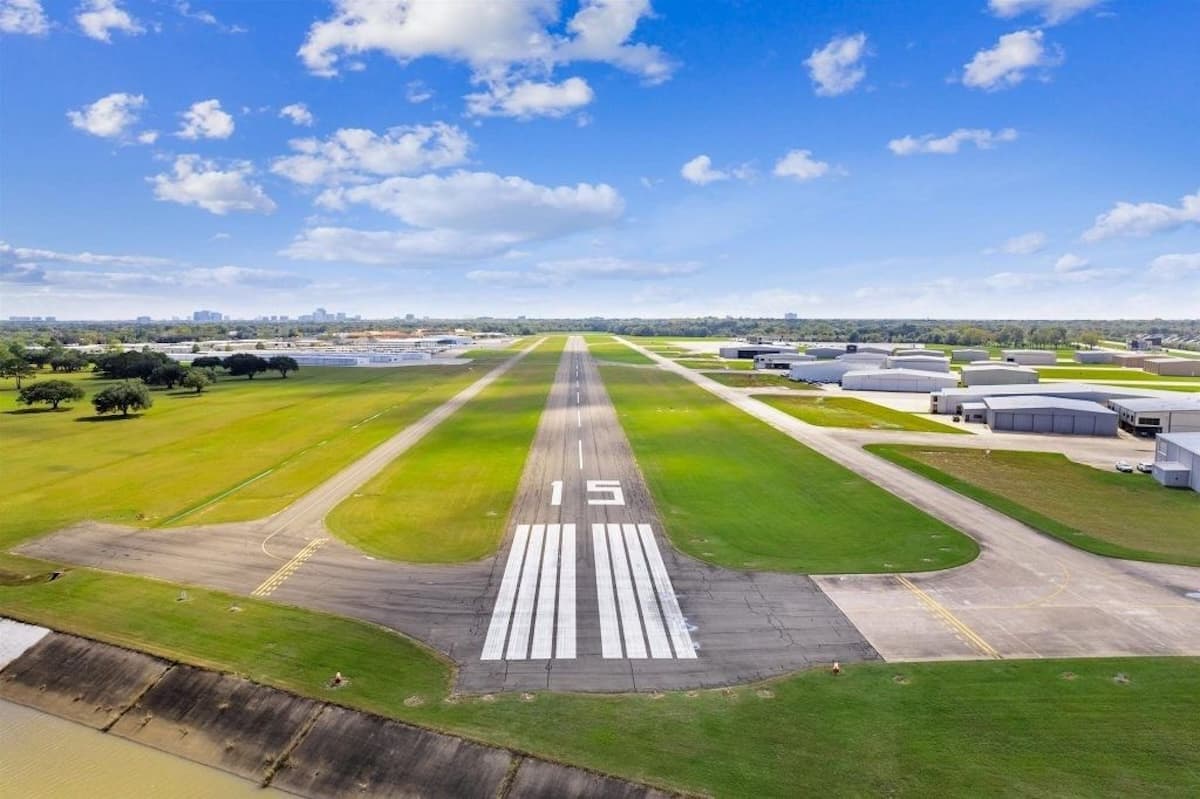
Guest Editorial By Mariah Aguilar, West Houston Airport
For many pilots, non-towered airports represent the heart of general aviation. They are where flight training begins, weekend adventures take flight, and local aviation communities thrive. While some people assume that the absence of an air traffic control tower makes these airports less safe, the available data tells a much more nuanced story.
In response to the increasing narrative that non-towered airports are inherently less safe than towered airports, I conducted an analysis of NTSB data. Rather than relying on opinions or anecdotal evidence, I wanted to examine the available data to provide a data-driven perspective instead of simply repeating a commonly held assumption.
To do that, I used the NTSB Aviation Investigation Search Database to identify reported midair collisions occurring at both towered and non-towered airports between 2016 and 2026. That analysis identified just 27 collisions where the airport type could be positively determined. Of those, 14 occurred at towered airports and 13 occurred at non-towered airports.
At first glance, those numbers may seem surprising. However, they become even more meaningful when viewed in the context of the thousands of airports that make up the nation’s aviation system.
The United States has approximately 527 towered airports compared with nearly 20,000 non-towered landing facilities, including public airports, private airstrips, grass and turf runways, gravel strips, and seaplane bases. When the collision data is normalized by the number of airport facilities, towered airports experienced approximately 2.66 midair collisions per 100 airports during the study period, while non-towered airports experienced only 0.065 collisions per 100 airports.
On a per-airport basis, that equates to approximately 41 times more recorded midair collisions at towered airports.
These findings should not be interpreted to mean that towered airports are unsafe. In reality, towered airports generally accommodate far greater traffic volumes, more complex aircraft operations, and a wider variety of aircraft. The analysis measures collisions relative to the number of airport facilities — not the number of aircraft operations.
The real lesson is that non-towered airports continue to demonstrate an excellent safety record despite relying on pilot coordination rather than air traffic control.
Safe operations at these airports depend on disciplined communication, standardized traffic patterns, vigilant visual scanning, and strict adherence to recommended procedures. Every pilot plays an active role in maintaining safety.
Organizations such as the FAA and aviation associations have long emphasized that non-towered airports operate safely because pilots share responsibility for sequencing themselves, announcing their intentions on the Common Traffic Advisory Frequency (CTAF), and maintaining constant situational awareness. When every pilot follows these established best practices, non-towered airports remain among the safest places to fly.
Whether arriving at a quiet country airstrip or departing a busy metropolitan airport, the fundamentals never change: Fly a predictable pattern, make clear radio calls, keep your eyes outside the cockpit, and remain alert for other traffic.
Safety at non-towered airports isn’t created by a control tower — it is created by informed pilots working together. The data reinforces what many aviators already know: When pilots communicate effectively and follow established procedures, non-towered airports continue to provide a remarkably safe environment for general aviation.
It’s not the airports! It’s some of the pilots that are the problem.
All those saying non-towered airports are unsafe, probably say guns kill!
Ridiculous!
I never really want new rules. But non-towered fields are all lumped together and many share little in common.
I break them into two types.
Type 1) Non-towered Airports with LOTS OF operations. Usually can be found near major cities where a lot of students practice and a lot of owners store their planes. A few in other places as well.
Type 2) Non-towered Airports with VERY FEW operations. Can be anywhere, but most pilots have visited them, some average less than one airplane operation per day. (makes it really hard to have a midair)
I did not indicate what volume makes it a Type 1 vs a Type 2. There should be some flexibility there. This is probably less than 5% of those non-towered fields.
As far as rule adjustments (just like the FAA has done to Super Class C etc).
Anyway, For rules, the Type 1 is where I see the most issues and would like to see an additional rule. Type 1 would REQUIRE the USE of a 2-way radio on UNICOM, and ADS-B OUT [no exceptions unless an emergency].
The Type 2 can continue as they are today. Trying to make things safer for everyone without making them burdened with extra stuff.
I agree with the requirements for a ‘type 1’ airport, using Nav Canada as an example;
At Canadian non-towered (uncontrolled) aerodromes managed within the NAV CANADA system, radio use is strictly regulated under two primary designations found in the [Canada Flight Supplement (CFS)](1.2.1, 1.2.6): Mandatory Frequency (MF) and Aerodrome Traffic Frequency (ATF)
Mandatory Frequency (MF) ProceduresRequirement:
Two-way radio capability and a continuous listening watch are legally required to operate within an MF area (typically a 5 NM radius up to a specified altitude).
One thing that really macks a difference at to weed airports is radar. A towered airport without radar must depend on aircraft reporting their correct position which is not always the case. One wrong position report with 3 or 4 using the airport can be a serious problem.
Excellent point Ray. I know some Control Towers may be helped a bit by unofficial ADS-B display, but only for airplanes with ADS-B OUT.
As someone who usually flies into airports that do have RADAR access, it is night and day when you go to one without it.
DC had a great track reccord with helicopters until it didnt
I should add that FAA statistics show that most mid-air collisions happen on clear days on and around NON-TOWERED airports…..
To say non-towered fields are safer is very misleading. Why?…..because many many near midair collisions and runway incursions go un reported…….
It is that simple…..!
“The real lesson is that non-towered airports continue to demonstrate an excellent safety record despite relying on pilot coordination rather than air traffic control.”
I don’t necessarily disagree with any of the author’s points; but I would definitely add some caveats to make sure the “real lesson” context is set correctly.
Stating that they have excellent safety records “despite relying on pilot coordination rather than air traffic control” implies that pilots have the ability to communicate; but since radios aren’t required at non-towered airports …we know that’s not always true. Conversely, I’ve never flown at a towered airport where talking to ATC made it ‘unsafe’.
Regardless, I don’t believe the fact that an airport hasn’t had a mid-air collision somewhere in its vicinity/traffic pattern(?) necessarily makes it a “safe” airport.
Although the author addresses the importance of adherence to those topics that should make non-towered airport operations safe …like complying with the FARs, following AIM guidance, and/or using formally established local procedures, etc., I think the study’s conclusion that non-towered airports are “safe” based solely on the number of NTSB-recorded mid-air collisions, is flawed.
There a lot more ‘metrics’ to consider before I’d declare a non-towered airport “safe”. They can be downright dangerous without the result being an actual mid-air collision:
What about the number of Near Mid-Air Collisions (NMACs) IVO non-towered that often go unreported via NASA’s ASRS program?
Or the very real, but un-documented “Wild West” activity that goes on, often resulting in the use of “non-standard” procedures, or FAR-violating tactics …just to fit in with the traffic flow?
Airports can have an “excellent safety record” but an “unsafe airport” reputation. There are plenty of non-towered airports I avoid because the lack of proper & effective “pilot coordination” makes them too dangerous to wade into.
Their “not if, but when” mid-air threat factor is too high, and I’d rather not become an NTSB statistic.
There is a lot of pilot-induced buffoonery …like taking off & landing downwind, or head-on into opposite direction traffic, or runway incursions, or a myriad of other events that may not actually result in swapping paint, but are definitely more likely to occur at non-towered airports.
You are right – this data is a complete surprise. Unfortunately it doesn’t jive with my personal experience flying around the central California coast. Almost all of my “unsettling/scary” encounters in the pattern have happened at untowered airports with disturbing regularity at particular fields. The culprit is almost always the “cowboy” who persists with a straight-in approach in spite of their being several law-abiding pilots who followed the recommended rules for joining, already circulating in the pattern. I’ve given up communicating to the offending aircraft with an advisory such as “not recommended”, as the reply is often not printable. I know data doesn’t lie – it just doesn’t fit with my experience. The only exception, where I definitely didn’t feel safer at a towered airport was when I came within a few hundred feet of of being turned to aluminum confetti by the Thunderbirds on downwind at at KMRY during the Salinas airshow. I was cleared for pattern work at the same time the Thunderbirds decided to do a low flyby on downwind – they were so close my cockpit filled with the smell of burned jet fuel in seconds as the F-16s blasted over me. The tower personnel at MRY still talk about that one! The local FISDO investigated but I never heard the outcome.
As a pilot since 1979, I have always choice non tower airports than towered airports only if need or in emergency, My reasons is because I am deaf and have a waiver only fly Nordo rules. However I had at times I had airport mangers or other pilots getting into my face for not using radio and state I shouldn’t be flying at All, even they refuse service, look out there are plenty Nordo flying pilots, relay on see and avoid than hear and focus on ADBS radar keep those eyes out, yes radio chatter is part of safety and also look out as well, plus comply with all airport pattern rules etc. Stay safe .
I would like to normalize the term “Pilot Controlled” in lieu of “Uncontrolled”
I’d like to normalize the term “out of control” airports.
Seems like comparing apples to oranges to me. Take 20,000 non-towered airports some that average less than 1 operation a day compared to 547 towered airports that average hundreds of aircraft operations a day. (Do the same with 20,000 rural road intersections vs 547 urban road intersections and see how dangerous it is to live in an urban area.)
Why not pick a few non-towered fields and towered fields with the SAME NUMBER OF OPERATIONS PER DAY. Now that would be something to study. Not just mid-air collisions but near mid-air collision.
I totally agree – you hit the nail on the head. The data as presented are meaningless. Around where I live, a good comparison would be comparing two busy fields KMRY Class C and KWVI with lots of traffic and no tower.
I think that in using private airstrips, you skew your data in a way that suits your narrative. I’m a huge proponent of non towered fields, fly out of one several times a week. Private strips, however, shouldn’t be included. There are well over a dozen within 20 miles of me, and 19 of them have less than five operations a year. I’d feel pretty confident saying that most private strips are the same. I would’ve kept it to public airports.
No doubt nontowered fields can be safe and are safe. It only takes one self important dillweed who feels like he doesn’t have time to fly the proper pattern, or thinks he should fly his straight in approach even though there are four in the pattern, to make everything unsafe.
I fly for pleasure and follow all standard procedures in and around non towered airports, but I have found it is safer to stay away from local flyin’s because it brings the fools out of the woodwork that never follow standard flying curtesy or safety protocols. I have found that a lot of these so called pilots do not even have a pilots license or a medical certificate. I am in SW Missouri and have seen this first hand. I follow all the rules and pay all the dues and yet you have to deal with flying fools all the time. This is as safe as we make it….it does not happen by itself.
Hello Aviation Alphabets – please repeat this good analysis far and wide. It would be interesting to know the type of aircraft involved. I would bet that sport aviators – those flying purely for pleasure – cause the least collisions. They are used to operating from smaller airfields with no one on the ground giving radio advice, and therefore keep their head on a swivel looking for others and communicating with them. The worst are probably those staring at some glass panel, assuming it will keep them out of trouble.
I would absolutely agree with your commentary.
Kent, I don’t think this is the analysis to have the “Aviation Alphabets” pass on to others. It seems like a study that is poorly designed.