


Way back when I was in the fourth grade, my class was assigned to a student teacher in training. I do not recall her name, but she was a nice woman. Kind, compassionate, and dedicated to elevating a new group of young people to a higher level of intellectual enlightenment.
To be honest I only remember one specific lesson from her tenure. The question was posed, “Why is the sky blue?” A question she answered with great confidence. Her message was this: The sky is blue because sunlight bounces off the oceans, which reflects the color of the ocean into the sky.
That’s not quite correct, but it is a good story. I found it curious at the time. As the years have slipped past, I find it somewhat endearing. She tried.
For my money, the two most important questions in life are simple, one-word queries. The first is why? The second is how?
Ironically, these pivotal questions first occur to us as small children. Anyone who has spent time with a toddler is familiar with the unending stream of “why” responses they can come up with. While the conversation may ultimately feel taxing and potentially never ending, the surge of repeated questions is an indication of a working mind. Curiosity has taken hold.
That’s good. Occasionally annoying, sure. But still good.
As our intellectual complexity expands our horizons, we tend to shift from asking why the world around us is as it is. Our new fascination becomes the far more practical query of how things work.
To ask only requires a bit of curiosity combined with a modicum of confidence. It’s human nature to shy away from exposing ourselves as ignorant boobs. Yet, it is the act of overcoming the potential embarrassment that helps us reach the next plateau of wisdom — a staircase of scholarly pursuit that will hopefully last a lifetime.
The search for knowledge is not to be confused with the search for an answer. Anyone can provide an answer. It doesn’t matter if they know what they’re talking about or not. Answers are easy. Truthful, accurate answers are harder to come by.
Tourists ask for directions from locals all the time. It’s not at all uncommon for a townie to misdirect the wayfarer either out of their own ignorance or for the dubious minor thrill of sending some poor innocent on a wild goose chase.
We would be wise to seek knowledgeable sources to bounce our questions off — which is an entirely different circumstance than merely looking for an answer. Or worse, an answer that supports our largely uninformed opinion.
The sky is actually blue because the shorter blue wavelengths of light scatter in our atmosphere, bounced around by the various gasses that surround the planet. That would probably be difficult to explain to a room full of largely bored eight- and nine-year-olds. And that’s if the teacher understood the science of it at all. It seems more likely the student teacher didn’t want to appear to be stumped by a child’s question, so she gave an answer that seemed plausible enough to end the discussion. Accuracy wasn’t the goal. Her quest was to move on.
In a fourth-grade class that had no particular need to understand the complexities of the full spectrum of sunlight, her answer was understandable — even if it was completely wrong.
In the adult world, it’s a bit more important that we understand with greater accuracy and nuance. This is the exact reason we must seek out answers to our questions from reliable, knowledgeable, reputable sources.
Just because Uncle Bob’s neighbor from down the street used to know a guy who flew for Eastern Airlines in the old days doesn’t mean he’s a reliable mentor on the subjects of aircraft systems or navigation. He may mean well. He may even have an answer to your questions. But we have to ask ourselves: What are those answers based on?
I recently had an exchange with a gentleman who took umbrage at my position on the importance of transition training. He insisted that stepping up from a Cessna 152 to a Cessna 182 was no big deal. Type specific training isn’t necessary in his considered opinion — a notion that was informed entirely by his personal views and beliefs.
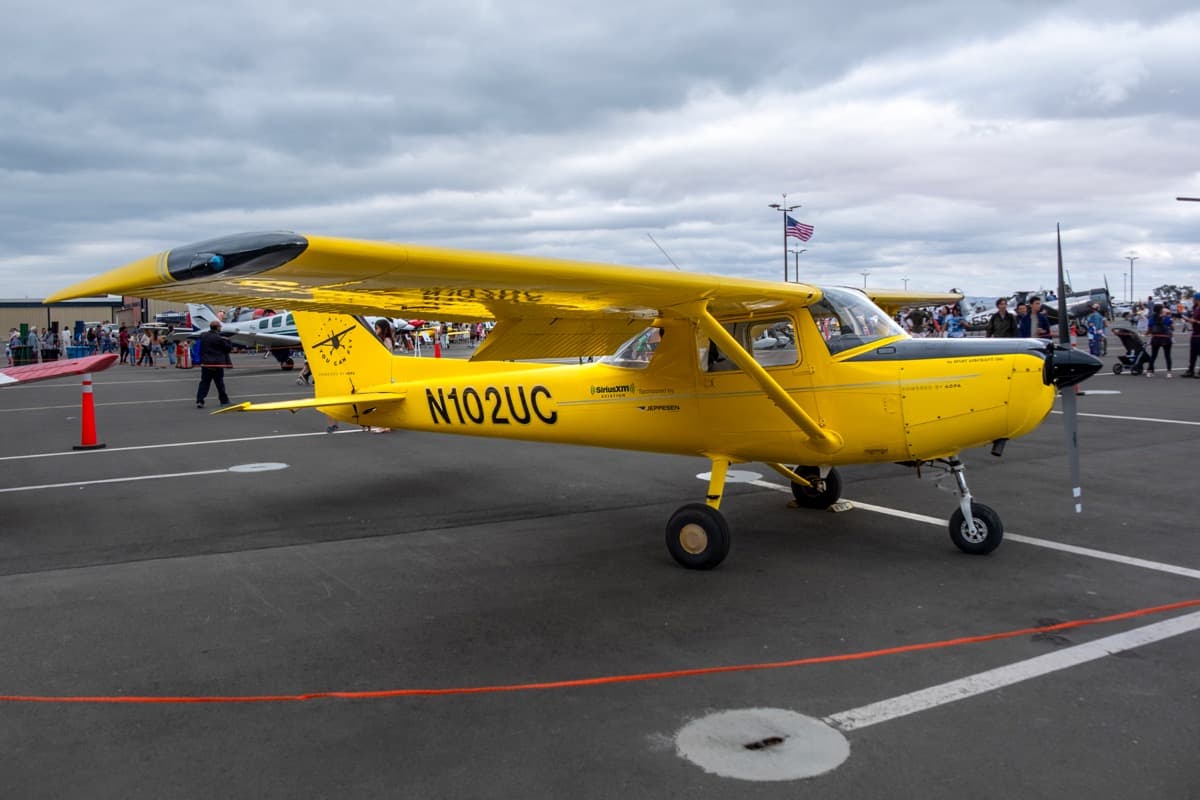
To be clear, the Cessna 182 has more than twice the horsepower of its smaller cousin. It weighs nearly twice as much, too. The 152 has a fixed pitch prop, while the 182 utilizes a constant speed prop and cruises at a far higher airspeed. The C-152 sports fixed gear, while some 182 models are fitted with retractable gear.

It is ludicrous, and potentially life-threatening, to suggest the two are similar machines beyond their basic shape when viewed from a distance. To some of us, that disparity is important. To some, it’s a mere aberration.
Whether we’re in the position of asking the question or answering the question, the risk of embarrassment is our greatest obstacle. The very human tendency to avoid that emotion can bite us in the butt if we don’t learn to overcome it.
There is no shame in admitting you don’t know. The best and the brightest among us do it all the time. That’s how they learn.
How many of us can recall a time when we were in a training class, feeling confused, perhaps a little lost, and maybe a bit concerned we might be too dumb to succeed in this field. Then suddenly a classmate raises a hand and announces to the instructor, “I don’t understand that. Can you back up and go over that point again?”
It’s the instructor’s job to slow down and rephrase the content in a way that’s more understandable to the audience. It’s the student’s role to be honest about how well they grasp the material and acknowledge any lack of understanding.
If either party ditches their responsibility in favor of a quick and easy exit from the conversation, that can become a real problem. In fact, it’s that sort of a fly-by-night training program that leaves some folks believing the sky is blue because sunlight bounces off the ocean and reflects the color onto the atmosphere. Or that a Cessna 152 and a 182 are pretty much the same thing.

You and your critic are both correct. If you are talking about basic control of the aircraft, the C152 and C182 are the same. Pitch up/pitch down, increase/decrease power – they have the same functions in each airplane. If you are talking about a feature you have never seen before, then you’d better do your homework.