

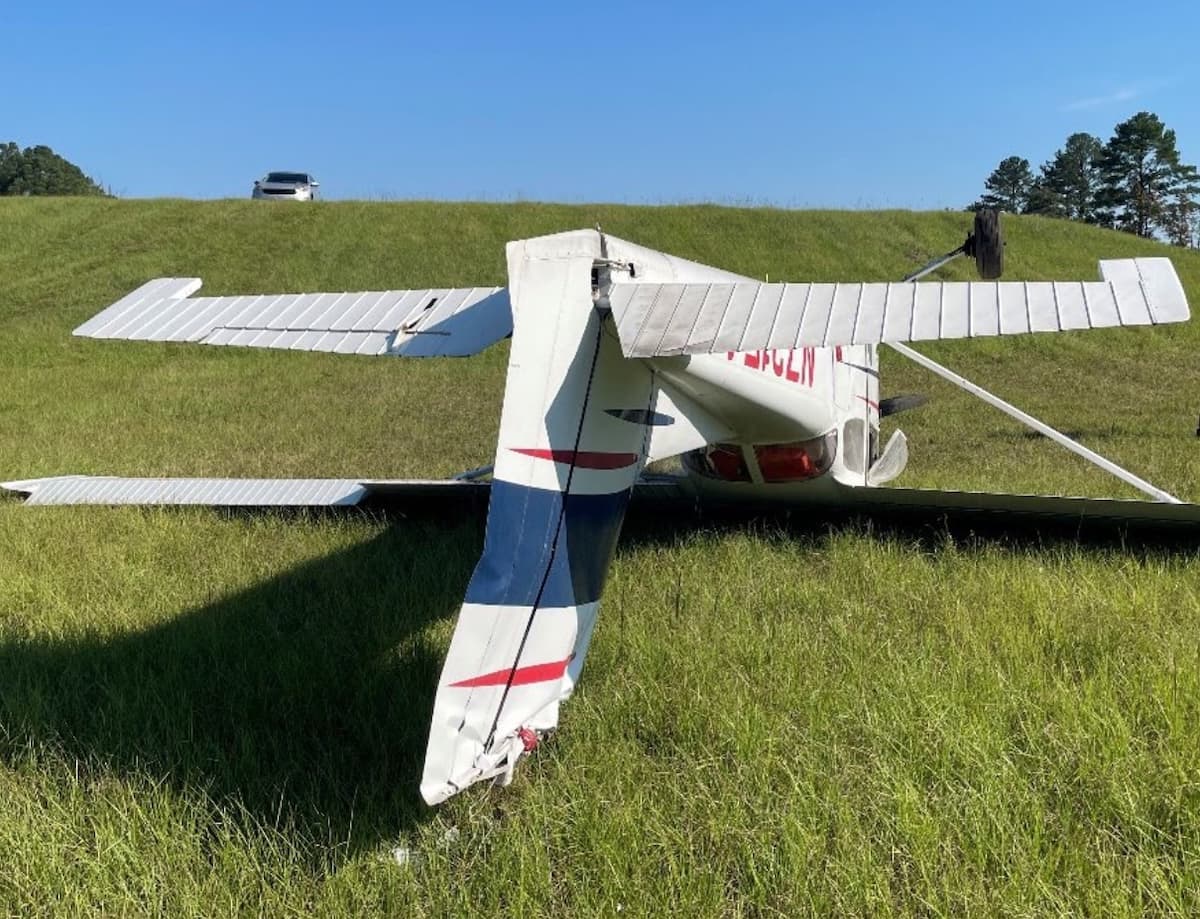
The pilot rented the Cessna 172M for a cross-country flight. During the flight, the control yoke became hard to move, and the airplane lost electrical power.
She told investigators the yoke could only be moved forward and aft about one half inch. She added that the pitch trim wheel became loose and moved without resistance.
She diverted to Ackerman Choctaw County Airport (9M4) in Ackerman, Mississippi, and circled the airport with the engine power at idle to reduce the airplane’s altitude.
After circling the airport twice, she attempted a landing on Runway 19, a 3,000-foot by 75-foot runway with dry asphalt, but the airplane was too high to land.
She performed a go-around and circled the airport a third time before attempting a second landing. During the second approach for landing, she placed the airplane into a slip to further reduce its altitude and landed about halfway down the runway at a speed of 83 knots with the wing flaps fully retracted. The pilot told investigators the wing flaps were retracted due to a lack of electrical power.
She applied brakes to try to stop the airplane, but the plane overran the departure end of the runway and nosed over in a grass field, sustaining substantial damage that included damage to the left wing and vertical stabilizer.
During the recovery of the airplane from the accident site, there was no control interference when the elevator was moved, with full travel, to the upper and lower control stops. Recovery personnel moved the elevator in both directions and a corresponding movement of the left control yoke was present while the airplane was inverted. When the airplane was placed into an upright position, the elevator was again moved and there was about 6 inches of free play before the left control yoke would move. The fuselage had longitudinal deformation from accident impact forces, which reduced the supportive length of the elevator control cable.
Post-accident examination of the flight control system revealed that the elevator trim control cable was found separated in the area underneath the cockpit seats. The elevator trim cable separation exhibited rust. Examination of the elevator control cable did not display separation, distortion, fraying, localized wear, or asymmetric wear. The elevator flight control cable pulleys did not display abnormal wear features and rotated freely. The instrument panel wiring near the control column had excess length and wiring that was within ½ inch of the flight control cables and pulleys. One of the wires near a pulley of the control column exhibited chafing.
The autopilot pitch servo clutch was not engaged and testing of the servo revealed that it met test specifications. Testing of the autopilot disconnect switch revealed normal operation.
Examination of the electrical system revealed the alternator had power and the ground wires that were frayed were covered with electrical tape. One terminal fell off the alternator when it was disconnected from the alternator during the examination.
Testing and examination of the alternator revealed the alternator case bolts were automotive bolts due to their greater length than the prescribed aviation bolts. The alternator brushes were copper, which was consistent with automotive brushes rather than silver aviation brushes. The alternator ran on a test bench with no anomalies that would have precluded normal operation.
The pilot reported that she had received her pilot certificate in 1997 and returned to flying in 2020 and had flown with instructors to relearn how to fly. She reported that the owner provided her a checkout in the airplane and had last flown 12 days before the accident. She texted the owner several days before the accident flight asking the owner the model of GPS and autopilot and watched YouTube videos on how to operate the Garmin 650 and to refresh her memory on the autopilot and avionics.
Probable Cause: The excessive airplane speed during a no-flap landing, and the pilot’s failure to attain a proper touchdown point, which resulted in a runway overrun. Contributing to the accident was the interference of the instrument panel wiring with the flight control system.
To download the final report. Click here. This will trigger a PDF download to your device.
This September 2024 accident report is provided by the National Transportation Safety Board. Published as an educational tool, it is intended to help pilots learn from the misfortunes of others.
No electrical, no flaps, no trim, corroded cables, excessive wiring service loop and no maintenance related probably cause finding. How does that compute?
A poorly maintained aircraft and an inexperienced pilot…a bad combination…Sad.