

It is no secret the aviation industry, at all levels, needs more maintainers.
One of the charts in the 2026 Pipeline Report gave me pause.
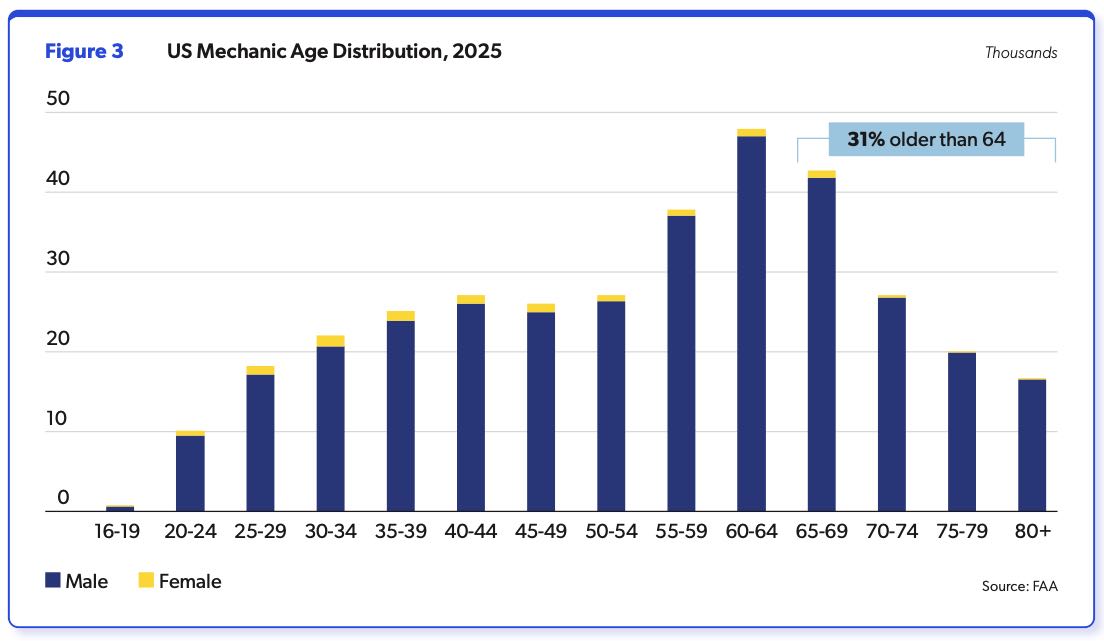
According to the report, Figure 3 (above) shows us 44% of all certificated mechanics in the United States are 60 or older.
Gulp.
That’s a lot of experience nearing, or past, retirement age.
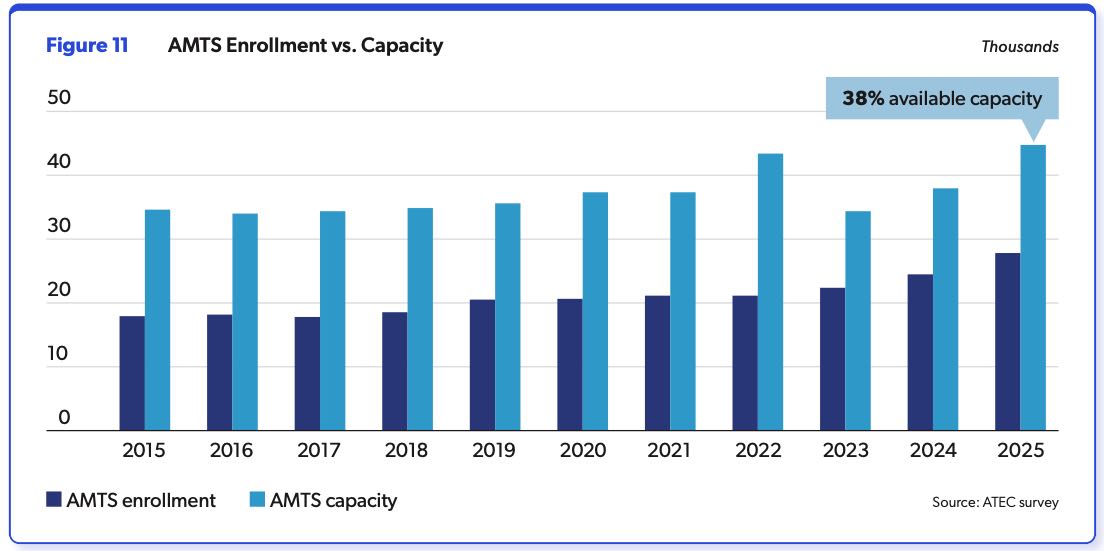
The report also tells us 27,740 students are currently enrolled in schools around the country. That number won’t replace the forthcoming retirements, but it’s better than nothing.
Figure 11 (below) shows there is capacity for more aspiring mechanics. We just need to promote the opportunity, line these students up with financial aid, if needed, and support them on their educational journey.
Mike Rowe, the Dirty Jobs guy, has a succint explanation of “The Problem” at his Mike Rowe Works Foundation:
It’s not a lack of opportunity or a shortage of good jobs. It’s simpler than that: We’ve been lying to ourselves about what success looks like.
Over the last 40 years, America has convinced itself that the best path for the most people is an expensive, four-year degree. Pop culture has glorified the ‘corner office job’ while unintentionally belittling the kind of work that built the corner office. As a result, we’ve devalued any other path to success, and an entire generation of people don’t understand the opportunities that exist.
The video at the top of the foundation’s webpage includes a young mechanic walking the “slow walk” with a military fighter aircraft in the background. That’s cool.
If you are an influencer — not just the social media type, but a parent, a grandparent, or a mentor of any stripe with today’s younger generation — throw in a good word for an aircraft or avionics maintenance career.
We’re going to need all the help we can get.

That 44% over 60 number is rough, and like you said, 27,740 students won’t cover it. One thing we see running a job board for traveling trades workers: young people move when they can see the pay. A posting with the rate on it gets clicked, and one that says “competitive” gets skipped. We keep a running look at what skilled trades jobs are actually advertising for pay, and the hands-on work keeps climbing. Shops trying to fill A&P seats might get further by putting the number up top, right next to the mentoring.
I think part of the problem with the shortage of A&Ps is the way the training is conducted. The community colleges should have a program where the students can go part time with evening classes similar to the way other skills are taught. I spent years trying to figure out how I could take classes part time and finally gave up and signed up for full time training. Now I have the certificate that allows me to take the test but am much too old to complete them
Ken. I ran a part 147 A&P school. It is almost impossible to break up an approved, 147 program. The monitored/required time and tracking of that is unlike any other coursework. And, I if I can still teach and do at 80 you can damned sure finish what you started 😎
Jim Mauro
Can you enroll him in a Part 61 flight school and get him started? He can solo now (at 16) and take his practical test when he is 17.
Suggestions?
My 16 year old grandson has expressed a strong interest in aviation mechanics and becoming a pilot. He is dual enrolled in his High School Junior year and local Community College first year for the ACE program at the local airport.
So far there is no hands-on or mentoring experience to maintain his enthusiasm. I am a pilot but live in another state.
Any ideas for maintaining his interest?
Thank you!
I went to A&P school, 2400 hours. Worked for a commuter airline a couple years. Worked Avionics because I also had 1st class FCC with Radar endorsement. Made peanuts! The guy fixing cars at the Chevy dealer was making 50% more with no liability! You want A&P’s, Pay Them what they are worth!
What’s crazy about that 27,000 enrolled number is that only about 6,000 per year will get their A&P certificate. This is a combination of low graduation rates (~40pct) and low passing rates for the A&P tests (~66pct), which continue to fall as test takers increase (FAA data). We need to get back to 20,000+ new A&Ps per year levels we saw in the early 90’s. The Experience & Apprenticeship track must be a part of this. Additionally, ATEC/Part 147 schools are more closely with the airlines to make sure 90pct+ of all those new A&Ps go to airlines and not GA, which is often never marketed as an alternative to a soul-sucking job as an airline mechanic. Obviously, policy can help in solving these problems, but also marketing (as the author mentioned) – the report will showcase how recruiters for A&P schools flash money-related benefits, attracting a cadre of incoming students interested in making a quick buck vs. a genuine interest in aviation maintenance. This shows up in the high vacancy rates as students fall behind. Finally, the incentive structure for schools needs to be redesigned, forcing them to keep the student in the seat as a mechanism to get funding for their program. For more detailed views on this topic, we’ve written about it and talked about it at airworthy.com
The concerns over the growing shortage of AMT’s are real but hard to quantify. We’ve been working this concern for our state and supporting the development of new A&P schools. Unlike commerical pilots who have to retire at 65 and that number feeds into the pilot data, mechanics can work forever and no one knows how many are working by age group. We even commissioned a University study to try and quantify the future demand and supply of technicians in our state. The problem with the data was that the FAA doesn’t differentiate between working or non-working technicians in their records. There is no mechanism for quantifying the already retired A&P’s. The industry would be well served if the FAA could poll the A&P’s for whom they have records. It would at least provide a baseline to work off of.