

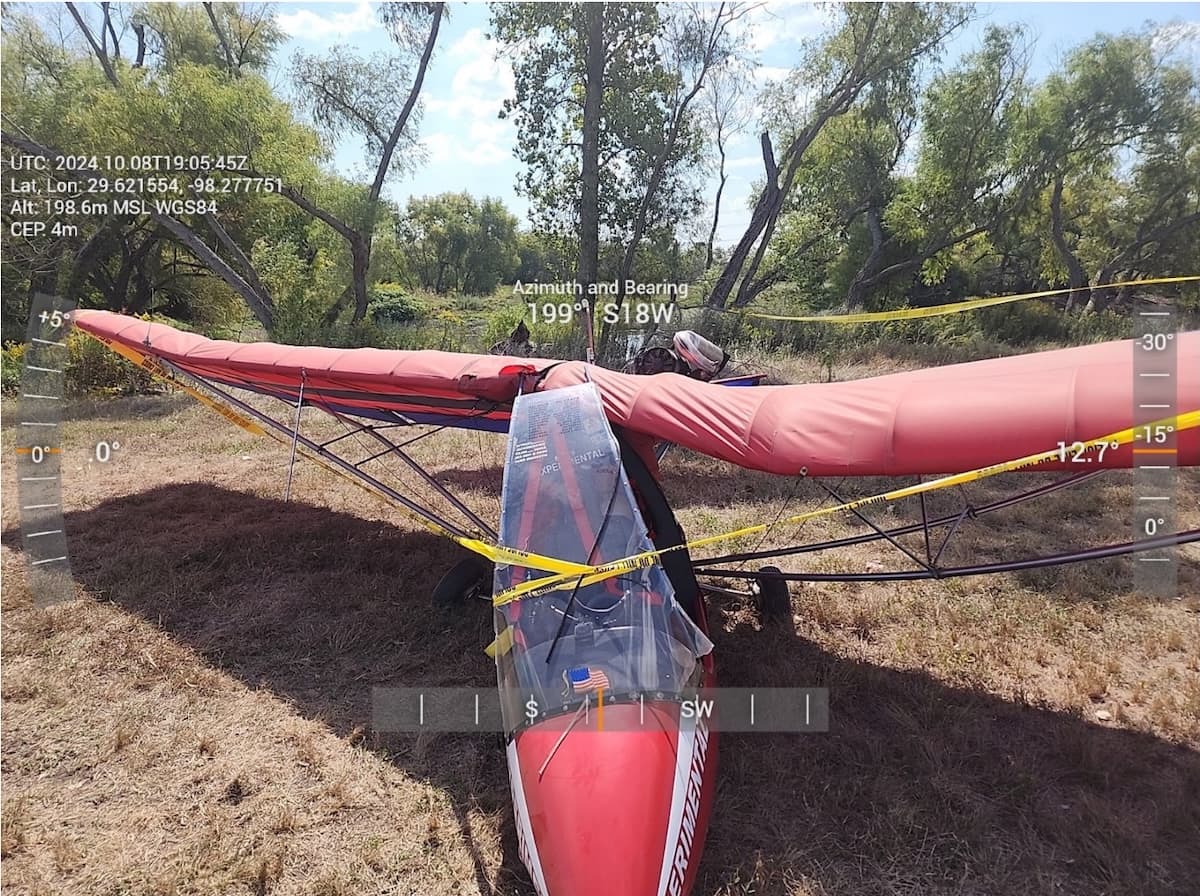
According to the pilot, he had recently performed maintenance on the Quicksilver GT 400’s carburetor and fuel lines, then completed multiple full-power engine tests before the accident flight.
The preflight and engine run-up before takeoff were normal with no anomalies noted. During the takeoff roll at the airport in Garden Ridge, Texas, the engine achieved full RPM.
About 100 feet above ground level, the engine exhibited a reduction in power to idle RPM.
Due to a stationary train car parked on a railroad track in his forward flight path, the pilot executed a low-altitude right turn. He told investigators, “the turn I made caused an unsurvivable loss of speed from which I could not roll the wings out and flare enough to soften the touchdown.”
The airplane hit terrain, came to rest upright, and sustained substantial damage to the fuselage and both wings. The pilot sustained serious injuries in the crash.
Post-accident examination of the airplane revealed flight control continuity was established to all flight control surfaces. One propeller blade was fractured near the hub. The propeller was manually rotated, and mechanical continuity was established in the engine.
The outlet fuel pump fuel line was found to have an improperly sized clamp. The line was cracked and fuel was leaking from the fuel line that ran between the fuel pump and the carburetor.
No other mechanical issues were noted with the airplane or engine.
Probable Cause: A loss of engine power that resulted from improper fuel system maintenance and the subsequent fuel starvation due to the leaking fuel pump outlet fuel line.
To download the final report. Click here. This will trigger a PDF download to your device.
This October 2024 accident report is provided by the National Transportation Safety Board. Published as an educational tool, it is intended to help pilots learn from the misfortunes of others.
Leave a Reply