

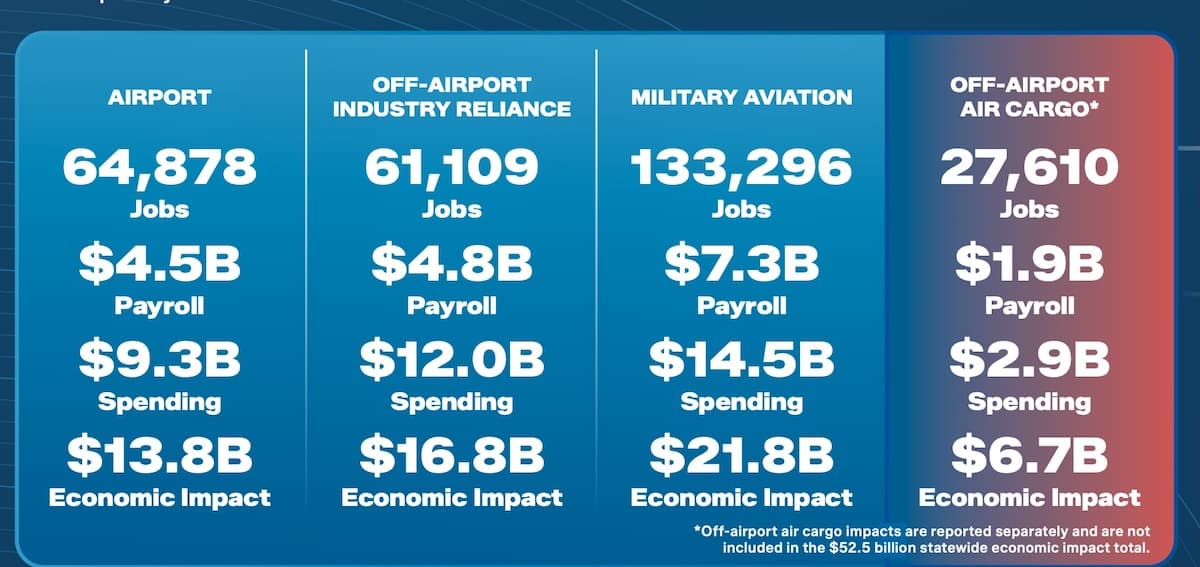
Oklahoma’s aerospace and defense industry generates $52.5 billion in annual economic activity and supports more than 250,000 jobs, according to a new study released Oct. 6, 2026, by the Oklahoma Department of Aerospace and Aeronautics (ODAA).
The new statewide economic impact study shows that aerospace and defense in Oklahoma has not only weathered the COVID storm, it has continued to be one of the state’s fastest growing industries, according to state aviation officials.
Economic Impact by the Numbers
The report breaks down economic impact by sector, each providing a multi-billion-dollar economic impact:
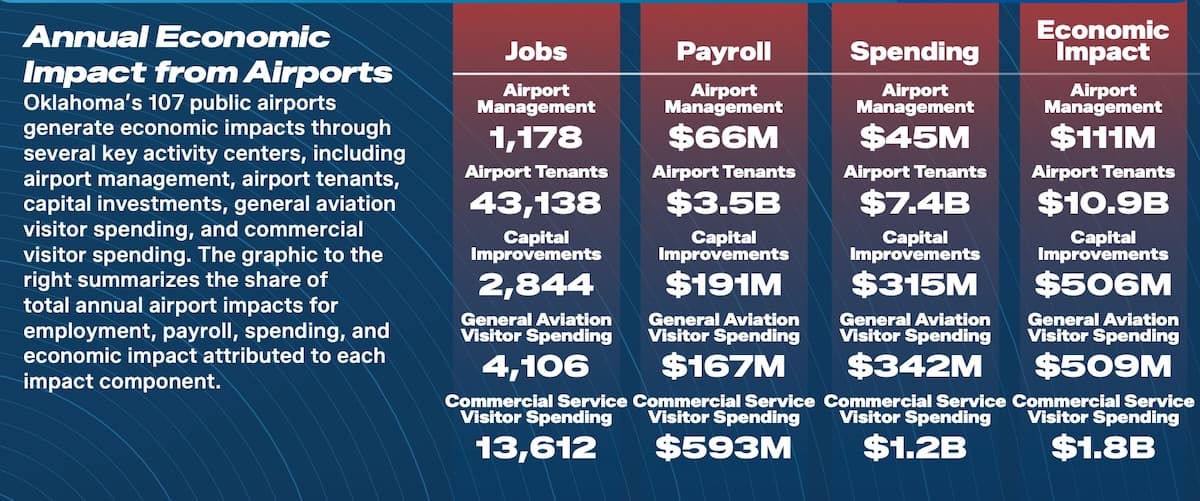
- Airports: $13.8 billion in annual impact generated through Oklahoma’s 107 public-use airports supporting an annual payroll of $4.6 billion, $9.3 billion in annual spending, and a combined 64,878 jobs.
- Off-Airport Industry Reliance: $16.8 billion in impact from 790 aerospace and defense manufacturers, engineering and technology firms, logistics providers, and other aviation-dependent employers, generating $4.8 billion in payroll, $12 billion in annual spending, and 61,109 jobs.
- Military: $21.8 billion in annual impact from five major military installations, two Air National Guard units, and a significant statewide Army National Guard presence, supporting an annual payroll of $7.3 billion and $14.5 billion in spending, with a combined 133,296 jobs.
The study also examines the significant economic role of air cargo, with approximately 50,000 tons of cargo moving through Oklahoma airports and generating an estimated $6.7 billion in economic activity while supporting 27,600 jobs. Air cargo is analyzed separately and is not part of the $52.5 billion statewide economic impact total, state officials noted.
The report credits a combination of factors for the state’s success, including economic competitiveness and workforce strength, driven by a pipeline of engineers, technicians, pilots, and skilled tradespeople supported by higher education, career technology centers, and military training programs.
Oklahoma has become a national leader in unmanned aircraft systems and advanced air mobility, earning a top ranking for readiness in drone commerce, according to state aviation officials. The state is also home to the Infinity One Oklahoma Spaceport in Burns Flat, the nation’s first inland facility licensed for suborbital operations.
Together, Oklahoma City, Tulsa, and Burns Flat form what state leaders have described as the Oklahoma Space Triangle by connecting the state’s military and aerospace infrastructure, commercial and military aviation MRO activities, research and innovation assets, and emerging commercial space capabilities to take advantage of the space industry renaissance that’s taking place.
You can download the full report at OKAreaImpact.com.
Leave a Reply