


The flight was the Piper PA-28-151’s first flight since its annual inspection. The pilot intended to fly from Newnan Coweta County Airport (KCCO) in Atlanta, Georgia, to Isbell Field Airport (4A9) in Fort Payne, Alabama. According to the pilot, there was 35 gallons of fuel on board.
The preflight inspection, engine run-up, and takeoff were all normal. However, during the initial climb, just after flap retraction, there was an engine stutter and power reduction followed by “sputtering.”
The pilot performed the engine failure checklist and attempted to troubleshoot as the airplane climbed, which included the application of carburetor heat, but he was unsuccessful in restoring engine power.
As the airplane reached about 1,300 feet MSL, it was no longer climbing and the stall warning horn sounded. He pushed the nose over and attempted a forced landing in a nearby agricultural field that contained hay bales.
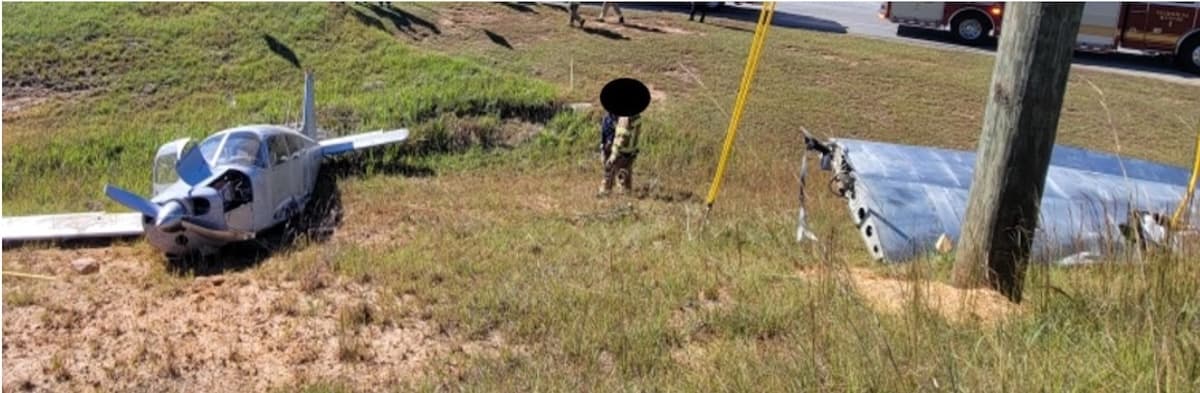
He lowered the flaps to slow the airplane and attempted to land, but the left wing hit a bale as it touched down. It then veered to the left and rolled down a sloped portion of the field. The pilot reported he was “carrying too much speed to stop,” and the airplane went down an embankment, crossed a road, and hit telephone pole guy wires before coming to rest. The left wing separated at the wing root and there was buckling on the underside of the fuselage.
ADS-B data showed that the airplane departed Runway 33 at KCCO, then climbed and proceeded on a track of about 314° for about 1/2 nautical mile as it reached a maximum altitude of about 300 feet AGL. The airplane then turned north briefly before turning right on a track of about 097° as it lined up on a short final approach to the field.
Post-accident examination of the airplane’s engine revealed that it was undamaged. The spark plugs were normal in color and wear, consistent with a Champion Spark Plug chart. Internal engine continuity and compression were verified across all cylinders by turning the crankshaft 720°, during which the magneto impulse couplers were heard “clicking.”
The fuel lines were disconnected and no fuel was present. The gascolator was found to be clean and free of debris. The electric fuel pump was inspected with no anomalies observed; the fuel selector was also checked with no issues noted. The carburetor was examined and no blockages were found in the induction system. The oil level was within the normal fill range.
A review of the airplane’s maintenance records going back 36 months revealed that the most recent 100 hour inspection occurred on Oct. 11, 2024 — five days before the accident — at a tach time of 3,865.9 hours. Several discrepancies were noted, including leaking valve covers, a left fuel line that needed repositioning, and an alternator that needed new brushes, all of which were repaired and signed off as airworthy. The engine was run with no discrepancies noted.
According to the FAA’s Carb Icing Chart, weather conditions at the time of the accident were conducive to the formation of carburetor icing at the glide power setting and was on the boundary of icing at the glide and cruise power settings.
At 1115, KCCO reported visibility at 10 statute miles, no clouds, temperature 54°F, dew point 32°F, and an altimeter setting of 30.32 inches of mercury (inHg). The calculated relative humidity based on these conditions was 43%. The pilot started his engine and began his taxi out about 1101 and began his takeoff about 1109.
According to FAA Advisory Circular 20-113, “To prevent an accident due to induction system icing, the pilot should regularly use carburetor heat under conditions known to be conducive to atmospheric icing and be alert at all times for indications of icing in the fuel system.”
The circular recommended that when operating in conditions where the relative humidity is greater than 50%, “…apply carburetor heat briefly immediately before takeoff, particularly with float type carburetors, to remove any ice which may have been accumulated during taxi and runup.” It also stated, “Remain alert for indications of induction system icing during takeoff and climb-out, especially when the relative humidity is above 50%, or when visible moisture is present in the atmosphere.”
Probable Cause: The pilot’s inadequate use of carburetor heat during the engine run-up, which resulted in a partial loss of power due to carburetor icing during takeoff.
To download the final report. Click here. This will trigger a PDF download to your device.
This October 2024 accident report is provided by the National Transportation Safety Board. Published as an educational tool, it is intended to help pilots learn from the misfortunes of others.
Leave a Reply