
• Skip to primary navigation
  • Skip to main content
  • Skip to primary sidebar
General Aviation NewsGeneral Aviation News

General Aviation News

Because flying is cool

  • Pictures of the Day
    • Submit Picture of the Day
  • Stories
    • News
    • Features
    • Opinion
    • Products
    • NTSB Accidents
    • ASRS Reports
  • Comments
  • Classifieds
    • Place Classified Ad
  • Events
  • Print Archives
  • Subscribe
  • Show Search
Hide Search

A Brief History of the Interstate S-1 Cadet

By Frederick Johnsen · October 16, 2026 · Leave a Comment

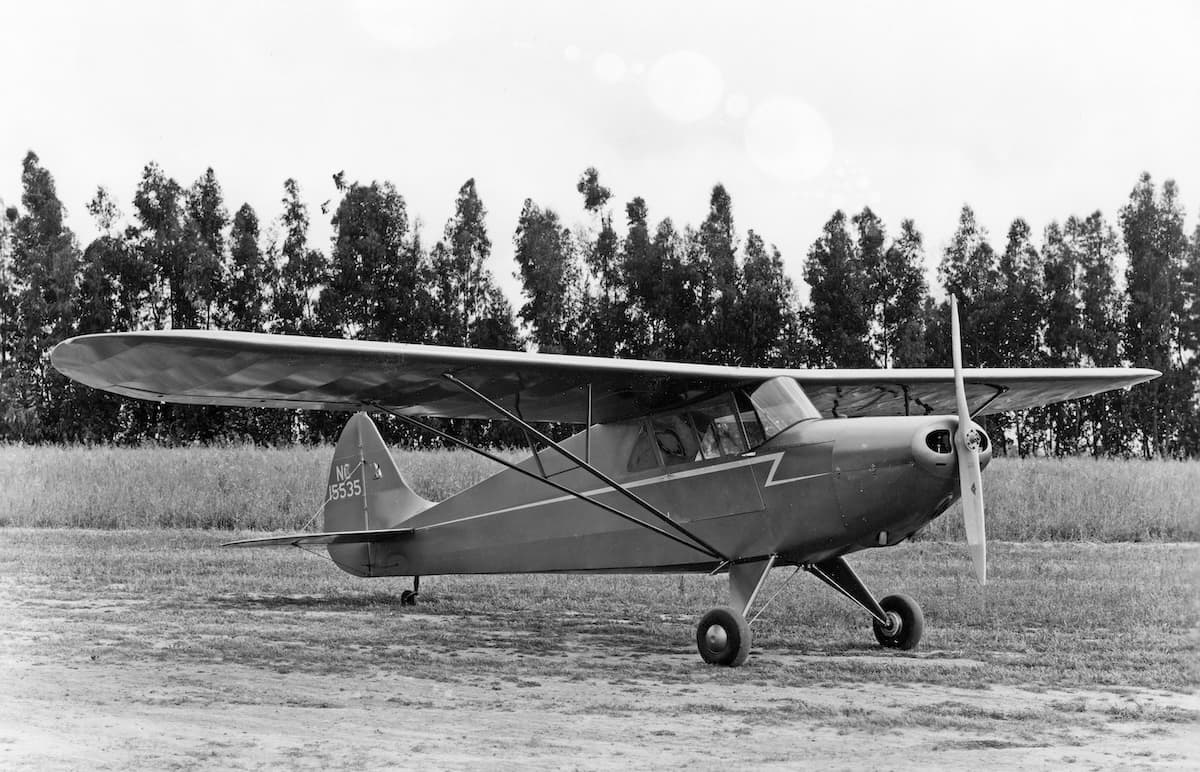
The Interstate S-1 Cadet was intended from the start to serve the Civilian Pilot Training Program ramping up in the U.S. before World War II. (Photo from the John W. Underwood collection via Peter M. Bowers)

With the popularity of small cabin monoplane taildraggers like those of Piper, Aeronca, and Taylorcraft setting the tone, a new company, Interstate Aircraft and Engineering, entered the field by 1940.

Interstate’s two-place Cadet general aviation aircraft was thoroughly traditional: A high wing mounted to a welded-steel tube fuselage, all covered in fabric and powered by available air-cooled engines like the 65-horsepower Continental A65.
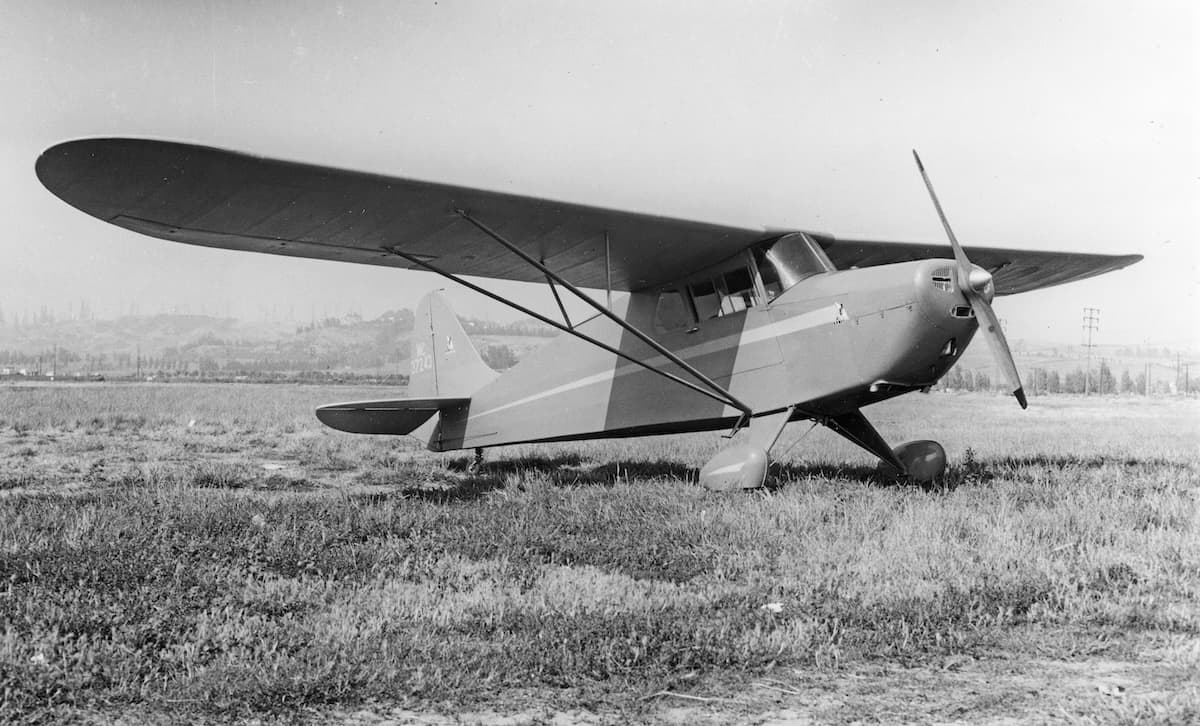
An S-1-A Cadet with optional wheel pants parked on the vast open spaces at Culver City, California, in June 1941. (Photo from the Peter M. Bowers collection)

Interstate, already known as a manufacturer of components for aircraft, envisioned the Cadet as a logical choice for the Civilian Pilot Training Program (CPTP) begun in 1938 in an effort to increase the pool of available fliers in America as European countries were already doing.

The first Cadets came off the line at El Segundo, California, in December 1940, marking the first production of light aircraft of this type on the west coast, according to aviation historian Joseph Juptner.

More than 300 S-1-A Cadets were delivered into 1942. S-1As used 65-, 85-, and 90-horsepower Franklin air-cooled engines, as well as 65-horsepower Continentals.

Juptner described the handling characteristics of the Cadet, designed for the rigors of new fliers in the CPTP, as being light but stable, saying it “plowed through rough air like a small freight train.”

The Interstate S-1-A with the Continental A-65 engine was 24 feet in length, with a wingspan of 35 feet, 6 inches. The wing’s NACA 23012 airfoil had a five-foot chord. Stalling speed was 36 mph. Cruising at 98 mph, the S-1-A could top out at 107 mph. It had a service ceiling of 14,500 feet. When fitted with the Franklin 85-horsepower engine, the S-1-A was said to cruise at 108. The price at the factory was listed at $2,095.
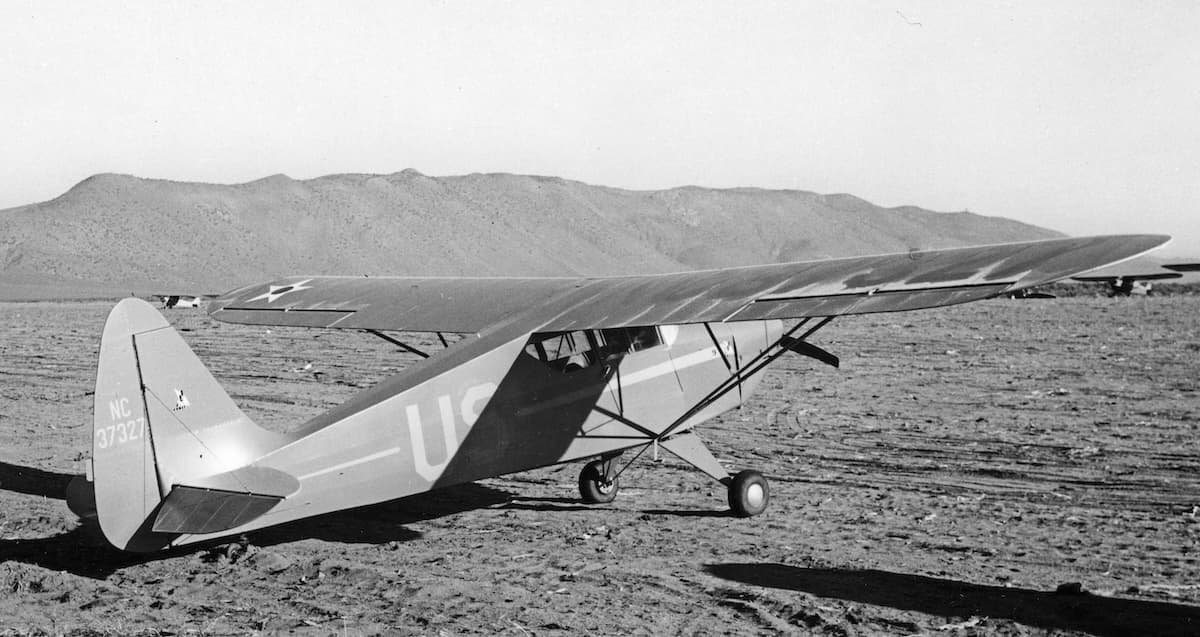
This Interstate Cadet, photographed at the Reno Sky Ranch on March 20, 1942, shows an interesting merging of markings probably representing its use in the Civilian Pilot Training Program. It bears the civil registration NC37327 on the rudder, the Interstate logo on the vertical fin, and a U.S. star insignia on the upper left wing surface. As if to remove any doubt about its nationality, large letters proclaim US on the fuselage. (Photo from the Peter M. Bowers collection)

The welded tube fuselage structure incorporates the Warren truss, a style developed for bridges in the 1800s that features equilateral triangles between horizontal members. This weight-saving load-bearing structure appears in other aircraft of the era, including the Piper Cub. The wing panels use spruce spars with built-up Alclad aluminum ribs.
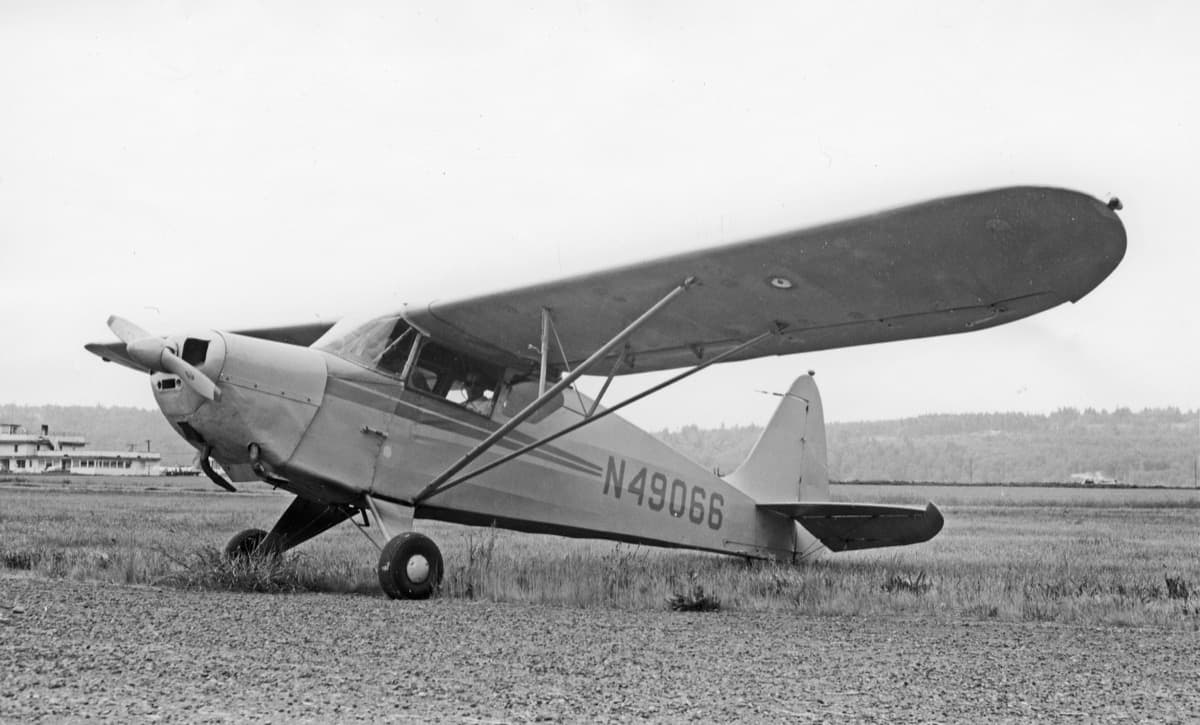
This S-1-B shows the streamlined v-struts used by Interstate. The aircraft was photographed at Kent, Washington, in 1962. (Photo from the Peter M. Bowers collection)

In wartime 1942, Interstate evolved its S-1-A into the S-1-B as a civilian airplane, or the O-63 as an Army observation/liaison aircraft of the Grasshopper genre. Piper, Aeronca, Taylor, and Stinson all went to war with their own Grasshoppers. The XO-63’s Franklin engine was now rated at 100 horsepower.

The O-63 was the last Army aircraft to be identified as an O for Observation machine. Soon, it and the other O-birds became L for Liaison aircraft. The Interstate version became the L-6. To accommodate the Army’s liaison and spotting missions, the L-6 embraced substantially more glazing, angled to provide a downward view for the observer and pilot.
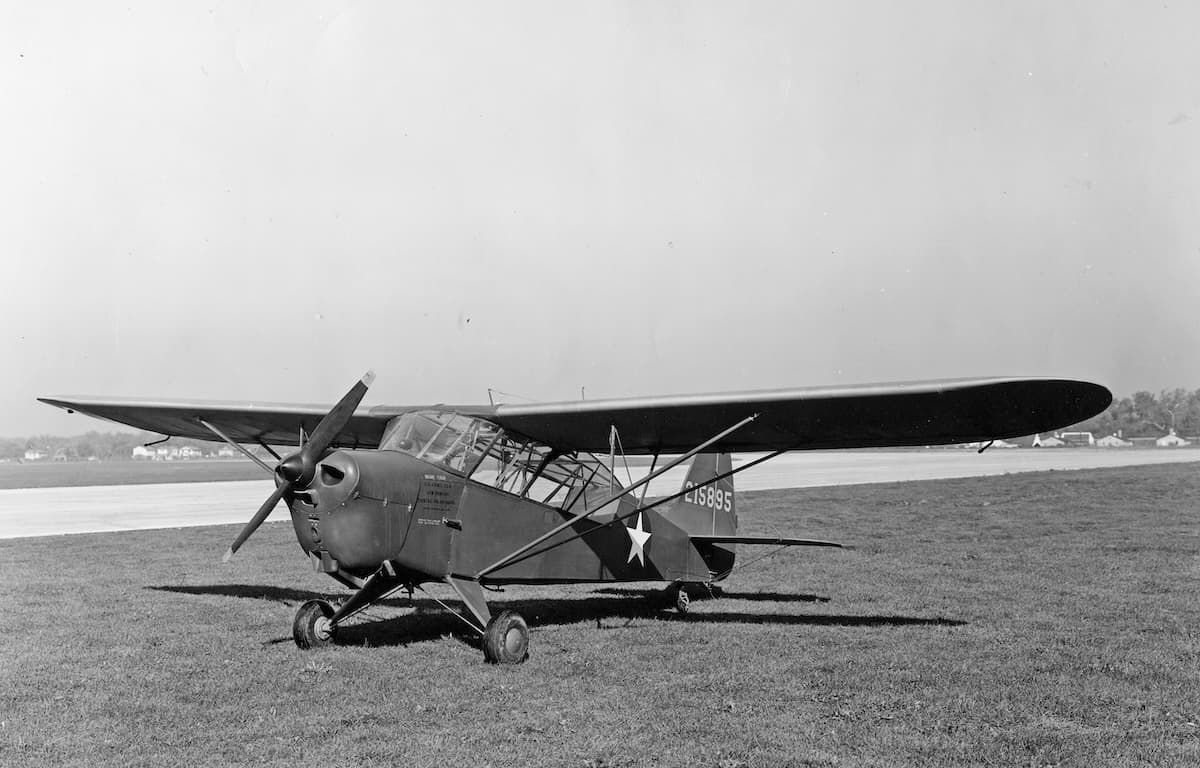
The Interstate L-6 was an Army Liaison aircraft based on the company’s Cadet trainer. (AAF photo via the Peter M. Bowers collection)

The Army ordered 250 L-6s from Interstate in April 1943. In addition to Interstate’s home plant in California, a second assembly facility in the midwest facilitated deliveries east of the Rocky Mountains.

Construction of military L-6s was finished in April 1945. By May, the war in Europe was over and victory in the Pacific was only months away. Surplus L-6s, sometimes called S-1-B1, entered general aviation after the war.

The National Museum of the U.S. Air Force displays an Interstate L-6. The museum’s website says the L-6 faced overheating problems that were partially remedied. The U.S. did not send its L-6s overseas, using them for liaison, utility, and training tasks domestically.

Thus ended Interstate’s adventure in aircraft design and construction. Rights, tooling, and inventory were sold to Harlow Aircraft in 1945. Subsequently Call Aircraft Co. (CallAir) bought the assets, later selling the Interstate rights again.

Rare at an air show, Warren Pietsch used this Interstate Cadet in an act that included landing atop a deck on a moving truck. This event was the Planes of Fame show at Chino, California, in May 2016. (Photo by Frederick A. Johnsen)

Interstate had another wartime claim to fame with its TDR twin-engine, optionally piloted, drone for the U.S. Navy. And that’s a story for another day…

(The author is indebted to Joseph Juptner’s pioneering work in documenting type-certificated aircraft of the United States in his book series “U.S. Civil Aircraft.” For this article, Juptner’s Volume 8, covering Approved Type Certificates 701-800 was helpful.)

About Frederick Johnsen

Fred Johnsen is a product of the historical aviation scene in the Pacific Northwest. The author of numerous historical aviation books and articles, Fred was an Air Force historian and curator. Now he devotes his energies to coverage for GAN as well as the Airailimages YouTube Channel. You can reach him at [email protected].

Reader Interactions

Share this story

  • Share on Twitter Share on Twitter
  • Share on Facebook Share on Facebook
  • Share on LinkedIn Share on LinkedIn
  • Share on Reddit Share on Reddit
  • Share via Email Share via Email

Become a better informed pilot.

Join 110,000 readers each month and get the latest news and entertainment from the world of general aviation direct to your inbox, daily.

This field is for validation purposes and should be left unchanged.

Curious to know what fellow pilots think on random stories on the General Aviation News website? Click on our Recent Comments page to find out. Read our Comment Policy here.

Leave a Reply Cancel reply

Your email address will not be published. Required fields are marked *

This site uses Akismet to reduce spam. Learn how your comment data is processed.

Primary Sidebar

Read the October 8, 2026 Issue

Cover of the October 8, 2026 edition of General Aviation News
October 8, 2026

Become A Better Informed Pilot.

Join 110,000 readers each month and get the latest news and entertainment from the world of general aviation direct to your inbox, daily.

This field is for validation purposes and should be left unchanged.

Recent Comments

  • Steven W on Deteriorated Gasket Leads to Fuel Starvation
  • R.J.Wellner on Pilot Hits Power Line During Pumpkin Drop
  • Kent Misegades on A View of 100LL I Hadn’t Considered
  • Kelly Carnighan on New CEO for Continental
  • Wes Skillings on New Book Sheds Light on Amelia Earhart Mystery
  • DA on Pilot Hits Power Line During Pumpkin Drop
  • Tom Curran on Inadequate Wind Compensation Leads to Cessna 182 Crash
  • Robert Stoney on Opening New Doors for Aspiring Aircraft Mechanics
  • Don P Morgan Sr on Weathering the Storm at the Triple Tree Fly-In
  • Are Cee on Pilot Hits Power Line During Pumpkin Drop

© 2026 Flyer Media, Inc. All rights reserved. Privacy Policy.

  • About
  • Advertise
  • Comment Policy
  • Submit Press Release
  • Contact Us
  • Privacy Policy
  • Writer’s Guidelines
  • Photographer’s Guidelines