

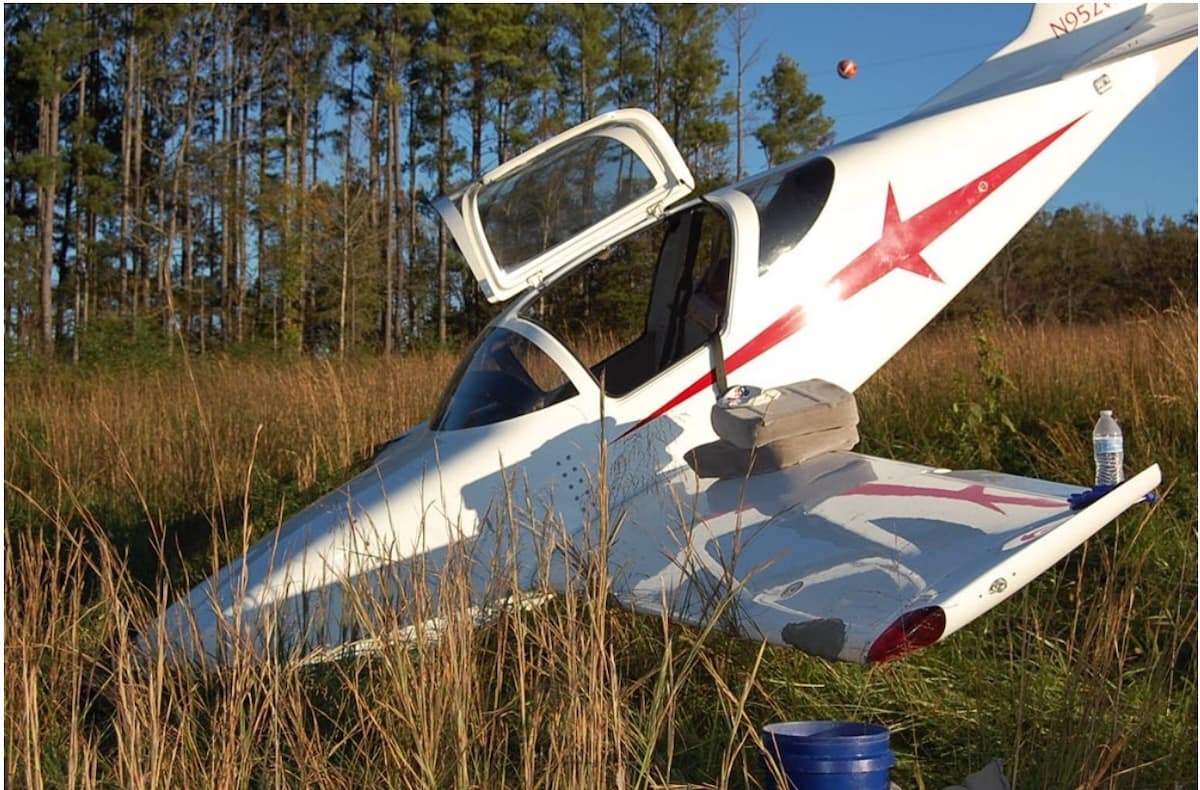
The pilot departed on a cross-country flight with 46 gallons of fuel. About 45 minutes later, upon nearing the destination airport in Forest, Virginia, he entered the traffic pattern to land on Runway 18.
He told investigators he had to make a left turn to avoid other inbound traffic, and he ended up circling the airport and reentering the traffic pattern on crosswind. The Glasair II SFT was high during the landing approach, so he performed a go-around.
While on the crosswind leg of the traffic pattern for a second approach, the airplane exhibited a partial loss of engine power. The pilot attempted to glide to Runway 36, but overshot the runway and landed in a field. The nose landing gear collapsed, resulting in substantial damage to the left wing and forward fuselage.
Examination of the wreckage by an FAA inspector revealed that a threaded coupler between the throttle rod end and throttle cable had loosened and disconnected the cable from the throttle arm, which allowed the arm to freely move toward the idle position.
The inspector added that he had never seen such a coupler before on certificated aircraft. Although it provided a means to adjust the throttle cable, it also proved to be a single point of failure. Additionally, there was no means to secure the coupler, such as a cotter pin or safety wire.
The inspector further stated that the airplane had accrued about 50 hours of operation since its most recent condition inspection was completed on Feb. 1, 2024, about nine months before the accident.
According to the owner of the kit manufacturer, the make and model kit does not include throttle cables, and builders usually source engine controls from other companies. The owner added that he had never seen a throttle cable coupler used for aircraft. He believed it must have been a custom installation.
Probable Cause: The installation of a non-failsafe coupler that resulted in the separation of the throttle cable from the throttle arm and a subsequent partial loss of engine power.
To download the final report. Click here. This will trigger a PDF download to your device.
This October 2024 accident report is provided by the National Transportation Safety Board. Published as an educational tool, it is intended to help pilots learn from the misfortunes of others.
Leave a Reply