

For a great many pilots, the goal is clear. We want to buy an airplane of our own. The freedom of travel, the flexibility of scheduling, and the pride of ownership all call out to us — sometimes long before we can fit the purchase into our budget.
Through persistence and patience, a good number of us find a way in the end. We satisfy the goal. We become owners.
For all the benefits that come with ownership — and there are many — the day will come when it’s time to sell that airplane. Perhaps it’s to upgrade to something more capable or possibly to downgrade to something less costly to operate. Or maybe just to clear an expense off the books entirely. The reason is immaterial. Every buyer eventually becomes a seller.
The difference is many of us dream about buying for years before we take the plunge. Selling is traditionally a more expedient decision. The reasons aren’t emotional as much as they are financial or practical. But since we haven’t been starry-eyed about the idea of selling to the degree we imagined the purchase, sellers are many times caught flat-footed because they are unfamiliar with the process and ignorant of the challenges that may be hiding in the fine print.
The FAA
The good news is that from the FAA’s perspective, selling an airplane is a quick and easy process. It involves surprisingly little paperwork and no filing fees for the seller at all. In fact, the feds only ask for two forms to seal the deal — and only one of those requires any attention from the seller at all.
FAA Form 8050-1 is the registration application. The instructions contain far more words than the application itself. The seller doesn’t need to even touch this form. It’s the buyer’s responsibility to fill it out and submit it.
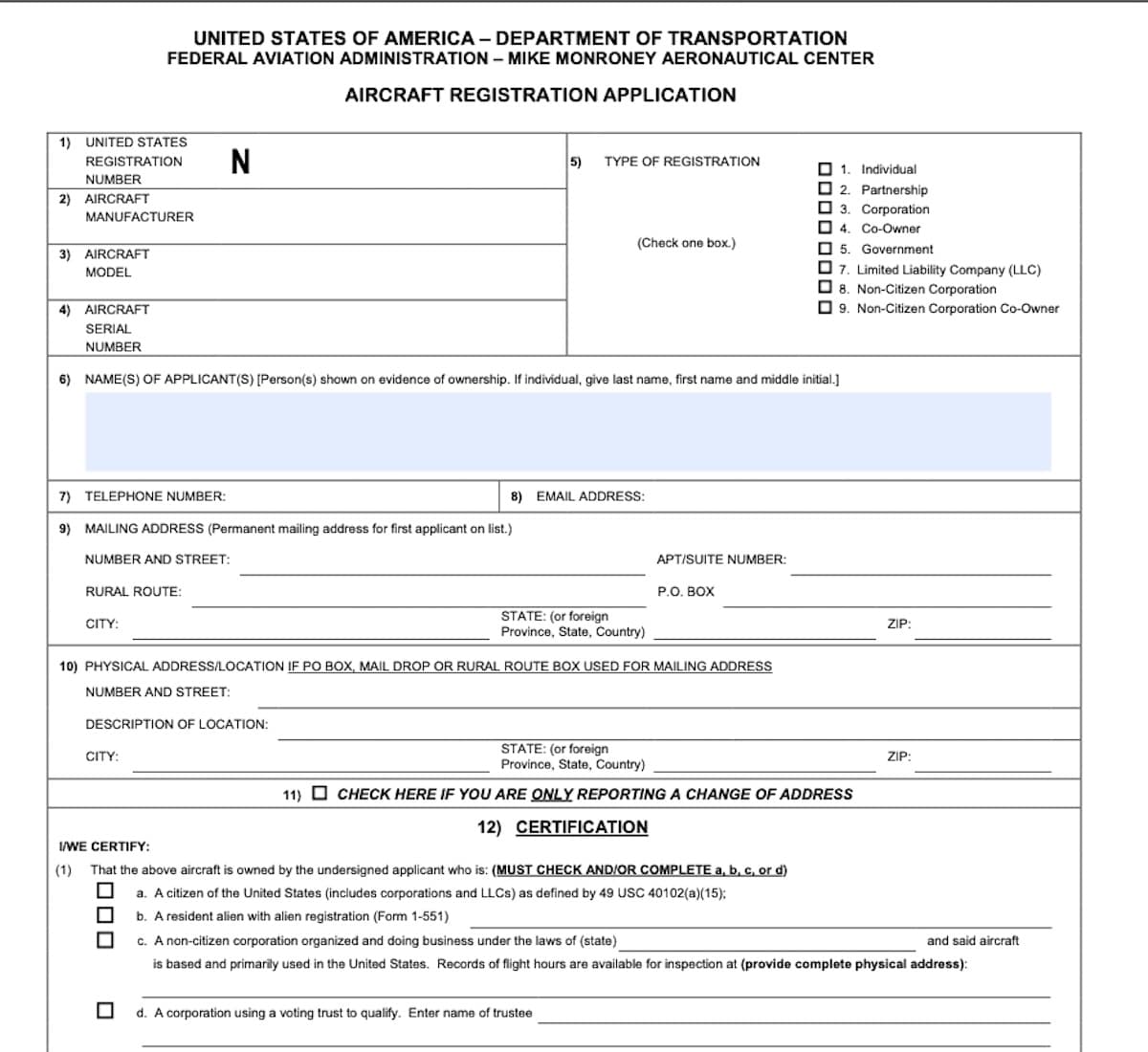
All that’s needed on the registration application is identification of the buyer or buyers (an individual, a co-ownership, an LLC, or a corporation), appropriate signatures, and a check made out to the FAA for the shockingly reasonable value of $5. The FAA refers to this as a recording fee. You can verify the cost via FAR 47.17 or 49.15. Both are short and to the point, perhaps the most clear-cut regulations you’ve ever seen.
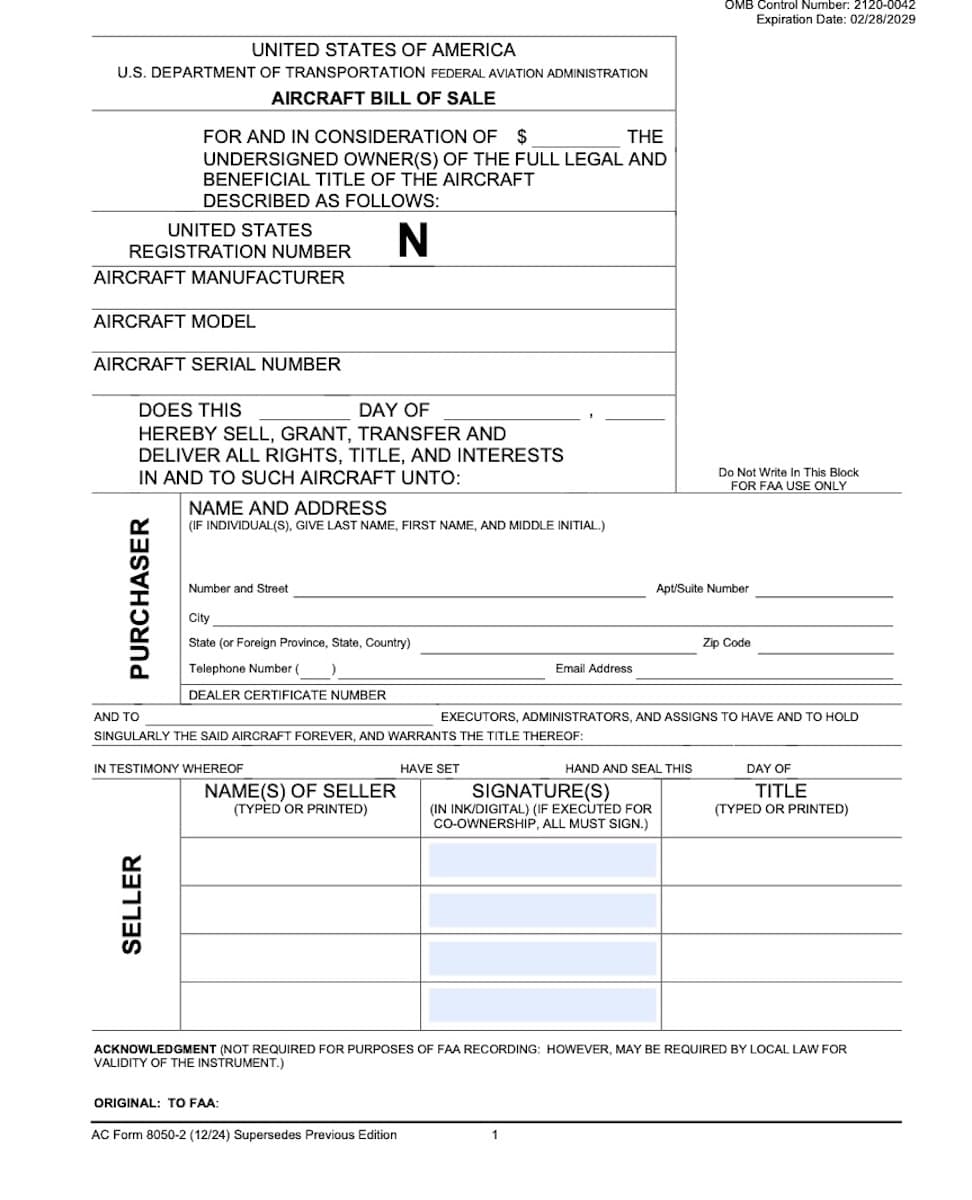
FAA Form 8050-2 is the official FAA Bill of Sale. The principal purpose of this document, according to the FAA, is for the collection of information regarding the specific aircraft being purchased, as well as identifying the buyer and seller.
The document is partitioned into three distinct sections. The first identifies the aircraft by N-number, manufacturer, model, and serial number. The second section identifies the name and address of the buyer. The last asks for nothing more than the name, signature, and title of the seller.
That’s it. Selling an Aircraft 101 requires only those two documents. Legally speaking.
But There’s So Much More
As with all things involving trade, there’s more to it really. How much more there might be is dependent on your personality, your willingness to shoulder a bit of risk, and your familiarity with buying and selling assets of great worth.
Selling an airplane is more similar to selling a house than it is to selling a car, or a motorcycle, or a boat. Not simply because the value of the asset may be greater, but also because there is a certain level of liability the seller tends to carry.
The first difference you may notice is in the filling out of the Bill of Sale. Many buyers would prefer not to include the purchase price on a form that, once filed, becomes a public document.
On the first line of Form 8050-2 (the Bill of Sale) it reads, “For and in consideration of $_______ the undersigned owner(s) of the full legal and beneficial title of the aircraft…”
As is often the case in real estate, “consideration” is not a synonym for dollars. It is a term that denotes value. This line is often entered as “$10 and OVC,” which translates to “other valuable considerations.”
Maybe that consideration is an additional $100,000. Or maybe it’s a 1964 Corvair the buyer threw into the deal. It’s nobody’s business, really.
Of course, taxes do have to be paid. And it does the buyer no good to lie or attempt to throw up a fiscal smokescreen when it comes to making the tax man happy. But a seller should not be rattled if they see the buyer has included a small dollar value and the term “OVC” included on the bill of sale.
For many sellers, this Bill of Sale is insufficient, however. There is an implied liability when selling a machine of any sort. At least there is in the mind of the buyer, and perhaps the courts will agree. To remedy this potential issue, many sellers craft their own Bill of Sale that is longer, more specific, and has the potential to shield them from future risk.
This is especially true for the sellers of experimental aircraft should the seller also be the builder. As the manufacturer of the aircraft, there is at least the risk of future actions being taken against the seller due to perceived misrepresentation or airworthiness concerns down the road.
That risk is not limited to the sellers of experimental aircraft, however. It carries over to some degree with any aircraft being sold.
Consider these unfortunate possibilities.
Scenario 1
The seller represents the aircraft honestly to the best of their ability. The buyer completes the deal without a pre-buy inspection. This is their option and a viable (but risky) way to save a few dollars. At the next annual inspection, the new owner is presented with a whopper of a bill for repairs mandated by an Airworthiness Directive (AD) that had been issued prior to the sale, but was not required to be performed until the next annual inspection.
The buyer may feel they’ve been taken advantage of by the seller. They may feel the omission of this information was intentional. Should they bring an action against the seller, they may prevail or they may not — a risk any seller should be aware of prior to finalizing the paperwork of the sale.
Scenario 2
When the buyer decides to upgrade their instrument panel two years down the road, they discover there have been instruments installed and removed over the years that are not noted in the aircraft’s logbooks. This causes the buyer to wonder what other issues might be lurking under the skin, out of sight and out of mind.
Again, they may feel misled and choose to take legal action. This is a real risk deserving of consideration.
Scenario 3
The buyer has been flying the aircraft happily for some time after the purchase. One day, while flying with family and friends aboard, the engine quits. With no place to make a safe emergency landing, the aircraft crashes into trees, seriously injuring the parties aboard.
A post-accident investigation uncovers a questionable maintenance issue from years earlier when the previous owner was in possession of the aircraft. In the face of mounting medical bills and property loss, the new owner or their insurance company may decide to seek damages from the prior owner.
The Land of Liability
All these possibilities and more exist when selling an airplane. America is the land of liability and lawyers are not hard to find. The solution for most of us may be to take a page from the buyer’s book of best practices.
Just as we would recommend the buyer do a thorough pre-buy inspection to assure themselves they’re getting what they hoped for, the seller should seriously consider having an aviation lawyer draw up a Bill of Sale document that relieves the seller of as much liability as possible.
I’ve owned several aircraft over the years. As a buyer, I’ve seen things I never expected. Twice I’ve agreed to buy an aircraft only to find out as I went through the process that the seller didn’t actually own the aircraft. They’d skipped the step of registering it when it came into their possession.
That’s a problem that can be corrected, thankfully. But it was totally unexpected. Neither seller revealed the problem during our discussions.
Oh, but it can get so much worse.
I’ve also been the happy owner of an airplane that I found out later had massive gaps in its logbooks. In fact, the airplane had once been involved in a mid-air collision that resulted in it being scrapped by the insurance company. There was no record of that in the logs. The prior owner’s wife had also collided with a runway sign at some point, tearing off half the horizontal stabilizer. That wasn’t in the logs either.
When selling that airplane, I disclosed the historical maintenance issues to the buyer. While I might have been left in the dark, I had no intention of continuing with the charade. The buyer was happy and I let the airplane go with a clear conscience.
I would be remiss in my duties as an advocate for general aviation if I didn’t offer one last option to those who might be considering selling their aircraft. Consider donating it to a non-profit with an IRS 501(c)(3) tax exemption. There are many such organizations, often focused on getting young people into aviation. They get a free airplane while the seller gets a tax receipt that has real value.
In any case, whether selling or donating, having a well-written Bill of Sale that exceeds the FAA minimum requirements can be of great benefit to a seller. And if you’re truly wanting to transfer ownership with the minimum of fuss and bother, consider including the term “As is” in your advertisements, as well as in the Bill of Sale.
It may not feel all that noble to be focused on covering your butt as you prepare to sell your aircraft to a total stranger, but as any decent lawyer will tell you, the time to get prepared is before the sale — not afterward when a process server shows up at your door.

Leave a Reply