

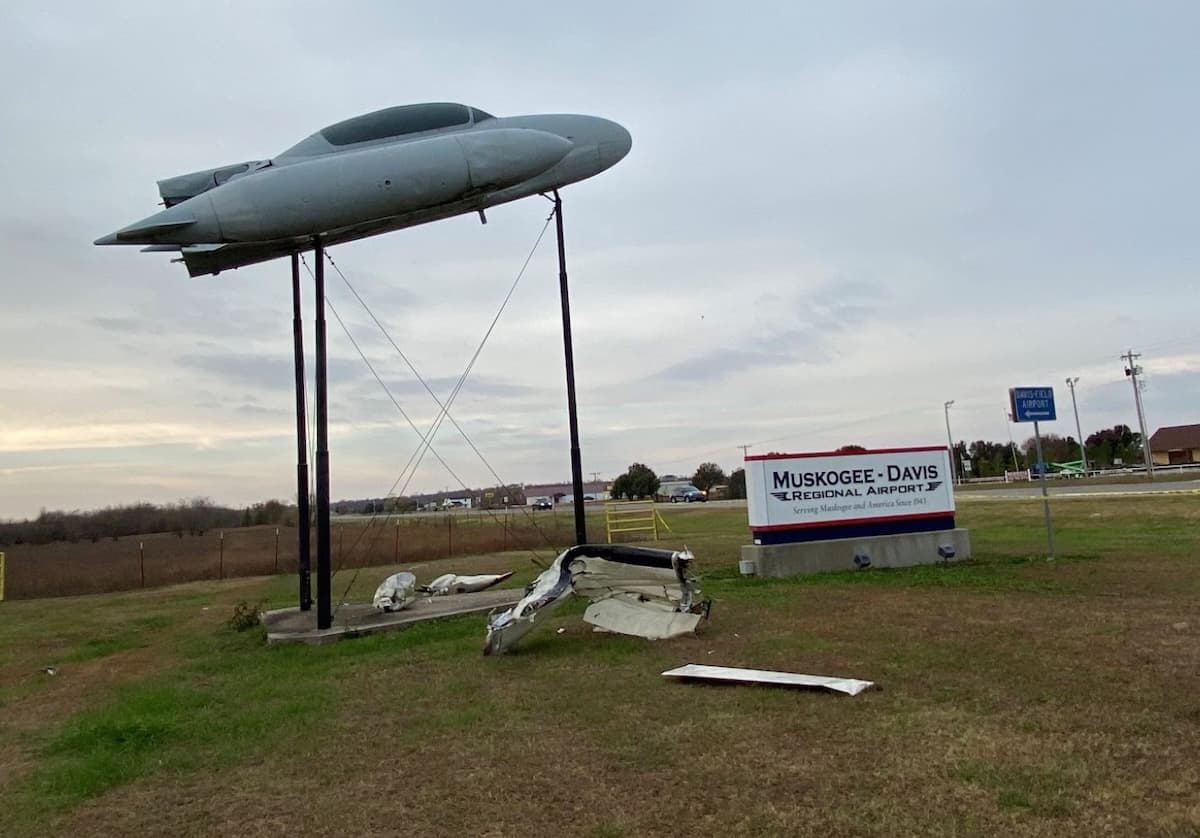
The pilot almost made it to the airport. Actually, that’s not quite accurate. He did make it to the airport. Just not the runway.
Instead, he came down just inside the perimeter, smacking the elevated “gate guard,” a T-33 Shooting Star — shearing the tail clean off — as he dead-sticked his Cessna 340 into an unglamorous midnight emergency landing with the fuel tanks bone dry.
Thankfully, this crash the day before Thanksgiving in 2024, left the family aboard much to be thankful for. The pilot and his wife suffered only minor injuries, and their three children — all under the age of five — were unharmed.
The two airplanes? Well, they were not so lucky.
But first, let’s talk about those bone-dry gas tanks.
The Flight
The family was making a cross-country from Mission Field (KLVM) in Livingston, Montana — the pressurized twin’s home base — to Muskogee-Davis Regional (KMKO) in Oklahoma, a flight of around 1,000 miles. The pilot was flying on an IFR flight plan. They took off in VFR conditions, picked up their clearance in the air, then entered the soup shortly after, staying in “actual” for about the first half of the flight.
The pilot, his wife, and children were flying to a family event, linked to the Thanksgiving holiday. Yes, I know, the external pressure alarm bells are already ringing in your heads.
But while human factors are 100% the cause of this mechanically sound airplane being completely destroyed (along with the perfectly innocent gate guard), I’m not sure that external pressure comes into play in this particular accident, nor did the National Transportation Safety Board (NTSB) call it out as a contributing factor. Instead, NTSB investigators fully assigned “the pilot’s improper fuel planning” as the probable cause of the accident.
But, as you’ll soon see, this is a gross oversimplification, as the pilot’s preflight planning seems quite a bit above standard.
Preflight
In his report to the NTSB, the pilot detailed his flight-planning process, which could best be described as professional and cautious, with one small exception. More on the exception in a moment, but first, more on his overall strategy.
He stated that he watched weather for flights three to five days out. At 48 hours, if the weather is in doubt, he purchases refundable commercial airline tickets to have a back-up plan. He also routinely extends part of the “IM SAFE” checklist to his passengers, checking on their health. He used a bathroom scale to check weights on his family and a hand-held scale to confirm baggage weight. He fueled the airplane himself, did a thorough preflight the night before and a last-minute abbreviated preflight the day of the flight.
The only thing in the description of his advanced planning for this flight that made the hair on the back of my neck stand up was his blasé statement following a description of the weather forecast that included trace/light icing, when he said “the weather was appropriate for the flight and aircraft, which is approved for Flight Into Known Icing.”
Granted, it was trace/light. But taking your babies into known icing? Maybe it’s just me, but I’m not a fan of any flight into known icing, much less one with precious cargo like that.
I remember a story my favorite flight instructor, Gill Harris, told me when I was 19 or 20. Gill had been a Marine Corps pilot in World War II, and was later a corporate pilot before “retiring” to teach us young whelps both how to fly properly and how to think like aviators. Gill’s boss had purchased an airplane certified for flight into known icing, as the story went, and told Gill point blank that he didn’t want any more excuses about flights being canceled due to icing conditions. Gill congratulated him on the purchase, then said simply that he’d need to find a pilot certified to do the same. (For my non-pilot readers, there is no such certification. Gill was making a point in his sly way.)
Anyway, as to the supposed improper fuel planning, the pilot, who was also the sole owner of the 340, calculated that he needed 150 gallons of fuel for the flight and believed that he had 183 gallons on board, which would give him around a one-hour reserve, a 25% bump over the required reserve for an IFR flight not requiring an alternate for forecast weather. (For VFR pilots, the IFR fuel reserve requirements of §91.167 vary depending on the forecast for the destination).
Now there are a couple of wrinkles here. The pilot reported that he “topped off” the airplane himself, and that it took on the fuel load he had expected based on his previous flight — 149.71 gallons.
However, there is some degree of doubt about the fuel status of the airplane despite all of that. Apparently he filled up after dark and did not have his headlamp, which he normally used, and instead, was using the flashlight built into his iPhone. Imagine yourself tanking up 150 gallons with the fuel pump nozzle in one hand and your iPhone in the other. The 340 has a rather complex five-tank fuel system. This particular airframe had main tanks, aux tanks, and a locker tank — all of which, apparently, have their own filler ports. Fun.
Additionally, the pilot later told authorities that he typically sticks his finger in each tank when fueling at night to ensure the proper fuel level, but that in this case, in hindsight, he could not remember if he finger-dipped the right tank.
So maybe he had 183 gallons, or maybe he didn’t. But he had a lot of fuel onboard to get started.
The Pilot
The pilot was a 49-year-old male with a private certificate for both single and multi engine land, and an instrument rating. He was flying with a Third Class medical. His total time was 756 hours, with 252 of that in twins, and the vast bulk of that twin time being in make and model. He had 165 night hours, suggesting he flew frequently at night. On the instrument side of things, he had 35 hours simulated and 16 hours of actual. He’d racked up 39 hours in the last 90 days and 15 in the previous month.
More Fuel Burn than Planned?
The first half of the flight, as mentioned, was in IMC, and the pilot chose to operate the pressurized twin’s engines at 100° rich of peak, instead of his usual practice of leaning to peak.
Running rich in IFR is not an uncommon playbook (but, like every possible mixture setting, is subject to debate and controversy nearing on religious fervor). The theory behind rich-in-the-soup is that being in “actual” is a very high workload environment, and running on the rich side reduces the risk of any distracting engine grumbling or hiccups, and the need for fine-tuning.
He also ran the cabin heater full time for the first half of the flight and on and off for the remainder. Now, for my single-engine readers who are wondering why the cabin heat even comes into a discussion of fuel onboard, a quick sidebar on twin systems. Most light twins have miniature furnace units that draw avgas from the fuel system to provide cabin heat instead of leveraging exhaust heat like single-engine airplanes do. The reason for this is simple: The engines are a fair distance from the cabin, so using the heater shroud approach would be both inefficient and add weight to the airframe.
All of that said, the heater doesn’t really use all that much fuel, between half a gallon to a gallon an hour, and compared to powerplant consumption of about 30 gallons an hour in cruise, the cabin heat penalty is something like a 3% increase in fuel consumption at worst. But it did use some fuel.
The impact of the richer mixture is a little harder to pin down, but in 340 pilot discussion boards online, it appears that this could bump consumption by 10 gallons an hour, depending on the power setting.
Interestingly, depending on how it’s operated, the plane itself can stay aloft sipping as little as 26 gallons an hour, but also has a quite wide “typical” cruise burn ranging from 30 all the way up to 50 gallons an hour — and, naturally, much more in climb, up to 70 gallons an hour.
The pilot reported that he was seeing fuel flow numbers of around 90 to 100 pounds an hour and, if my math is right, that would be something like 32 gallons an hour for both engines during the cruise portion of the flight.
So the pilot knew — or had every reason to know — that he was using up more fuel than planned. What did he do about it?
Apparently, nothing.
The Final Minutes
In talking to officials from the FAA after the accident, he reported that when he arrived over Tulsa, his fuel level was “lower than desired,” and that the numbers he was seeing on his fuel gauges didn’t seem to match the numbers he was expecting. Low enough, according to the summary of the interview, “that he took notice of it.” At that point, he would have been about 40 miles from his destination.
But he flew on.
About halfway between Tulsa and Muskogee, at between 5,000 and 6,000 feet, the right fuel flow indicator began to fluctuate between high and low. Then the right engine quit. The pilot cross-feeds the right engine to the left tank and when he does, the right engine fires right back up, but almost immediately the left engine begins to surge, so he switches back. The left recovers and the right shuts down. He feathers the right engine just in time to have the left one now shut down, too.
His gauges still show he should have 35 pounds of fuel in each tank (less than six gallons, so no matter which fuel flow numbers you use, there’s no way that there was a legal reserve in the fuel tanks, even if the gauges had read correctly).
He’s actually on long final at this point, but with two dead engines, he’s not going to make the runway. He recalls from past visits that there is a clearing, then a “bunch of trees,” then the runway. He dumps the flaps and the gear to try to get down in the clearing, not taking a chance on getting over the trees.
The Accident
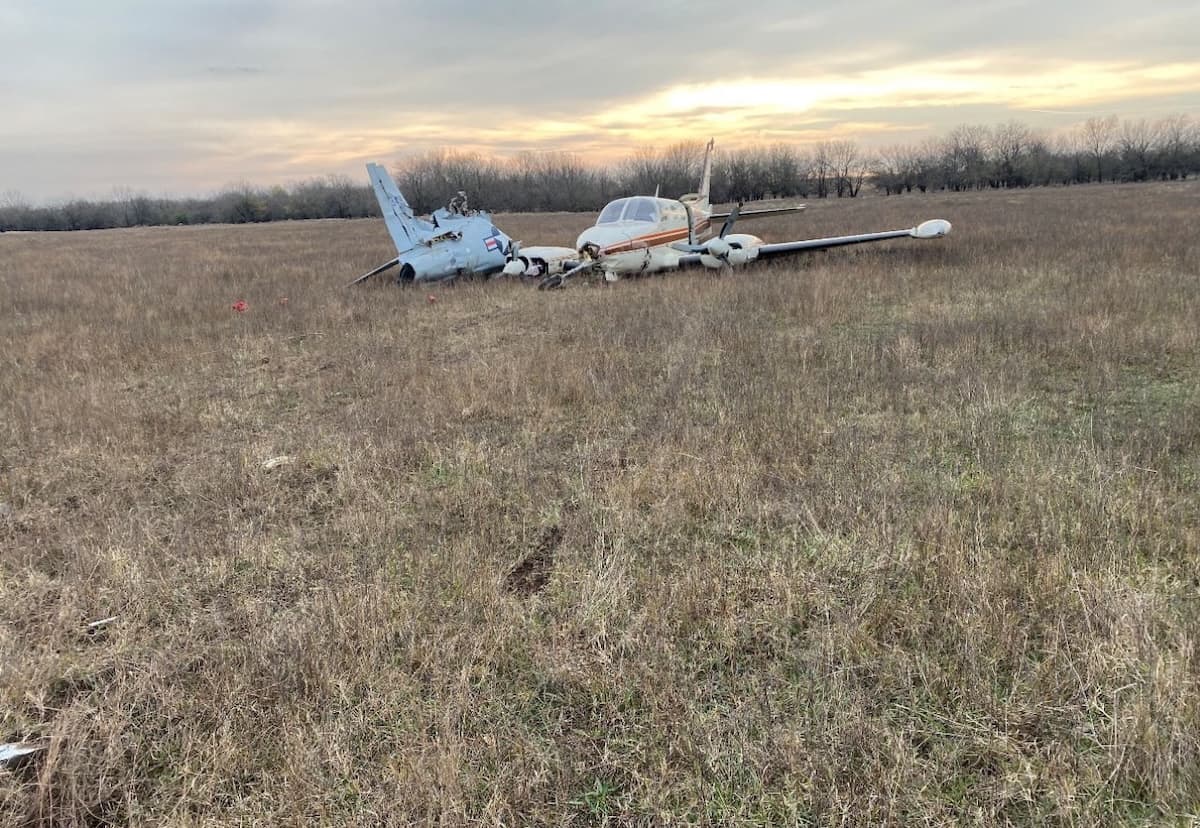
It might have worked out, had it not been for the gate guard, which the pilot reported not seeing — either from down range focus or dark of night. But the right wing sliced the tail clean off the elevated T-33. The impact spun the Cessna 180°, and it smacked down tail first, with the empennage of the T-33 still embedded in the 340’s wing.
The NTSB
After the crash, NTSB investigators found all the fuel bladders intact and no sign of “fuel blighting” on the grass anywhere around the wreck.
When one investigator queried the salvage company that removed the airplane about how much fuel was on board, the company’s president responded that there was basically no fuel in the airplane, writing, “They could have put all the fuel in a Coke bottle.”
Analysis & Discussion
In his interview with authorities, the pilot did report some warning signs from the airplane during the flight. In addition to arriving over Tulsa with less fuel than he expected, the right hand fuel flow gauge was “drifting down” in a manner he’d not seen before. He also had to deal with a fuel imbalance in the later part of the flight that he did not expect.
Still, none of that is part of the fuel planning that the NTSB called the pilot out on. Rather than a bad plan, it seems to me to come down to a failure of inflight monitoring of that plan or a failure of inflight decision making.
So the important question then becomes: What makes a pilot who is so thoughtful and careful in his ground-based preflight planning become careless enough in the air to blow through a full hour of “extra” fuel — whatever the reason — and not stop en route to tank up? When he realized above Tulsa that the numbers were not what he expected and that there was still (barely) enough fuel he could have put down and tanked up.
Why didn’t he?
I don’t know. Over-reliance on fuel gauges? Continuation bias? Fatigue? Too much faith in his planning? Maybe the kids were (finally) asleep? Was it because he was on an IFR flight plan? Did he lack the training to know how to amend in flight?
Or was it simply that in the speedy twin they’d make their destination in 10 to 15 minutes so surely they would make it. Only the pilot knows, and even he might not truly understand how he decided on his course of action that night.
The Takeaway
So what can the rest of us learn from this, the latest chapter in the on-going saga of Running Out of Gas?
I think the universal takeaway from this accident has nothing to do with avgas. Rather, I think it is a reminder that a plan is only that. Everyone knows the famous proverb about the best laid plans of mice and men. I’m also a fan of Helmuth von Moltke’s observation on military planning that translates roughly into “all plans of battle fail at first contact with the enemy.”
Perhaps, too, all flight plans fail at first contact with nature.
And that’s OK. Because a plan is just that. It is a starting point. And the more the variables, the less likely the plan will play out as planned, so given the variables we face in flight, it’s actually quite unusual when a flight plan actually goes according to plan. In fact, it’s so rare that there are even precision flight planning contests with trophies for the winners.
The very hubris of even thinking that it is possible to truly plan a flight is the reason we have regulatory fuel reserves. And personal minimums. And it’s the reason we make student pilots fly way-point based cross-countries in flight training, using a navlog that requires continual updating — comparing the plan with the real facts of the flight as it progresses.
Now, obviously, the pilot could not do that. He was on an IFR plan and in the soup much of the time. But the principle is the same. You make a plan, and when the plan starts falling apart, as plans do, you need to address it.
If you, say, arrive over Tulsa with a lot less fuel that you planned for, you don’t just keep forging ahead.
The Scrap Yard
Aviation Safety Network reported the 340 was “written off” following the accident. The NTSB also noted in its documents that the airplane was out of annual by 30 days, making the entire flight illegal in the first place, possibly giving the insurance company an excuse to decline paying a claim on the accident.
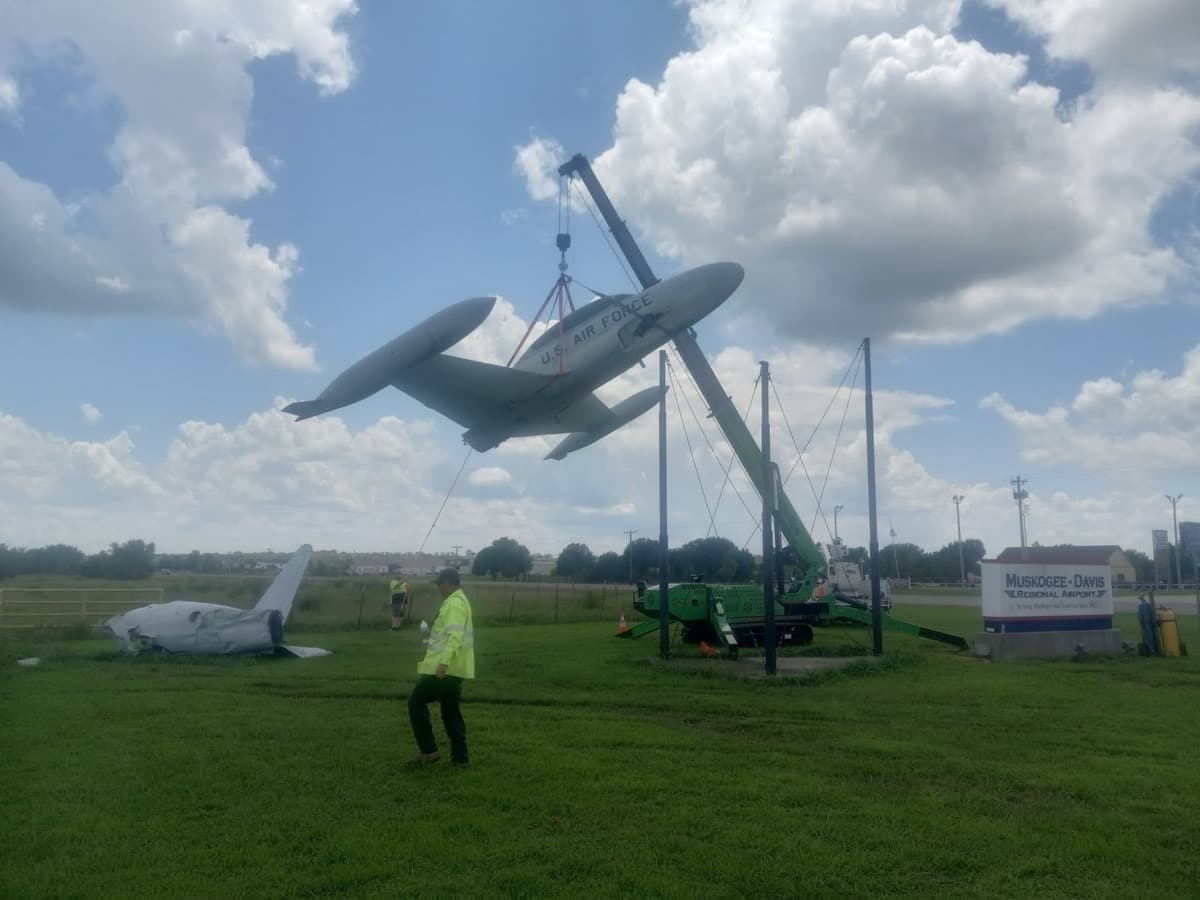
And the clipped gate guard that lost its tail? It stayed on its poles for a little over six months, wings still spread as if in supplication, before the airport authority judged the T-33 to be unrepairable, documenting the removal of the remaining portion on its Facebook page the summer following the crash.
The Numbers
Want to read more? Download the NTSB’s final report here or view the items on docket here.

Leave a Reply