

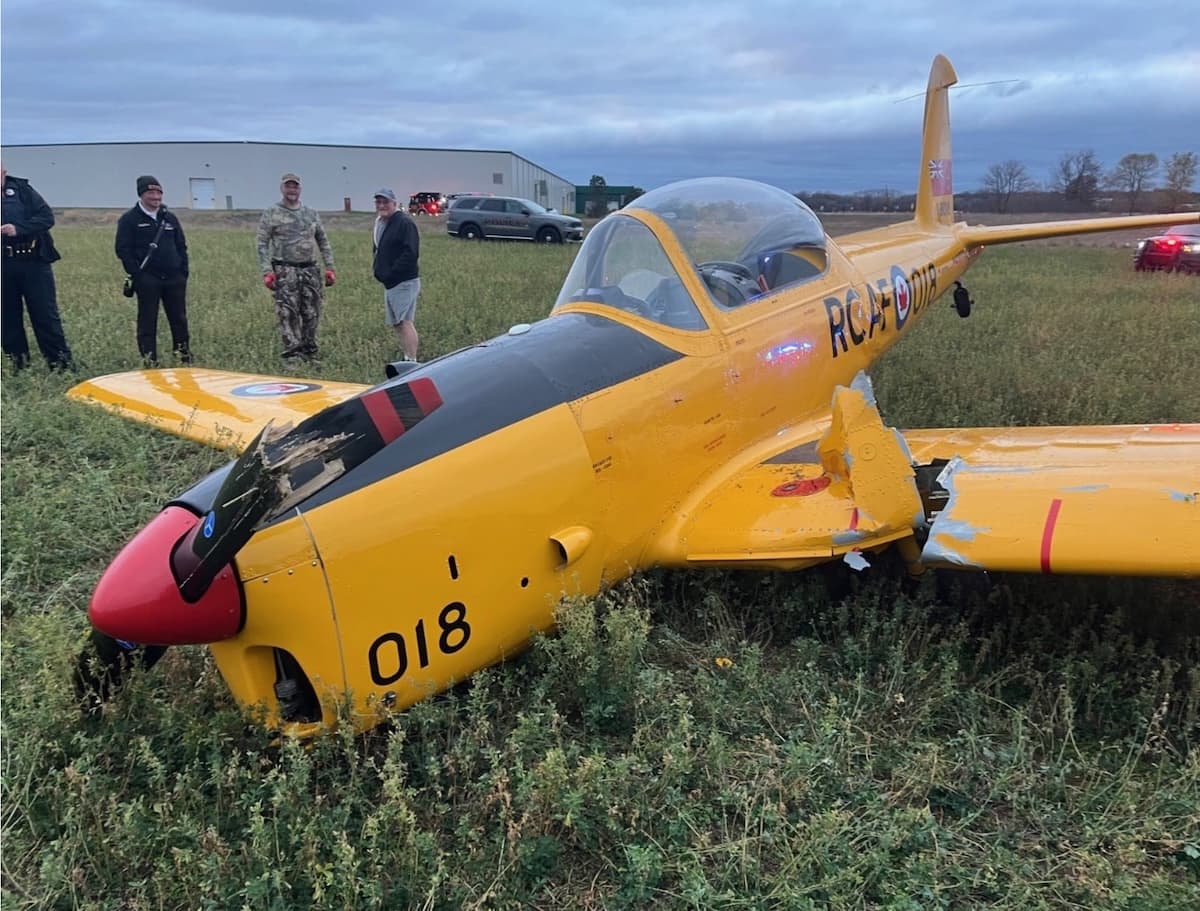
The pilot told investigators that, during his preflight inspection, there were three gallons of fuel in the left wing fuel tank and four gallons in the right wing fuel tank. He added that the de Havilland DHC-1 had a fuel capacity of nine gallons per wing tank.
He said he determined the fuel quantity in each tank by looking at the fuel gauges and looking into each fuel tank to see if it was wetted.
He departed the airport in East Troy, Wisconsin, performed one touch-and-go landing at the airport, and then flew about three miles west, where he performed two steep turns. He returned to the airport, and while the airplane was on the downwind leg of the traffic pattern for landing, the left wing fuel tank quantity gauge indicated two gallons and the right wing fuel tank quantity gauge indicated three gallons.
While on final approach for landing at an altitude of about 250 to 300 feet AGL, the engine lost total power. He changed the fuel tank selector, but the engine did not regain power.
He made a forced landing about 300 to 400 feet short of the runway, resulting in substantial damage to the wings and fuselage. He sustained minor injuries in the crash.
A post-accident examination of the airplane revealed that the fuel selector was in the right wing fuel tank position. The airplane was equipped with direct-reading fuel gauges at the inboard left and right wings, adjacent to each wing fuel filler port. Both gauges indicated zero at the accident site. The left wing fuel tank was empty, and the right wing fuel tank contained about 1-½ gallons of fuel.
No fuel leaks were present in the left and right fuel tanks. No fuel was present at the carburetor jets or the fuel supply line to the carburetor. The wing fuel tank vents and the fuel selector valve had no anomalies that would have precluded normal operation.
While testing the fuel tank quantity gauges for accuracy, the left wing fuel tank quantity gauge indication was stuck at three gallons when fuel was introduced, and it remained at three gallons as the fuel quantity was altered. Examination of the left fuel tank quantity gauge assembly found that it was corroded. The right wing fuel tank quantity gauge was accurate during testing.
Probable Cause: The pilot’s inadequate fuel management, which resulted in fuel starvation and a total loss of engine power. Contributing to the accident was the inaccurate fuel gauge.
To download the final report. Click here. This will trigger a PDF download to your device.
This November 2024 accident report is provided by the National Transportation Safety Board. Published as an educational tool, it is intended to help pilots learn from the misfortunes of others.
Leave a Reply