

WASHINGTON, D.C. — The U.S. helicopter accident rate, as well as the fatal helicopter accident rate, have fallen for the third consecutive year, according to FAA data.

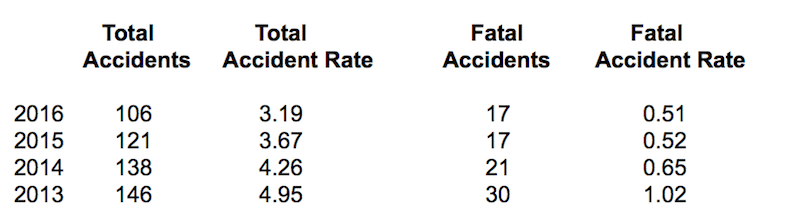
The overall accident rate fell to 3.19 accidents per 100,000 flight hours in 2016 compared with 3.67 accidents in 2015.
The fatal accident rate fell slightly to 0.51 accidents per 100,000 flight hours in 2016 compared with a 0.52 rate in 2015. However, the rate is down from 0.65 in 2014 and 1.02 in 2013, FAA officials point out.
In raw numbers, there were 106 helicopter accidents in 2016, including 17 fatal accidents. That is a 12% decrease compared to the previous year and a 27% decrease compared to 2013, according to FAA officials.
“The FAA and the helicopter industry have worked together to educate the civil helicopter community about safe practices, to drive these improved results,” said FAA Administrator Michael Huerta. “The FAA and the industry also are taking an active role in advancing safety through new technology, collaborative policy changes and proactive outreach.”
The FAA and the helicopter industry have worked together through groups such as the International Helicopter Safety Team and the U.S. Helicopter Safety Team to prevent accidents, agency officials noted.
They say the effort is achieving success through a series of proactive measures:
Creating a culture of safety
The FAA has encouraged helicopter companies and individual pilots to promote safety in the workplace. Efforts include establishing a system where anyone can report an unsafe condition without fear of reprisal, making every employee a champion of safety, and establishing safety training programs for mechanics, pilots and other employees.
Cutting the red tape
The FAA issued the Non-Required Safety Enhancing Equipment policy in 2013 after consultations with industry. The policy allows operators and manufacturers to install safety equipment through a streamlined and less expensive approval process. The policy seeks to strike a balance between risk and safety through a “common-sense” approach.
New technology
Both the FAA and industry are using technological advances to promote safer helicopter flights.
For example, the FAA mandated that the Automatic Dependent Surveillance Broadcast system (ADS-B) be installed in U.S. helicopters by Jan. 1, 2020, if they intend to operate in busy airspace. ADS-B’s satellite-based technology can provide three-dimensional information (latitude, longitude, altitude) about a helicopter’s position, along with information about its direction and size, without the geographic drawbacks posed by radar.
Collaborative rule-making
The FAA is working with industry representatives to ensure that newly-manufactured helicopters can help prevent injuries, post-crash fires and catastrophic damage from bird-strikes. Some manufacturers and operators are already voluntarily stepping up and installing the life-saving equipment.
In addition, the FAA required in 2014 that Part 135 commercial helicopter operators, including air ambulances and air taxis, have stricter flight rules and procedures, improved communications, training, and additional on-board safety equipment.
FAA International Rotorcraft Safety conference
For the past two years, the FAA has hosted a three-day gathering focused on a variety of safety topics. The conference includes presentations about decision-making, fatigue, safe autorotations, protective equipment, a culture of safety, and first-person experiences.