

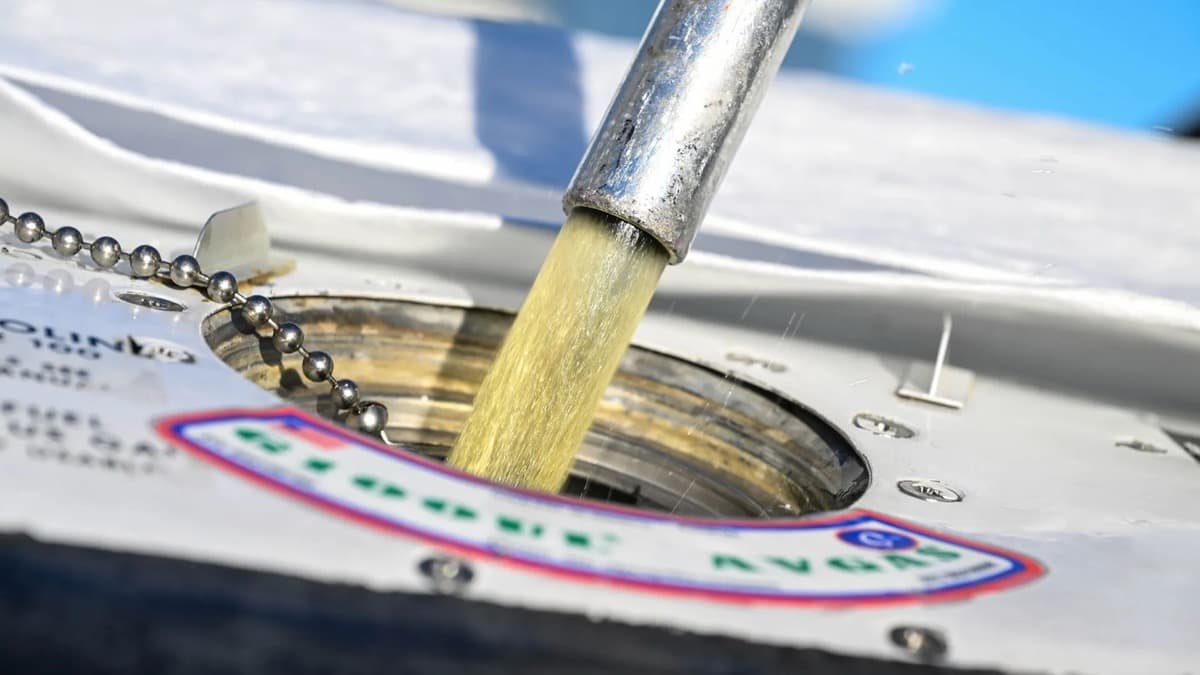
At the start of a new year, it’s good to look back over the past year and see what progress has been made. In the aviation fuels and lubricants world, the big story remains unleaded fuel and the development of new specifications for that fuel by ASTM, a global, non-profit organization that develops voluntary, consensus-based technical standards for a vast array of materials, products, and systems, including aviation fuel.
As a bit of history, the move to an unleaded avgas began in the 1990s. I remember attending an organizational meeting for an ASTM spec during EAA AirVenture Oshkosh in the late 1990s. The ASTM representative stated it should take about five or six years to write and get a new specification approved. I pointed out that it had taken about 17 years to approve the 82UL avgas spec.
As for the unleaded fuel spec? Work on that began more than 25 years ago and continues today.
The problem is that the committee writing the spec has to make sure the new fuel meets all of the requirements for every aircraft ever manufactured. And it has to cover almost any blend of new fuel, as well as any compatibility concerns that could come up.
So what is the status of the 100 octane unleaded avgas spec and unleaded fuels for general aviation?
There are three candidate fuels in the transition to unleaded avgas that have been approved in two different ways.
The G100UL fuel from General Aviation Modifications Inc. (GAMI) is now being produced and sold at some airports after getting approval through a Supplemental Type Certificate (STC) process in 2022. All gasoline powered aircraft and engines in the FAA’s type certificate database are covered by the STC for G100UL, according to GAMI officials.
Swift Fuels, one of the first in the unleaded fuel space, received an ASTM spec in September 2025 for its 100R unleaded avgas for use in Cessna 172R and 172S models with Lycoming IO-360-L2A engines. The company is working with the FAA to expand that Approved Model List (AML).
And in late December 2025, the last of the contenders, LyondellBasell and VP Racing received its first specification for UL100E, which is still undergoing testing through the FAA’s Piston Aircraft Fuel Initiative (PAFI) program. These evaluations are expected to be completed by September 2026, according to Lyondell officials.
As the testing continues, the two different approval methods have created some issues.
That’s because the industry needs a universal specification that all manufacturers can approve and will stand behind. Pilots are used to a common specification for 100LL so they can fly anywhere in the U.S. — or even outside the country — and be confident that the fuel they are buying is approved for their aircraft.
General aviation has given itself a deadline of 2030 to fully transition to unleaded fuels, working through an industry-government initiative known as EAGLE (Eliminate Aviation Gasoline Lead Emissions).
But can it meet that deadline when so many technical issues remain?
Of the candidates, the GAMI fuel seems to work well except it has some chemically active components that may cause fuel system deterioration in some older aircraft. It also has no exhaust valve seat protection and is only approved by an STC, which means an aircraft owner must buy the STC to use the fuel in their aircraft.
My experience with STC-approved products through Shell was not very positive.
It reminds me of a story. Back in 1958, Shell developed the Aeroshell Oil W line of aircraft piston engine oils and was trying to get them approved by the military. The military would not approve a new oil without competing products. That meant Shell had to get another company to produce a competing product before a new spec could be issued.
Back to the Future
The other two fuels that have earned initial specifications are based on a good quality alkylate plus ETBE (Ethyl Tertiary Butyl Ether). The Swift fuel also has an unidentified exhaust recession additive.
I see a couple of possible problems here.
The first is water pollution.
Back in the 1990s, there was a real battle between MTBE (Methyl Tertiary Butyl Ether), ETBE (Ethyl Tertiary Butyl Ether), and ethanol for which one would be used in auto gas. Ethanol won by showing that MTBE and ETBE were a danger to ground water and should not be allowed.
There is also a concern about safety when handling ETBE, as well as what could happen if there is a fuel leak in flight.
And we all know the effects of inhaling an ether product.
Meanwhile, the industry still needs to create the infrastructure needed to produce and deliver the on-spec fuels, not just to all parts of our country, but around the world.
So there are still many technical issues to settle, plus the need for a single approved specification that all aircraft manufacturers will stand behind. We need a single authority that knows what they are doing, that can sort out the technical issues, and make an informed decision.
Since 2030 is only four years away, maybe we should start looking at 2040 or later.

The valve problems in North Dakota were the result of following improper procedures. Never operate at peak or lean of peak when using unleaded fuels. Operate slightly rich of peak. Had they done that it wouldn’t have been an issue.
2030? Four years?
That’s funny.
University of North Dakota used 300,000 gallons of Swift fuel.
They stopped using it, burnt up their valves.
Lycoming will not grant approval of this fuel.
Any questions?
Lets me think about this Ken? Gamble on bringing the government into G. A Aviation more than it is now with a mandate on unleaded fuel or change 8 valves/seats on your 150 Cessna. I can buy, right now, 120 octane unleaded fuel for my hotrod. A HellCat runs on unleaded pump gas and can produce over 1,000hp from the factory. I wonder why pilots have a reputation of being a bunch of cheap whinners.
from what I’ve read, the new cylinders have hardened exhaust valve seats [ 4 ]
It’s probable less costly to replace the cylinder assembly , than to replace the exhaust valve seat on old cylinders.!!
The Hellcat engine has variable valve timing, electronic ignition retard, water cooled heads, and much smaller diameter cylinders, than the Lyc and TCM engines.
…an ‘apples to oranges’ comparison.
Whiners, not whinners
Detonation damage in your Hellcat brings you to the side of the highway waiting for AAA. Detonation damage to your Bonanza brings you, if your lucky, to a highway to land, and “breaking” on the local news. The aviation underwriters take a dim view of this.
Who do you buy the unleaded 120 octane from ?
All the race gas that I’ve looked at have either a lot of ethanol or TEL.
We already have TEL in avgas and ethanol is not allowed.[ a lot of aluminum in the fuel system ]!!
https://www.faa.gov/aircraft/draft_docs/draft_unleaded_avgas_transition_plan
Cynthia you seem to have a grudge against Swift fuel it appears. If you what to make your case against Swift you need to get your information correct. The flight school engine problems using Swift 94UL fuel involved a seat, recession problem, not a burnt valve problem.
Wonderful, does the head have to be pulled? How much is that going to cost?
They stopped using that fuel as a result.
Swift has run one of their engines up to 400 hours. I asked them when I was at Oshkosh. Does that seem like enough for you?
I was at Oshkosh. I asked them questions. Then I went over to Lycoming and ask them questions. Lycoming said they do not approve that fuel in their engines. Not a grudge just stating facts.
Back to the future – all we Americans do is run around in circles while in the meantime the world’s largest producer of aircraft engines, Rotax, designs its engines to run best on lead-free, ethanol-free gasoline. And how do airports in Europe react? They sell it alongside Avgas and Jet-A. Why is it that aviation fuel suppliers in Europe are happy to provide mogas at airports, but none will in the US? Follow the money. The stance of these companies and the do-nothing aviation alphabets is killing spirt aviation, from which most future generation pilots would normally have come.
I doubt that Lycoming and Continental will design new engines that are water cooled , which will have lower exhaust valve temps, and a PSRU that allows higher rpm and lower torque from the engine.
Our old , low compression engines will run just fine on no-ethanol, 91 octane auto gas.
It’s the higher compression and turbo engines that need the 100/130 octane fuel.
Yea, this is not going to happen. I have an airplane that doesn’t need one of these 100 unleaded products that are never going to find their way to the market without a mandate from the current dysfunctional government. I would like to see an unleaded product that I could use that is already approved such as 91 octane car gas without alcohol or the ASTM approved UL 91, like they sell in Europe. Basically, I am tired of the damage the lead is causing in my engine and to the environment, l really would like to move on. So what would it take to make this happen or should we just stay in this predicament taking us nowhere or should we take a direction that might actually go somewhere.
I have a Cessna with an ‘auto gas’ stc. but in California, all auto fuel has ethanol.
So, I’m stuck with 100LL, even though the poh and engine manual list 87 octane as the minimum octane fuel.
recently I started adding Alcor TCP to the fuel, 1 oz per 10 gallons. Within 4 hrs of flying, the engine ran much smoother and idled better than it has in the past 15 years.
After an oil change, the metal ppm were 1/2 of all the previous samples, with the same hours on the oil. The lead levels were also 1/2 previous too, at 1.100 ppm.
So, TCP seems to negate the nasty affects of TEL….
Others thoughts on using TCP ?
TCP has been around for many, many years. Helped them. Helps now. That and Marvel Mystery Oil. Ask the old timers.
TCP was introduced as a spark plug anti-foulant for the B-36. It has many benefits including reducing exhaust valve recession. But it is a neuro-toxin so may not be allowed for long term use.
thanks Ben,
I’ll continue to use it with extreme care.
Ben,
I’ve been using the recommended 1 oz per 10 gallons of fuel.
Would be reasonable to reduce the amount to 1/2 oz or less, now that the TCP has ‘cleaned’ my GO-300 engine ?
TCP is a bit expensive, adding $0.32 per gallon to the cost of fuel.
I’ll experiment with reduced amounts and see what the borescope and oil analysis shows.
BTW, I see that MMO has about 1% TCP.!