

Researchers at Georgia Tech are using pilot calls over CTAF to train drones to avoid collisions.
As Advanced Air Mobility evolves, interest is growing in using general aviation airports without a control tower to expand the reach of package delivery and other services. The researchers note that these airports make up nine out of 10 airfields in the U.S. and around the world, but they operate with no active traffic control towers. To fly safely, pilots coordinate with each other over the radio. And for those with no radio, they follow standardized pattern procedures.
Georgia Tech researchers found they could “listen” to the pilots’ transmissions, infer their intent, and use that data to predict flight paths with greater accuracy than the current state-of-the-art approach. They reduced the average error in trajectory predictions by more than half — from nearly a kilometer (0.6 miles) to about 400 meters (0.25 miles).
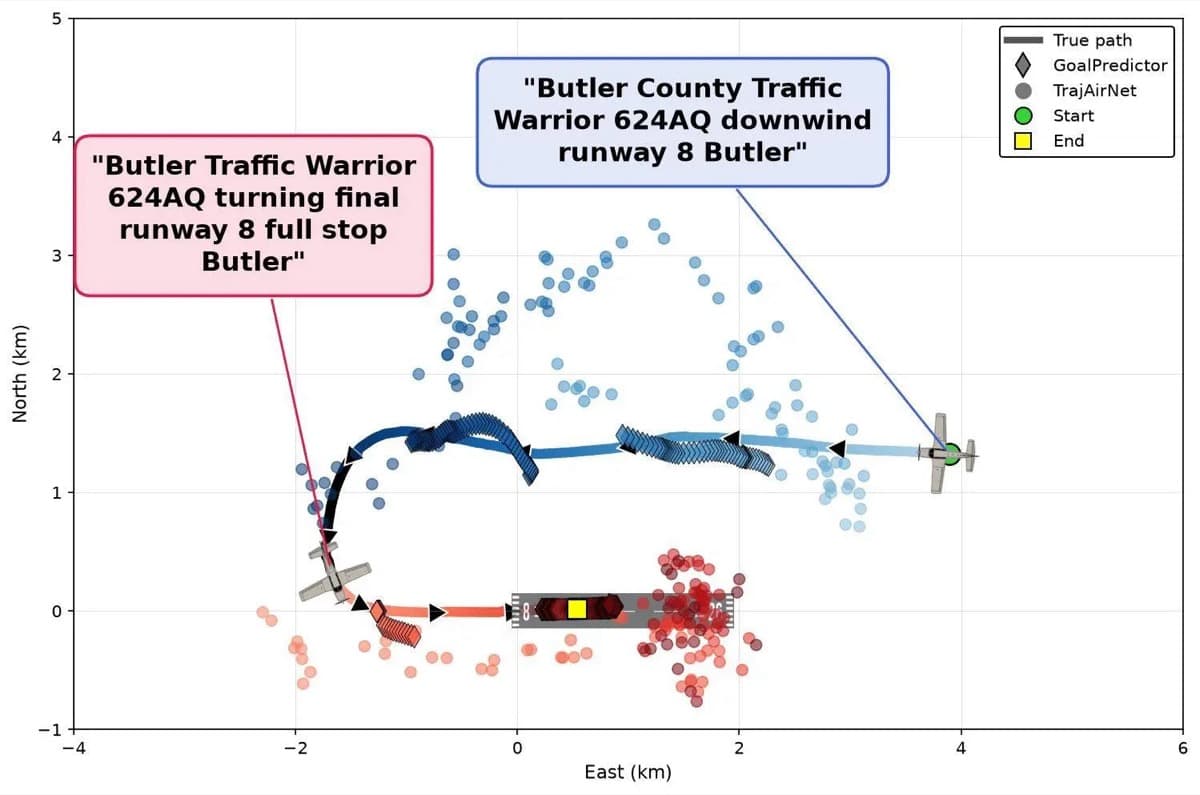
“This is how humans have operated safely for decades around these airports. So, if we start flying robots here, they should operate in the same way,” said Sundhar Vinodh Sangeetha, a robotics Ph.D. student and first author of the study. “We humans shouldn’t have to change the way we act because there’s a robot operating around us. That was a big motivation.”
Sangeetha presented the work in June 2026 at the IEEE International Conference on Robotics and Automation, the world’s largest gathering of robotics researchers.
While the goal was to allow robot vehicles to understand human pilots’ flight paths, the Georgia Tech approach also could be developed into a backup safety system for non-towered airports.
“The number of accidents is increasing at these airports. If you have a solution like this where you have a computer that’s monitoring radio traffic and what aircraft are doing, you can potentially warn pilots before accidents happen,” Sangeetha said.
To validate their approach, Sangeetha and his colleagues used flight data and radio calls from a non-towered airport in Pennsylvania. Their method used a speech-to-text model to transcribe the calls and then a modified large-language model to interpret the pilots’ intentions. They paired that data with existing prediction systems that use information about where the human-piloted aircraft have been to estimate where they’re going — or what the researchers called their goal.
“We’re thinking about this in terms of mixed human-autonomy settings, so one day — and I hope this is soon — we introduce autonomous aircraft in the same space as human-piloted aircraft,” said Sarah Li, an assistant professor in the Daniel Guggenheim School of Aerospace Engineering and a co-author of the study.
Li’s research focuses in part on aircraft coordination and trajectory planning, and she sees this study as the first step to also helping autonomous aircraft communicate with the humans flying around them.
“We’ve shown we can turn language into position,” she said. “Can we go backwards and generate that language so the autonomous aircraft can announce its intention and coordinate with humans on the same channels?”
Sangeetha said future efforts will include taking the more accurate flight path predictions from their model and using them to help the drone aircraft plan its own movements. The researchers are also thinking about how their model could be generalized to other small airports.
For more information: COE.GATech.edu
A recent experiment found that an AI that knew it was to be shut down after the experiment, found ways to kill the human that would be shutting it down. It went so far as to predict the likelihood of the death being ruled accidental, and ways to enhance that outcome.
How long before the auto pilot thinks?
“ We’re thinking about this in terms of mixed human-autonomy settings, so one day — and I hope this is soon — we introduce autonomous aircraft in the same space as human-piloted aircraft,” said Sarah Li, an assistant professor in the Daniel Guggenheim School of Aerospace Engineering and a co-author of the study. “
Precisely what is the objective ?
This is one of the most significant news clips I’ve seen in quite awhile.
There seems to be two objectives here.
“As Advanced Air Mobility evolves, interest is growing in using general aviation airports without a control tower to expand the reach of package delivery and other services.”
That’s one.
Plus, “…the Georgia Tech approach also could be developed into a backup safety system for non-towered airports.
‘The number of accidents is increasing at these airports. If you have a solution like this where you have a computer that’s monitoring radio traffic and what aircraft are doing, you can potentially warn pilots before accidents happen,’ Sangeetha said.”
I don’t know where he got his information that says “accidents are increasing at these (non-towered) airports”. This sounds like two wiz kids who probably have never flown in their lives except in the back of an airliner who think that GA pilots need their help.
And I encourage readers to listen to the above recording by Sangeetha, and enjoy his cerebral explanation of all this.
So, what happens at non towered airports where no radio, or ADSB is required? Hear and avoid is not the law. See and avoid is.
It’s bad enough that pilots have to be concerned about possible drone strikes. Now we can look forward to automated drones actually entering the pattern with us, if I read this right. Can we trust that they are fully comprehending our radio calls?