

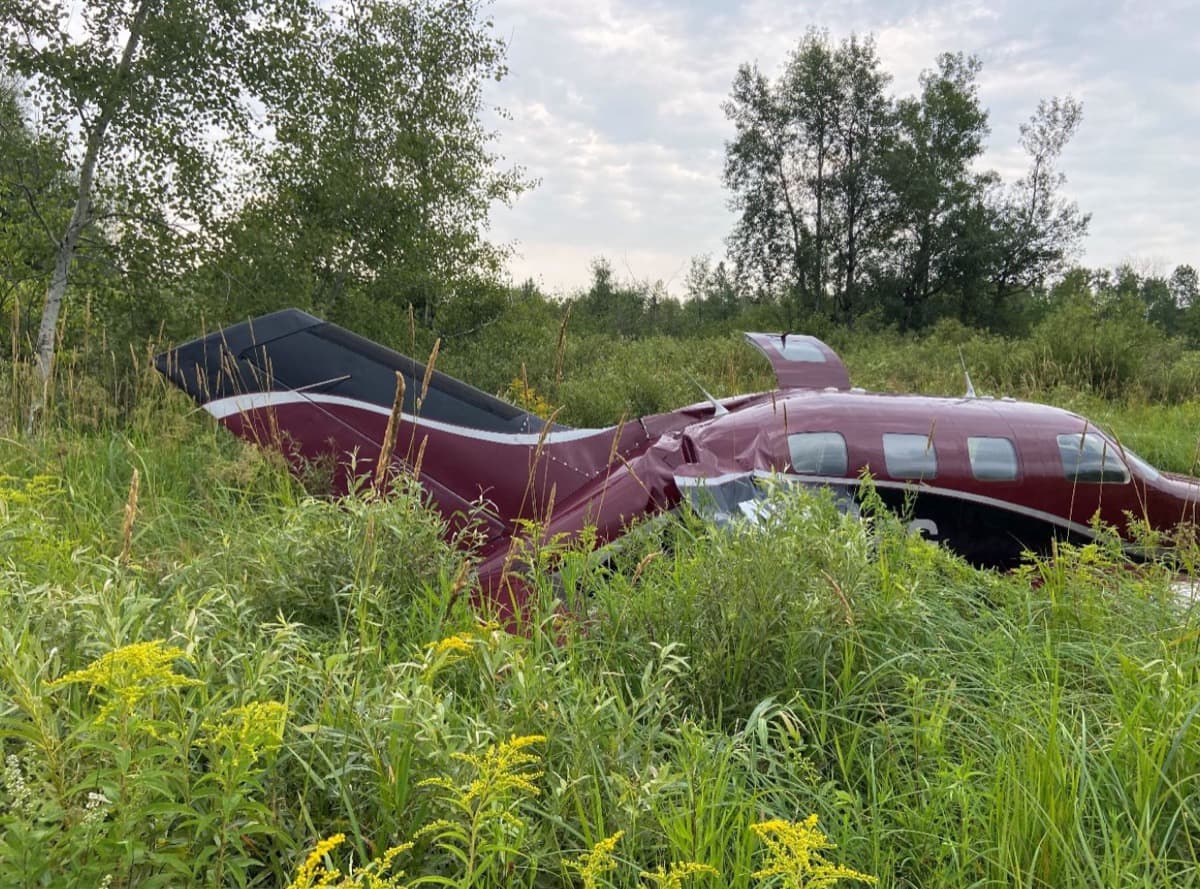
I’m sure the commercially rated pilot had at least a transitory “I can’t believe this is happening” moment following the engine failure. But it was in the accident’s aftermath that the truly unbelievable was revealed.
But I’m getting ahead of myself.
The Flight
The pilot was on the return leg of a round-trip flight from Sawyer County Airport (KHYR) in Hayward, Wisconsin, down to Lake In the Hills (3CK) near Chicago, and back up to Sawyer again — pretty much flying from the tip of Lake Michigan to the tip of Lake Superior for the return leg — a distance of around 300 miles.
He departed in VMC conditions on an IFR flight plan. It was now late morning. About 10 minutes from his destination, Center instructs him to begin a descent from 6,000 feet to 4,000 feet. He reduces the PA-46-310P Malibu’s power and sets up a pleasant 500 fpm descent, enriching the mixture to prepare for landing. He’s shortly to his new altitude, so he engages the altitude hold on his autopilot and throttles back up.
Nothing happens.
In his report to the NTSB, he wrote, “it felt as though someone had pulled the power back to idle.” He could feel the deceleration and “immediately realized I had lost power in the engine.”
He does everything right. Mixture full rich. Prop full forward. Throttle full forward. Switch tanks. With no time or altitude to waste, he declares an emergency.
Center gives him a vector to a small strip, but the glide ring on his iPad shows that it’s out of reach. He advises Center, and picks the best of two small fields below, and prepares for an off-airport landing. With the few seconds remaining he tries “one last ditch” effort to get the engine running, including bypass air, backup fuel pump, and cycling all his power levers — just for the hell of it.
The Pilot
The pilot was a 58-year-old male. He held a commercial ticket with single-engine land and sea, multi-engine land, and an instrument rating. He had 2,400 hours, 300 in make and model. He’d clocked 18 hours in the last month.
He was the owner of the airplane, which had come out of annual a little over a month previously. During that year’s maintenance, along with the somewhat lengthy list of items you’d expect on a high-end complex pressurized airplane, both alternators were replaced, new spark plugs were installed, and all 12 fuel injectors were replaced with new ones.
The Final Moments
The field is painfully short so the pilot decides to leave the gear up “to use the grass to bleed energy and speed off.” Also a seaplane pilot, and owner of a Lake Amphibian, he told investigators that as the Malibu touched down on its belly, the plane sweeping along the grass initially “sounded like water flowing under the hull.”
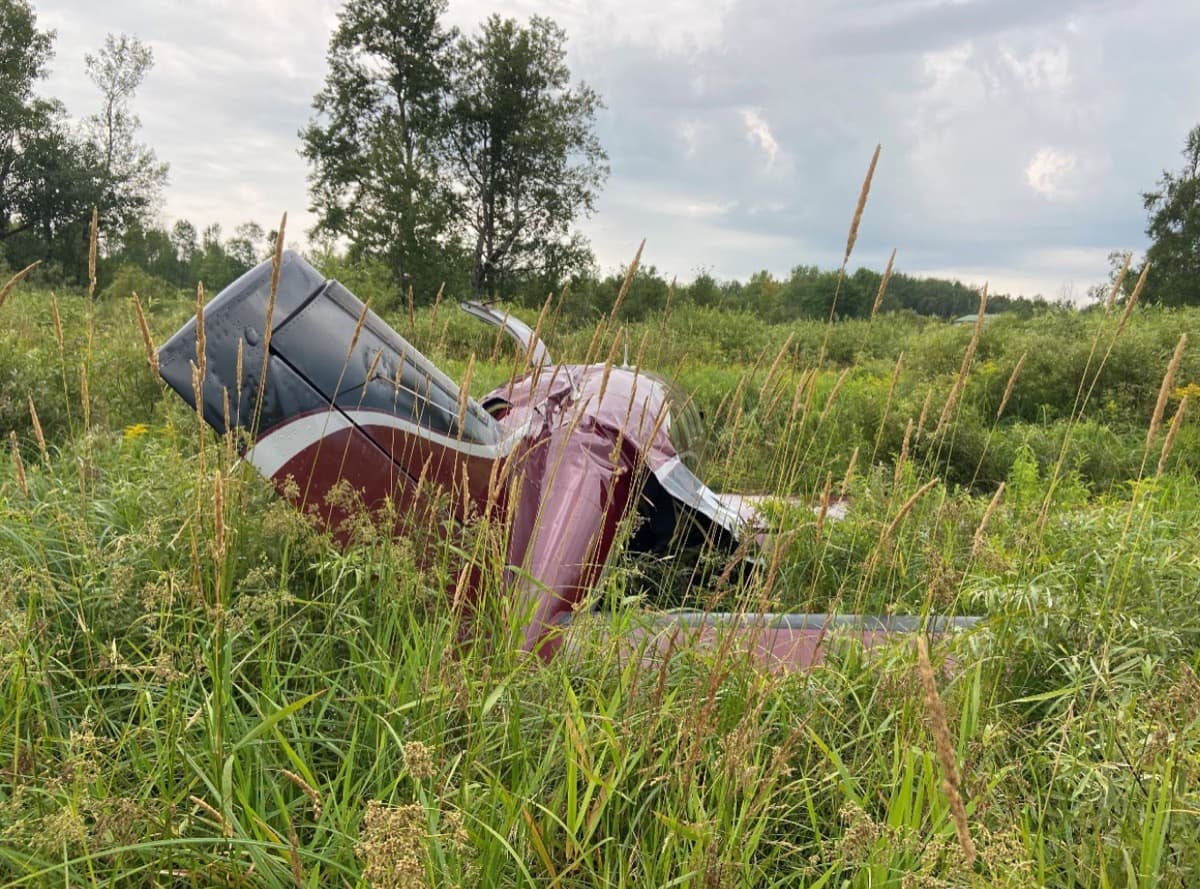
But there are rocks in the “water,” and the airplane is severely damaged in the final seconds. The pilot, however, walks away without a scratch.
The NTSB
A sharp-eyed investigator found the cause of the crash moments after taking off the Malibu’s cowl while the airplane — like a beached whale — still lay in a field near Radisson, Wisconsin. The cap for the fuel system’s service port was missing. This port is a garden-variety brass elbow fitting in the fuel system. It’s used to connect a fuel pressure gauge during maintenance for measuring unmetered fuel pressure.
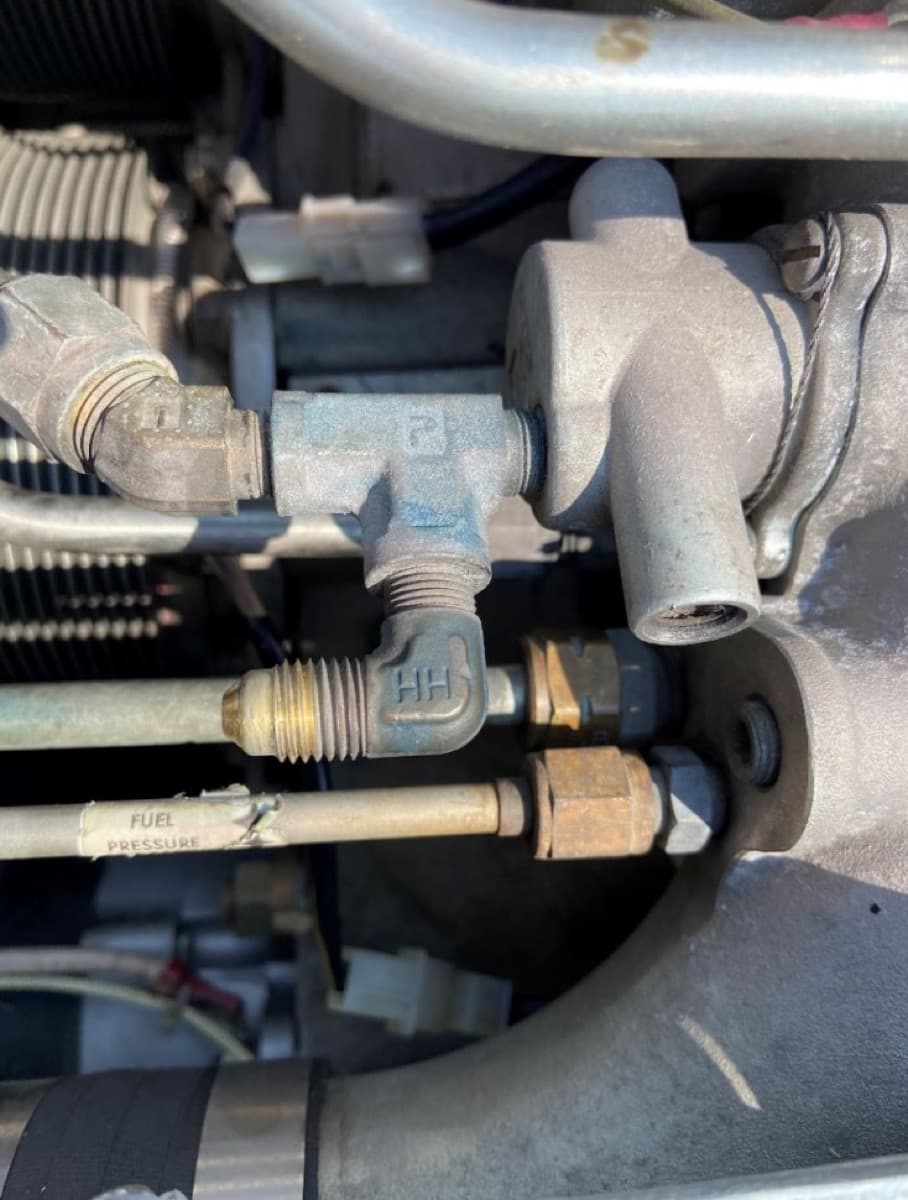
The missing cap was never recovered. In reviewing engine monitor data, the NTSB investigators discovered that right before the engine failed, the fuel flow spiked to 80 gallons per hour, the maximum the system could record. If you imagine the effect of losing the cap as being the same as having a fuel line separate, you wouldn’t be far off.
The NTSB investigators concluded that the cap had not been properly torqued during the recent annual and had departed the engine in flight. Even the best mechanics sometimes get distracted. But imagine the accident investigator’s surprise when he found out that the mechanic who signed off on the most recent annual inspection was actually dead at the time he did so. In fact, he had died 17 years before signing the logbook.
Yes, 17 years. Nearly two decades. I know we have a mechanic shortage, but I didn’t think we’d resort to summoning the dead.
It turns out that it was the deceased mechanic’s son who signed off the annual, using his dead father’s mechanic certificate number. We can “will” many things to our children, but not our FAA privileges.
In the understated tone of NTSB reports, the lead investigator wrote, “The non-certificated mechanic fraudulently represented himself as a certificated mechanic with inspection authorization and the appropriate knowledge, training, and experience by signing off the annual inspections and returning the airplane to service.”
Analysis & Discussion
I’ve got to say, that’s a pretty impressive scam: Running (apparently successfully) an aviation maintenance shop for almost two decades with no certificate. I’m guessing he learned the trade from his father but, if so, he should have had enough on-the-job training to just take the test and be legit.
The NTSB included the logbook entries from the last annual, and I must admit, they look good. Assuming he actually did the work, that is, and I suspect that he did. And for evidence of that, the uncertified fraudulent un-A&P and non-IA apparently used the Continental Motors Standard Practice Maintenance Manual, which requires a fuel system operation and pressure test — necessitating the removal of the cap — when fuel injectors are replaced.
It’s sort of ironic that the only reason he was “caught” was that he properly followed the manual, but then apparently forgot (or was distracted from) the last step — a mistake that, frankly, could have also easily been made by a properly certified person. Not that I’m excusing his fraudulent behavior.
But this begs the question: Did the pilot have a clue his mechanic wasn’t the real McCoy? I wasn’t able to learn that from the official documents. My guess is that he was as surprised as the NTSB — and we can only begin to imagine how angry.
It’s hard for me to imagine someone who has invested in an aircraft of that caliber settling for illegal pencil-whip annuals. After all, this is a high performance, pressurized, complex airplane — one that requires annual recurrent training for insurance.
Speaking of which, as the annual was basically a fake, did the insurance company bail on covering the loss? Sorry I was not able to find that out either. Nor was I able to discover how many years the un-mechinic, non-IA maintained the Malibu for the pilot. Lastly — sadly — I was also unable to determine what happened to the bogus mechanic.
What kind of person sets up such a long-running fraud? I don’t know, but based on reading his father’s obituary, which the NTSB included on the docket for the accident, Papa Mechanic sounded like a wonderful man. He was both a pilot and a mechanic and was part of the team that built the very first Boeing 747. He was an Army Air Force vet and had been a member of the corps marching band with bugle and trumpet. The obit said that in his retirement he was an active community volunteer, among other things playing the trumpet and flugehorn and singing in his church choir.
He’d probably be ashamed of his son.
The Takeaway
Clearly, there’s not much oversight in this end of our biz, despite the stated worries of many A&P mechanics that they can lose their certificates for the smallest infraction of the rules. So what are we pilots to do?
Well, while it sounds paranoid, one thing you can do is look up any certificate holder (pilot or mechanic) using the FAA’s Airman Registry online. The mechanic tab will tell you when the certificate was issued, which certificates someone holds (Airframe, Powerplant, or both) and, in the case of an IA credential, the issuing FSDO and issuance date. In this case, Papa Mechanic’s certificate had been issued in 1971. So if you are face to face with someone who appears to be the same age as his or her certificate, there might be a problem.
Still, how common can this kind of thing possibly be? Not common at all, would be my guess, but I do recall reading at least one case recently where the mechanic, while a legitimate A&P, signed off on an annual despite the fact he did NOT hold Inspection Authorization, which is illegal.
In the case at hand, the last IA date for Papa was 1984. The privilege lasts for two years, so at the date of the Malibu’s annual, the dead mechanic had been “out of privilege” for 38 years. That’s a rather epic scam.
The takeaway? Like so much in aviation, I guess, given the world we live in, we need to fall back on “trust but verify.” Perhaps with VERIFY in all caps, at least when you are dealing with a new-to-you mechanic.
And thankfully, it really doesn’t take long to verify his or her credentials, although I hate the thought that we’ve come to this point.
The Numbers
Want to read more? Download the NTSB’s final report here or view the items on docket here.

I bet nothing happened to him, owner can sue but I doubt anyone will prosecute. Nothing ever happens to frauds and people who suck in aviation
Jerry King says he (rightly) doesn’t have or want a cell phone. Dear Bride (a/k/a “She Who Must Be Obeyed”) forces me to have a cell phone. There are three numbers on it – Her, the mayor, and Gorbachev, but I think he’s mad at me because he hasn’t called me lately.
Best Regards,
Miami Mike
Scary, indeed. I remember the first annual on a 150 back in the ‘70s when we found that the landing gear was seriously damaged before we bought the plane. Discovered by a competent mechanic (and fixed). Imagine if the guy wasn’t trained or certified and just pencil-whipping the paperwork? We all depend on those mechanics, even if all we do is take seat 23A in back of an airliner.
Pease note that mechanics can opt out of having their names and information about them accessible to the general public If this is the case with your mechanic, then ask to see his certificate, record the information on it (a pic perhaps) and contact your FSDO to verify the mechanic’s information.
And names? That’s a new one for me. How does one go about requesting that one’s name be withheld?
To have an I.A., one needs to have a fixed base of operation with all necessary equipment and manuals needed to perform said job. The FAA generally does an inspection of such facility every year or so. I know the FAA is understaffed but…..
I’ve had a IA for decades. I have never been audited for facilitates or equipment. Only IA renewal, yearly, then bi-annual. Either 4 annuals or 8 hours of study.
This has been a common, long running scam for some businesses. There was once a business that specialized in low budget overhauls for Franklin engines. The overhauls were junk with worn out used parts, improperly welded cranks, etc, etc. The owner had his license suspended years before, so the logs always came back signed by mechanics that had been dead for years. I did a follow up on one of his overhauls that failed with the first 25 hours.
Franklin Engine Club. I had a owner with a Seebee. Had 0/80 compression on 5 cylinders. Unknown TT and multitude of other problems. Couldn’t find anyone that would touch that engine. One day an engine from a fore mentioned business showed up at the shop having been purchased by owner. Began removing lower spark plugs to drain preservation oil. Removed spark plugs with my fingers. Began to look at quality of overhaul. Removed top spark plugs. The sun was shining through the window behind me and beaming directly through the upper spark plug hole giving a clear view of the piston. It had the appearance of a piston that had an exhaust valve failure and was all dented and torn looking. Proceeded to remove cylinder to investigate. Removed intake pipe. Found gasket was cut to outside diameter of flange and had someone puncture center of gasket tearing it. Torn edges of gasket completely blocked pipe. Removed cylinder base nuts with my fingers. At this point my boss said, enough, stop working on it. The FAA eventually came by and took the engine. A log book with a fictitious name and A&P number showed up after a couple of months.
I am betting that the mechanic was every bit as good at his craft as his dad, but not certified. The big question is WHY. Looks like he certainly had enough experience.
As far as the missing CAP, likely CELL PHONE ITIS – All too damned common theses days and the main reason I do not own one. Yeah, I’m OLD… and STUBBORN.
Jerry King A&P
How was he able to renew the IA, has to be done every 2 years.
Why bother to renew it? He never had it in the first place. Did you not read the story?