

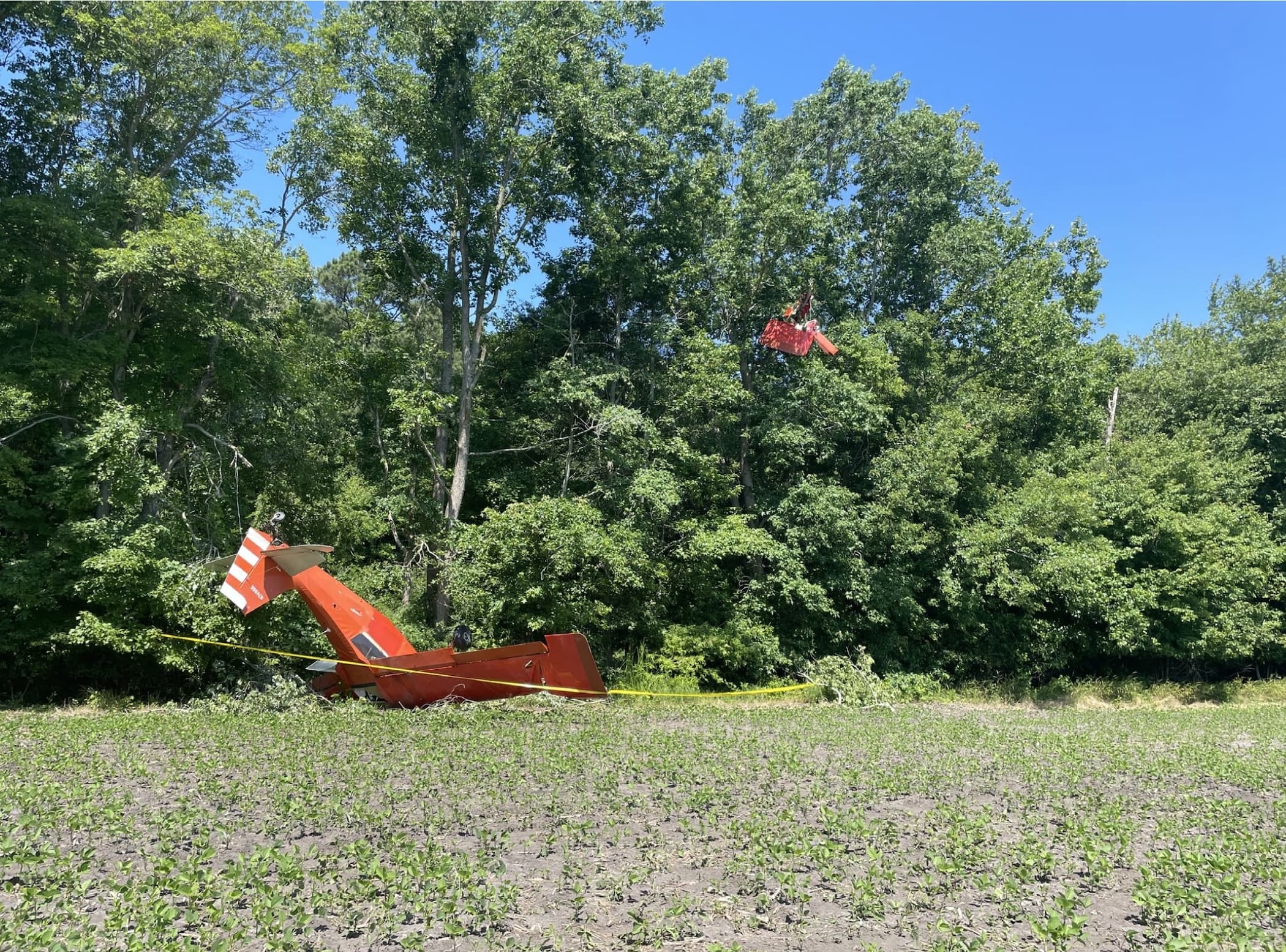
According to the pilot, the airplane was based at Bunting’s Field Airport (4MD1) in Berlin, Maryland. Before the first flight of the day, he added a quart of oil to the Bellanca 8GCBC’s engine and completed a preflight inspection with no abnormalities noted. He also added fuel to the airplane and conducted an engine run-up that was normal.
He then departed and flew several aerial advertising banner flights throughout the day without incident, adding fuel as necessary.
During the accident flight, with the banner in tow, he proceeded to fly from 4MD1 to the Ocean City, Maryland, inlet at 1,000 feet mean sea level (MSL), then descended to 300 feet MSL and flew north along the Rehoboth Beach coast. The flight was uneventful, and all engine indications and airplane performance were normal and “in the green,” he told investigators.
However, toward the end of the route, the engine oil temperature, which usually was about 190° F, indicated about 220° to 230° F.
He advised the operator of the higher-than-expected oil temperature and was informed that it was within limits as the outside air temperature was hot that day. As he approached the end of the advertising portion of the flight, he initiated a climb to 1,200 feet MSL, however the airplane would not maintain altitude even though the throttle and mixture controls were full forward.
The airplane was slowly descending, while the engine RPM was dropping with simultaneous engine roughness that was increasing in severity.
He dropped the banner over a vacant field as the airplane descended through 700 feet. As the airplane reached 500 feet, it exhibited a further reduction of engine power.
The pilot intended to perform a forced landing to a field near Frankford, Delaware. However the airplane was unable to reach the field, and it hit the top of trees. It then fell to the ground inverted, which resulted in substantial damage to the wings and airframe. The pilot sustained minor injuries in the crash.
An examination of the airframe and engine revealed fuel and oil were present. The engine’s crankshaft was rotated via the propeller and crankshaft and valvetrain continuity were confirmed. There was compression on each of the cylinders. Erosion damage was noted on the edge of the No. 3 cylinder intake valve and valve seat insert, which also included a cracked lower spark plug.
A review of the maintenance records revealed that the No. 3 cylinder assembly was replaced with a new cylinder during the annual inspection 45 days before the accident. The airplane was subsequently signed off as airworthy.
Probable Cause: A partial loss of engine power resulting from cylinder detonation and a cracked spark plug, which resulted in a forced landing and impact with terrain.
To download the final report. Click here. This will trigger a PDF download to your device.
This July 2024 accident report is provided by the National Transportation Safety Board. Published as an educational tool, it is intended to help pilots learn from the misfortunes of others.
This one’s a mystery to me. Caveat: I am not an A&P.
NTSB: “Probable Cause: A partial loss of engine power resulting from cylinder detonation and a cracked spark plug, which resulted in a forced landing and impact with terrain.”
Except he eventually had a complete power loss …and then the engine subsequently restarted (by itself?) prior to impact.
Pilot: “The engine quit. Thought the field would be suitable as was used to descending over trees and other various obstacles during banner pickups. Was also forced to make a landing in the tops of the trees as the engine restarted.”
So even though the pilot had ‘power available’ in the end game, he opted not to use it: “I lined up my approach and before reaching over top of the treeline (opposite to the side of the treeline I came in contact with) my engine restarted, though still running rough, my airspeed increased. I immediately pulled my throttle to idle, because I did not trust my engine would not give out again, and due to my altitude I was not aware of what was on the other side of the treeline. With the increase in airspeed it resulted in me being unable to land the aircraft on my intended field.”
It all began when the oil temp went up, but the 407-hour “commercial pilot” was told (by the plane owner’s son) that the “220-230 degrees” was the still within the POH’s 100–245-degree F limits… and that “I’ve flown with it that hot before.”
There’s no mention of the oil pressure …or cylinder head temps. I’m guessing this 180 HP Scout didn’t have a CHT gauge: Another reason to have one.
The new, 45-day-old, #3-cylinder assembly had an intake valve already exhibiting some damage due to “detonation on the edge of the intake valve and valve seat insert”…but no damage evident on the piston itself, and it was still holding compression. Was the single “cracked spark plug” the cause or a result?
Since the engine quit after running rough, instead of seizing outright, my first guess was bad/contaminated fuel: There’s nothing about fuel system/carburetor autopsy results in the final report other than “There was fuel on board”. How about carb ice in July?
Scout’s have at least 3 checklists that would’ve applied here: Abnormal Oil Pressure and Temperature Indication, Partial Power Loss or Rough Running, and Engine Air Restart.
Although we have no clue as to what trouble-shooting steps he actually took, using full rich mixture was the right call, but continuing to use ‘full throttle’ to climb/maintain altitude probably didn’t help with the detonation.
We also don’t know what caused the engine to restart. But clearly the pilot’s decision to “not trust” it to continue running affected the outcome.
Regardless, it appears that the NTSB Form 6120.1 was filled out by the Scout’s obviously unhappy “Owner/Operator”, not the pilot. His short statement in the “Owner/Operators Safety Recommendation” section is pretty blunt: “Better Pilot Training”.
OTOH, kudos to the 24-year-old for dropping the banner where it did no harm and getting through this with only minor injuries.