

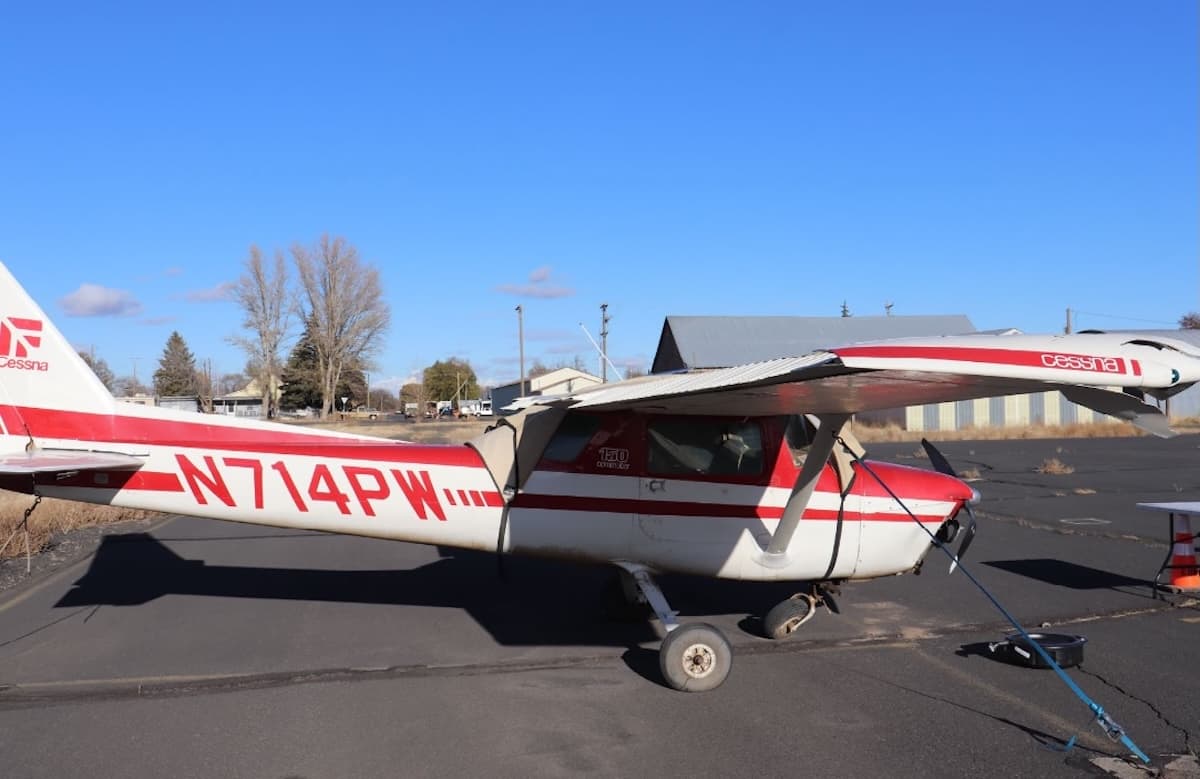
The pilot reported that, while en route from Spokane, Washington, to Yakima, Washington, he heard a loud metal sound, followed by an immediate reduction in engine RPM and a rough-running engine in the Cessna 150M.
While troubleshooting the engine, he diverted to Pru Field Airport (33S) in Ritzville, Washington. While en route, a loss of engine oil pressure occurred, followed by a total loss of engine power.
He initiated an off-airport landing in an open field. During the landing roll, the nose landing gear collapsed and the airplane hit terrain.
Post-accident examination revealed that the left wing and forward fuselage were substantially damaged.
Subsequent lighted borescope examination of the engine revealed mechanical damage to the No. 2 cylinder’s combustion dome and piston face. The No. 2 cylinder was removed and it was discovered that the exhaust valve stem had exited the cylinder valve guide and was impaled into the cylinder head. The exhaust valve was fracture separated from the valve stem and not observed within the cylinder or engine. Metallic debris was observed within the No. 2 cylinder. Remnants of the piston were observed within the cylinder and oil sump.
The No. 2 cylinder, piston, and remnants of the No. 2 exhaust valve were sent to the NTSB Materials Laboratory in Washington, DC, for examination. That examination revealed the cylinder head damage was consistent with impact with the exhaust valve tip after it had been displaced out of the exhaust valve guide.
The exhaust rocker arm exhibited grinding marks on the rocker pad. Marks corresponding to contact with the spring seat were also observed on the arm adjacent to the rocker pad. Wear marks corresponding to contact with the exhaust valve keeper halves were also observed on the center hole bore. The exhaust valve stem was fractured near the valve head, and the stem was bent into an “S” shape.
The outside diameter of the valve stem measured 0.4343 inch near the tip end of the valve stem, which was slightly above the maximum outside diameter of a new exhaust valve stem. Fretting damage from contact with the keeper halves was observed at the shoulder near the valve tip. The fracture surfaces of the valve stem exhibited features consistent with overstress fracture.
According to engine maintenance logs, the engine was last overhauled on June 11, 1981. All four cylinders were subsequently removed, repaired, and reinstalled on July 24, 1988. The maintenance record entry documenting this work included the statement, “ground and laped [sic] valves and seats,” which was the most recent entry that would require disassembly of the valves to complete. In the last maintenance entry, dated July 10, 2024 (five days before the accident), the engine was reported to have 1,232.45 hours since major overhaul and 320.25 hours since repair of the cylinders.
Continental Aerospace Technologies, Publication M-0, Standard Practice Maintenance Manual, dated August 2024, states: “Replace or overhaul the engine upon accumulating the operating hours specified in Table 6-1, or twelve (12) years after being placed in service, whichever occurs first.”
Probable Cause: Maintenance personnel’s improper installation of the No. 2 cylinder exhaust valve, which allowed the valve to drop into the cylinder and resulted in a total loss of engine power.
To download the final report. Click here. This will trigger a PDF download to your device.
This July 2024 accident report is provided by the National Transportation Safety Board. Published as an educational tool, it is intended to help pilots learn from the misfortunes of others.
If I, as a non-expert, read the Table 6-1 correctly, for a pre-2012 engine. the TBO IS 1200-2000 or 12 years, it would appear that this engine was almost double the TBO hours and triple the TBO time, so instead of recognizing the owner’s horrid lack of maintenance, the Feds reach back nearly four decades to blame the A&P mechanic? Seriously? Oh, and the oversize valve stem end? Wouldn’t you mushroom a bit if you hit something hard at a high velocity?
Hard to believe it takes 320 hrs for an improperly installed valve to show it’s self. Small Continental motors have had devastating damage due to a sticking/stuck valve. I’ve seen a bent rod caused by one.
The TCM service bulletin required to inspect all the valve springs to ensure that both keepers were installed.
The analysis photos do show fretting where both keepers were wearing the spring retainer.
So, maybe the marks on the spring retainer caused the rocker arm miss-alignment to press on the retainer and not the valve stem, causing the keepers to loosen and eventually fall out.
The analysis did not list the valve keepers as being found….where did they go ?
I had an exhaust valve recede into the seat, causing the rocker arm to contact the spring retainer, but everything remained attached, just very low compression.
So if I’m reading this correctly the cause is being blamed on 36 year old / 320 hour work on the engine which averages to less than 10 hours per year? I think the problems go deeper than that.
Probable cause valve failure due to manufacturing defect finally failing. My C172 did the same thing.
This failure is not necessarily a maintenance issue.
TCM Manditory Service Bulletin MSB 93-12 required checking all the valves for proper installation of the valve keepers, and to make sure that both were there.
So, some cylinders appear to have been shipped with a missing valve keeper.
In this case it took 320 hours for a failure to happen.