

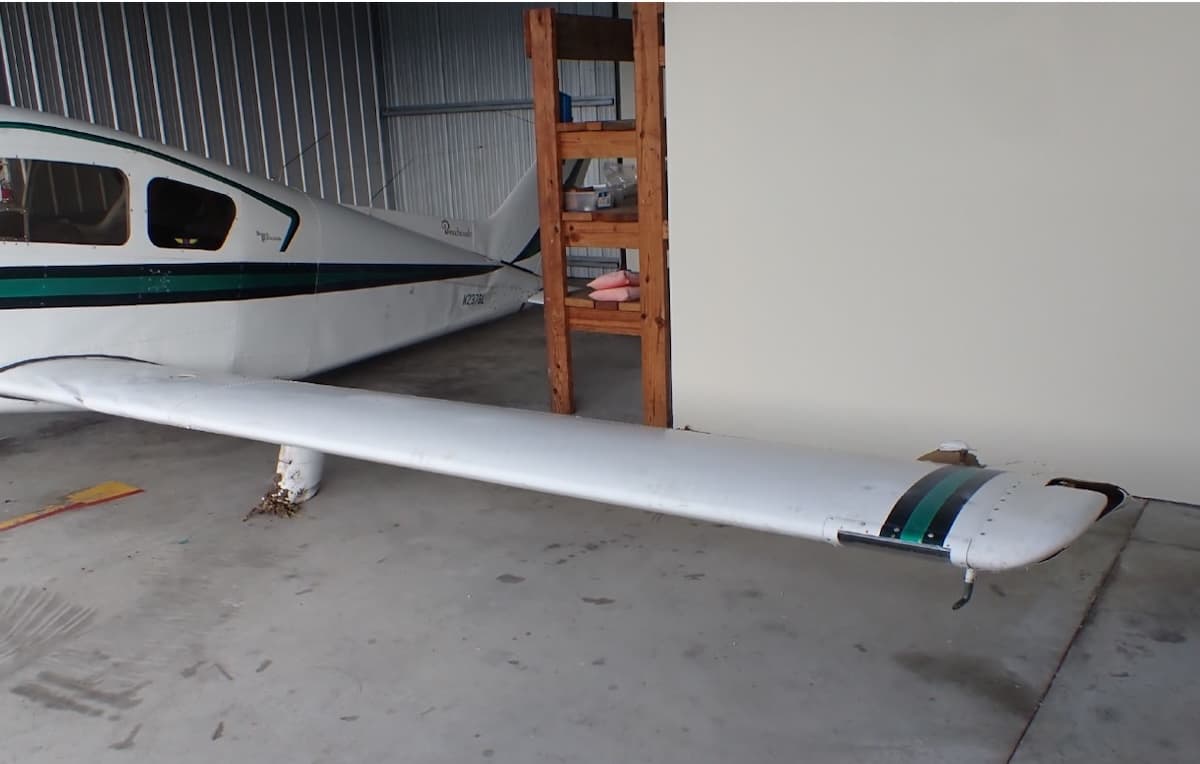
The pilot reported that the purpose of the flight was to “check to see if we could see any indications of any oil leaks,” as he had recently observed trace amounts of oil in the Beech 23’s cowling.
After completing a preflight inspection and an engine run-up at the airport in Jacksonville, Florida, he took off and climbed to 1,500 feet mean sea level (msl). He then completed one full traffic pattern at 1,500 feet. While on the downwind leg of the second traffic pattern, he descended to 1,000 feet to begin setting up for a full-stop landing.
He told investigators that as he approached the runway numbers “…the plane seemed to get slow, and when I tried to add some throttle, my rpms dropped to almost idle.”
He then reported that, about 20 feet above the runway, the airplane “seemed to just drop like a rock.”
The airplane landed hard on the runway centerline, the left main landing gear separated, and the airplane skidded to a stop in the grass to the left of the runway.
The airplane sustained substantial damage to the left wing and fuselage.
Post-accident examination of the airplane confirmed flight control continuity of all primary flight controls from the controls in the cockpit to the flight control surfaces. The examination also found continuity from the stabilator trim control in the cockpit to the flight control surface. The stabilator trim control in the cockpit was observed in about the neutral position. The flaps were found in the UP position and the flap control in the cockpit was also found in the UP position. The throttle, mixture, and carburetor heat controls were all found in the full forward position. All three controls were actuated and moved smoothly from stop to stop.
The right and left fuel tank caps were secure in place on their respective wings and the fuel filler opening placards indicated a fuel tank capacity of 29 US gallons and usable fuel of 26 US gallons.
The right wing fuel tank was opened and a minimal amount of fuel was present that exhibited the appearance of 100LL aviation fuel. The right wing fuel tank was sumped and about 1.5 tablespoons of water were found.
The left wing fuel tank was opened and fuel was present that exhibited the appearance of 100LL aviation fuel. The left wing fuel tank was sumped and no water was found. The fuel strainer was sumped and no water was found.
The fuel selector in the cockpit was selected to the right fuel tank. The fuel selector moved smoothly from the right to the left detent and back again.
The airplane was recovered from the accident site to an aircraft recovery facility. During the recovery of the airplane, the fuel was drained from the wing fuel tanks to facilitate the removal of the wings. The recovery personnel reported that about 3 gallons of fuel were recovered from the right wing tank and about 9 gallons recovered from the left wing tank.
A post-accident engine test run was performed. A fuel tank was plumbed into the right wing root and the engine was started with the fuel selector on the right. The engine started and ran smoothly at an idle speed of about 700 rpm. The rpm was increased to 1,800, and the magnetos were checked. Both magnetos dropped about 150 rpm and the engine ran smoothly on each magneto. The engine was then run at full power and achieved 2,450 static rpm. No anomalies were noted with the engine that would have precluded normal operation.
After the engine run, the carburetor fuel inlet screen was removed and a small amount of dark granular material was observed in the screen.
The pilot had reported that during his preflight inspection he checked the fuel in each tank with a fuel stick and noted 18 gallons of fuel in the left fuel tank and 17 gallons of fuel in the right tank. The pilot reported that the fuel stick was homemade and came with the airplane when he bought it.
When asked how the fuel stick was calibrated, the pilot stated, “I had no reason to believe it was not accurate” and did not report that he had done any sort of calibration testing himself.
During post-accident examination, the right wing fuel tank was filled with water to check for any leaks and none were noted.
The Beechcraft 23 pilot operating handbook (POH) indicated that the airplane had a total fuel capacity of 59.8 US gallons with 52.2 gallons of usable fuel. The review of the POH fuel schematic also showed that there was no cross-feed between the left and right fuel tanks or any other way for fuel to transfer from one fuel tank to the other.
Review of aircraft maintenance records revealed that Beechcraft service instruction No. 0624-281 was never complied with. The purpose of this service instruction was to install new placards to indicate minimum fuel for takeoff and the amount of unusable fuel. When complied with, new fuel quantity decals were to be installed at the fuel tank filler openings, on the fuel selector valve guard, on the instrument panel below the fuel gauges, and on the face of the fuel gauges.
The airplane fuel tank filler opening placards were placarded in accordance with the service instruction, however there were no placards in the cockpit to indicate the service instruction had been complied with.
Probable Cause: The pilot’s improper inflight fuel management, which resulted in a total loss of engine power due to fuel starvation while on final approach to land, and the subsequent hard landing, which resulted in separation of the airplane’s landing gear.
To download the final report. Click here. This will trigger a PDF download to your device.
This August 2024 accident report is provided by the National Transportation Safety Board. Published as an educational tool, it is intended to help pilots learn from the misfortunes of others.
DA, What has you fixated on the oil level as a factor? There is no indication that the pilot neglected to check the oil level during preflight. The engine ran normally when supplied with fuel during the post-accident investigation, so oil level was not a factor.
The right fuel tank was selected, which turned out to have 3 gallons in it, with a small amount of water. Doing the arithmetic, with 59.8 gallon tank capacity and 52.2 usable, there is 7.6 gallons unusable fuel, so 3.8 gallons unusable per tank. So the engine was sputtering and quit due to fuel starvation with possible contamination.
The airplane was over the runway and “dropped like a rock” (stalled). That’s what caused the damage. The flaps were up. I don’t know the Musketeer well, but most aircraft call for flaps with a normal landing. Maybe that would have been enough difference.
I assumed at the outset it was a low-time, gray-haired “pilot”, and I was right.
Wonder if he checked the oil before checking for leaks? I am constantly amazed at the calibre of pilots and their lack of competency in these accident investigations; who signs them off?
I just don’t get it.