

Amy, a student pilot in Texas, writes: Why is UTC time called Zulu? I’m not wrapping my head around where the “Z” comes from.
There are two reasons — or should I say reazonz? — although I was not able to find out which one was the deciding factor that gave Coordinated Universal Time, or UTC, its aviation nickname of Zulu Time.
But before I get to that, just to get everyone up to speed and on the same page, UTC is an international standardized time. No matter where you are on the planet, this time is the same. When it’s 1830 Zulu in Paris, it’s 1830 Zulu in Philadelphia, too.
We also use the 24-hour clock in aviation for the same reason: To avoid any confusion around what time something is taking place or will take place.
The benefit of having a universal time — given that with airplanes we can travel great distances at high speeds — is obvious. It avoids confusion over when an airplane will be somewhere, be doing something, etc. Heck, you don’t even have to go that far or travel that fast (I’m looking at you, Piper Cub) to go from one time zone to the next and create confusion and missed connections.

Zulu Time is used for most aviation communications and reports. The FAA, generally speaking, uses Zulu for all operations, and controllers are to state “local” or the specific time zone, if giving a non-Zulu Time in any instructions. Flight plans require it, as well. Plus, Zulu Time is used for most weather forecasts, including TAFs and Winds Aloft, weather warnings like SIGMETs and AIRMETs, weather observations like METARs, and even AWOS broadcasts of real-time weather conditions.
I confess I had always wondered why automated weather station broadcasts included the Zulu Time — they update every 60 seconds and only broadcast for a few miles — until a recent flight when the AWOS was reporting plague and locusts on a perfectly lovely day. Perched in my cockpit high in the sky, I couldn’t fathom at first how this one location could be so different from all the airports around it, until it finally clicked that the time it was reporting was waaaaaaay off. Apparently, the station had malfunctioned during a storm the day before and was sending out old news. If I had paid better attention to the time it was broadcasting, I would have known that from the start!
There are set formulas for conversion between local and Zulu — add or subtract five hours for Eastern, add or subtract seven hours for Mountain — somewhat complicated by Daylight Saving Time, which doesn’t exist for Zulu. Back in the day, many pilots wore dual time zone watches that had one set of standard hands for minutes and local hours and either a sub-dial or cutout for Zulu’s hour (the minutes stay the same, just as they do between time zones).
For those of us who reluctantly gave up on our beloved analog pilot watches to take advantage of all the other features of a modern smart watch, you can still mimic this aspect of the old tech. For instance, on the Apple Watch, add UTC to the World Clock tab on your Clock App, then it becomes selectable as a watch widget. It’s called UTC, not Zulu, though, darn it.
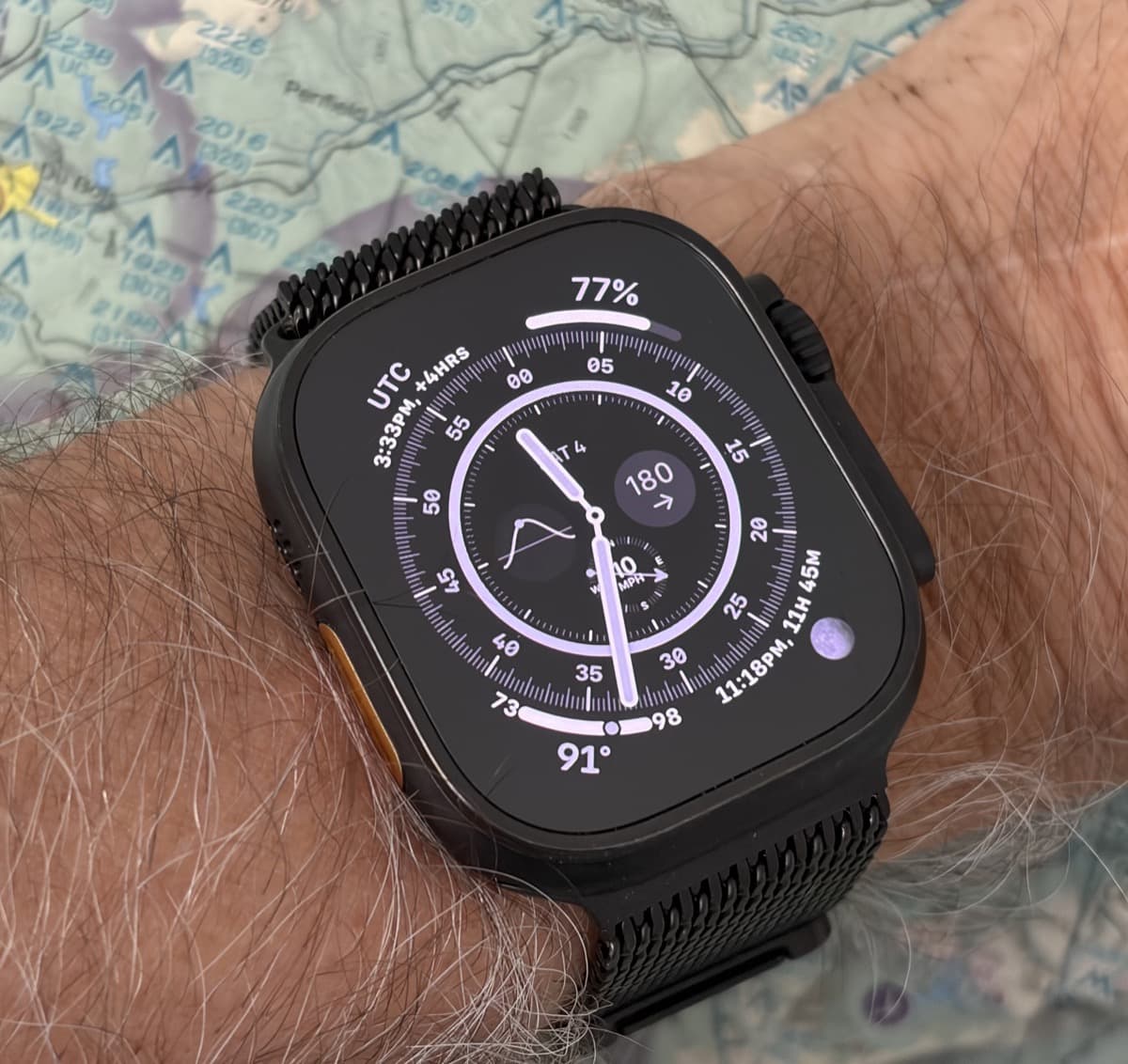
Of course, there are also stand-alone apps for tracking Zulu, too, many of them free.
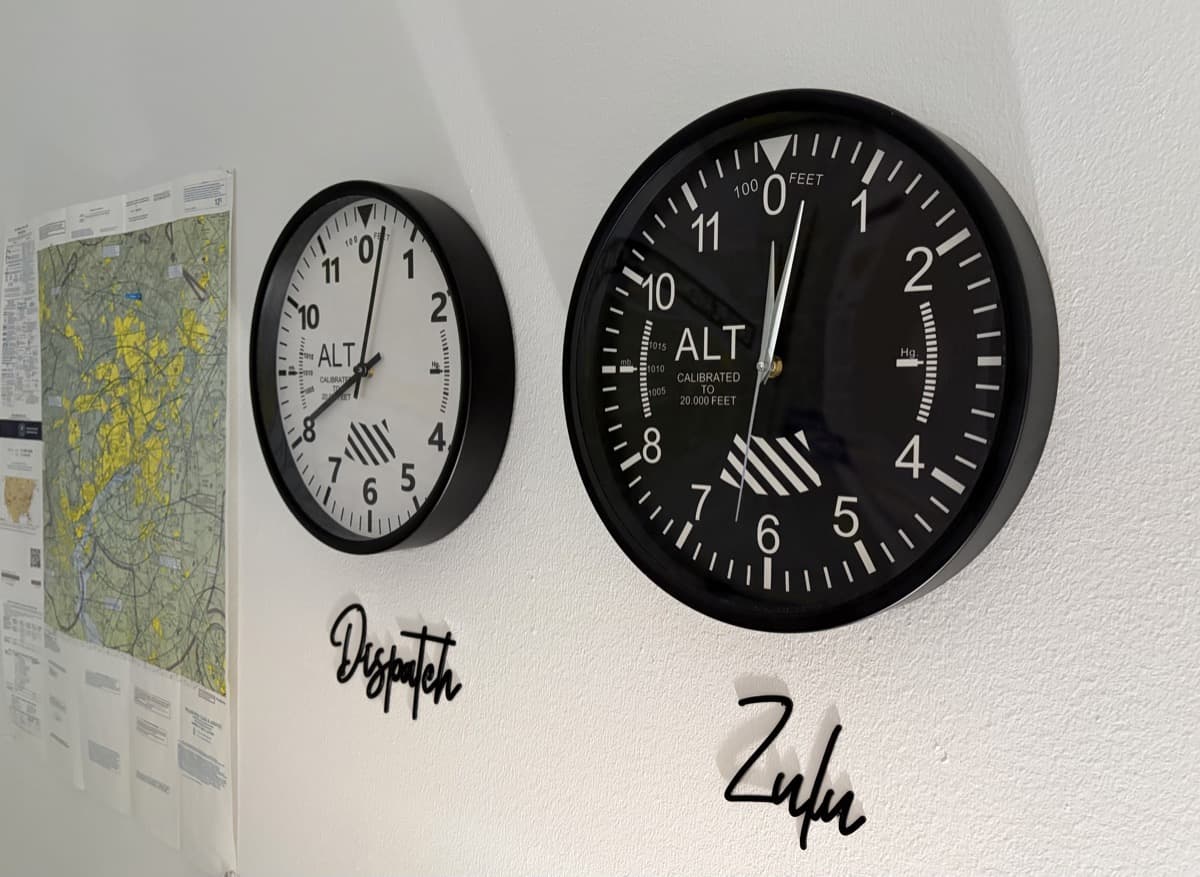
Speaking of time pieces, traditionally FBOs and pilot’s lounges had two clocks on the wall: One for local time, aka Dispatch Time, and one for Zulu Time. I still have a pair of clocks in my flight planning lounge, although more for the aesthetics than for practicality.
UTC, in addition to being a universal time, is also the starting point for determining the world’s time zones. Back in my day we called it Greenwich Mean Time, or GMT, which was functionally the same thing, although the methodology for measuring and adjusting between the older GMT and the newer UTC varies.
But I digress.
As the starting point for all the global time zones, Zulu is, therefore, the Zero Hour.
For our non-pilot guests (we love you!), in aviation communications, we use something called the Phonetic Alphabet, which uses code words for letters to make sure one letter doesn’t get mistaken for another letter over the radio. For instance, “M” and “N” can be mistaken for each other, as can “F” and “S” — especially when the radio signal isn’t the strongest or there is some static-y interference. But there’s no mistaking Mike for November or Foxtrot for Sierra.
In our current Phonetic Alphabet — and there have been several versions over the history of aviation — the word “Zulu” stands in for the letter Z. Prior to World War II, the phonetic code-word for the letter Z was “zebra,” but apparently it was later realized that Zulu is easier to pronounce in multiple languages than zebra, bearing in mind that the Phonetic Alphabet is used for more than just English-speaking aviation. It’s also used in maritime communications and by law enforcement, emergency services, and military personnel around the world.
As a side note, many readers may be wondering how on earth you can get UTC out of Coordinated Universal Time. Shouldn’t it be CUT?
While English is the international language of aviation, it isn’t necessarily the international language of other branches of human endeavor, and UTC actually comes to us from 1960s-era compacts of the International Telecommunications Union and the International Astronomical Union. The former is a United Nations body, the latter, a non-governmental organization based in Paris.
While in English we would say Coordinated Universal Time, in other languages word order is different. In French, for instance, it’s Temps Universel Coordonné, so French speakers would naturally gravitate to TUC. “UTC” was accepted as a non-Anglo/non-Franco compromise to serve as a universal acronym for international time, as set forth in various international agreements and compacts.
Regardless, I think we lucked out. Zulu not only sounds cooler than You-Tea-Sea, Sea-You-Tea, or Tea-You-Sea, it rolls off the tongue easier. Which would you rather say: “My ETA is 1930 U-T-C,” or “See ya’ at 1830 Zulu?”
Granted, we aren’t supposed to say “see ya” on the radio, but you get the idea.
See ya’ next time. In whatever time you want to use.

On another note regarding confusion, seems to me something other than Sierra would have been a better phonetic choice, as in radio communications it is sometimes heard as “zero”.
“GMT, which was functionally the same thing, although the methodology for measuring and adjusting between the older GMT and the newer UTC varies.”
How so?
TIA
Interesting subject. I never had dug into this question previously about why it’s called Zulu time. Zero hour makes sense. A quick Google AI question responded with Zulu resulting from it being the zero meridian. I think maybe that makes more sense.
This led me to a search for more information about the location. I didn’t know the real zero meridian is in the Royal Observatory in Greenwich. Someone even added a pic of it while standing above it (his feet are in the pic). How did this come to be in London? Were there great battles in the European tradition to locate control of the world’s time there? Probably not. But as a history buff, I no doubt will check it out – sounds like an interesting story.
Interesting story but it still doesn’t get to the heart of why we selected the letter Z and its matching phonetic code to denote UTC. Why not U for Uniform?
Been fooling around with airplanes for over half a century, learn something new every day! Thanks!
William, your answer was interesting but didn’t go to the question.
According to my quick internet search for the International Treaty to establish standard timekeeping, (attributed to Wikipedia, so I guess that gets me off the plagiarism hook) the international standard for time was established by the International Meridian Conference held in Washington, D.C., in October 1884. Representatives from 26 nations attended the conference.
The conference designated the longitude line passing through the Royal Observatory in Greenwich, England, as the universal Prime Meridian (0° longitude), much to the consternation of our Revolutionary War allies who wanted the center of the universe to be in Paris.
A universal day was defined as a mean solar day starting at midnight at Greenwich, with time counted on a 24-hour clock.
The world was divided into 24 standard time zones, each spanning 15 degrees of longitude, building on the system proposed by engineer Sir Sanford Fleming.
Alphabet designations for time zones refer to the military and nautical system that assigns single letters from the NATO Phonetic Alphabet to 24 primary global time zones. How the letter system works begins with the Prime Meridian (UTC+0): Designated as Zulu (Z) time, also called Coordinated Universal Time (UTC). East of Greenwich (Positive Offsets): Uses letters Alpha (A) through Mike (M) (skipping the letter J) for UTC+1 through UTC+12. West of Greenwich (Negative Offsets): Uses letters November (N) through Yankee (Y) for UTC-1 through UTC-12.
The letter J (Juliett) is traditionally used to designate the local time of the observer.
You can view the full breakdown of offsets and names on the Time and Date Military Time Zones page on Wikipedia.
Been to the Prime Meridian mine in Greenwich, very interesting place for an aviator or mariner. not so much for mere mortals.
The East India Clipper “Cutty Sark” is also close by in Greenwich in all of its renovated splendor.
Nice little town.
This gets more and more interesting. England was the dominant shipper in the world and they adopted Greenwich for their own charts in 1767. Many other countries used English charts. By the 1884 conference, it appears it was a given. Why change and cause massive disruption. The vote was overwhelming in favor of Greenwich – the French held out until 1914.